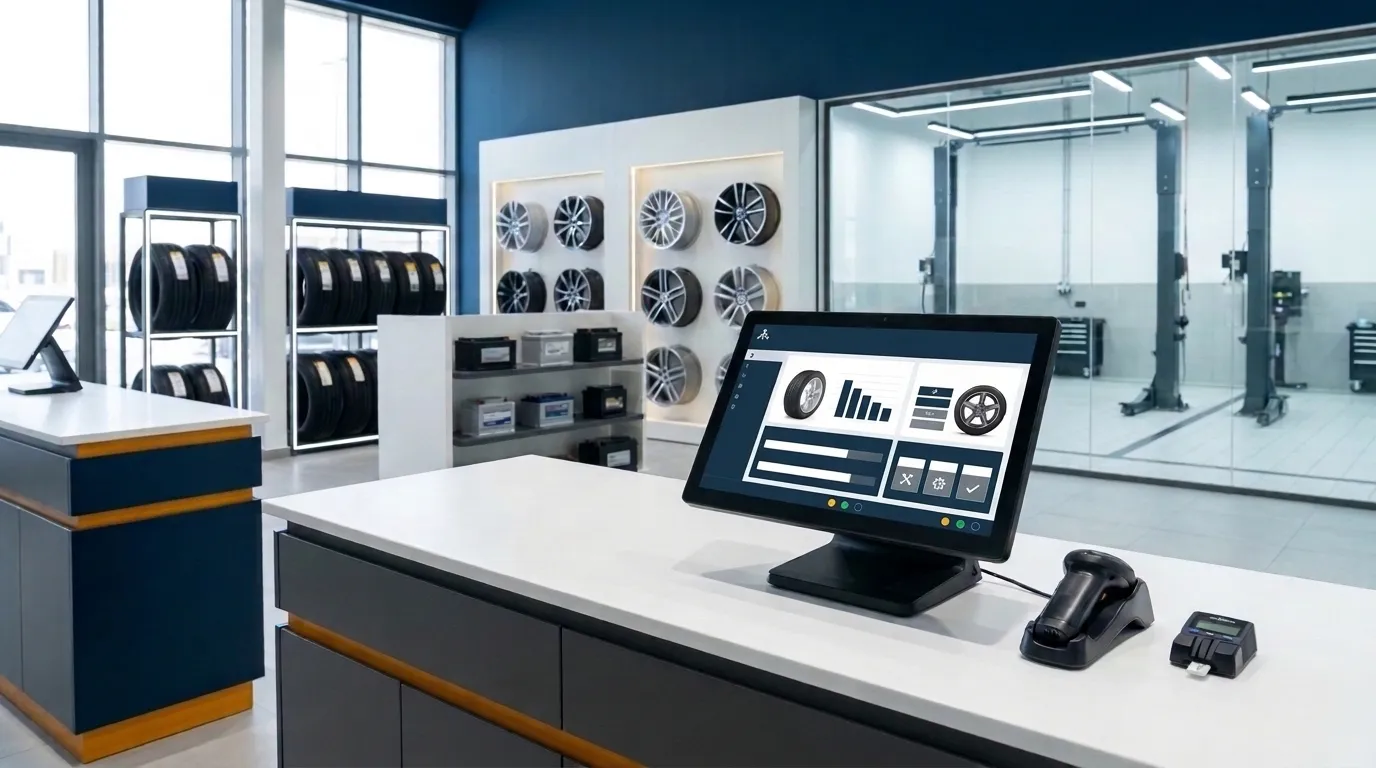
In the extreme climate of the Arabian Gulf, where summer road surface temperatures regularly exceed 60°C (140°F), automotive tires and batteries are consumable lifelines. A blowout on a Riyadh highway or a dead battery in a Dubai basement parking garage is not just an inconvenience—it is a critical safety issue.
Consequently, running a commercial tire dealership, wheel fitment workshop, or auto battery center is subject to intense regulatory oversight and complex shop-floor logistics:
- Strict DOT Expiry Laws: Both the Saudi Standards, Metrology and Quality Organization (SASO) and the UAE Ministry of Industry and Advanced Technology (MoIAT) enforce strict tire aging rules. Selling passenger car tires manufactured more than 24 months prior incurs severe Ministry of Commerce fines and showroom closure.
- Battery Scrap Core Accounting: Virtually every car battery sale involves a "core trade-in" (استبدال رجيع البطارية التالفة). Handling the scrap value credit, hazardous material inventory, and VAT deduction requires specialized accounting workflows.
- Service Bay Synchronization: Unlike retail where customers take a box and leave, tire and battery sales require service bay labor: tire dismounting, rim cleaning, dynamic laser balancing, valve replacements, and 3D wheel alignment.
- Fleet Commercial Accounts: Logistics fleets, ride-hailing drivers, and rental agencies purchase hundreds of tires monthly on credit, requiring vehicle plate logging and strict warranty tracking.
When tire and battery retailers attempt to manage these high-stakes operations using generic retail POS or manual paper work orders, aged tires slip through, scrap batteries vanish, and warranty disputes explode. Here is how specialized Automotive Tire & Battery ERP & POS software solves these operational challenges.
1. The 4-Digit DOT Mandate: Defeating Expired Tire Fines with Serialized Batch Tracking
Every tire carries a Department of Transportation (DOT) date code stamped on its sidewall. The last four digits indicate the week and year of manufacture (for example, DOT 3224 indicates the 32nd week of 2024).
The Regulatory Risk:
- Tires stored past 24 months from production cannot legally be sold as new in Saudi Arabia and the GCC.
- Ministry of Commerce inspectors frequently conduct surprise field audits in tire souqs and retail fitment centers. Discovering expired tires on display racks results in heavy commercial fines, product confiscation, and reputation damage.
How WaslaSoft Solves DOT Compliance:
- Goods Receipt (GRN) Batch Logging: When a container of 1,200 tires arrives from Japan, Germany, or China, warehouse staff scan or input the size along with the specific DOT code.
- Automated FIFO Allocation: When a counter salesman selects Michelin Primacy 4 225/55R18, the POS directs warehouse staff to pick the oldest compliant batch first, preventing fresh stock from burying older compliant tires.
- Showroom Aging Alert Dashboard: WaslaSoft flags tires reaching 18 months of shelf life in amber and 22 months in red, prompting managers to discount or clear stock before they become illegal to retail.
- ZATCA Invoice DOT Printing: The specific DOT code sold is automatically stamped onto the bilingual ZATCA Phase 2 electronic tax invoice, providing permanent proof of compliance.
2. Scrap Battery Core Trade-Ins: Accounting for the Lead-Acid Buyback
In automotive battery retail, almost every retail customer arrives with a dead battery under their hood. Retailers offer a scrap trade-in allowance (typically SAR 30 to SAR 50 per battery) toward the purchase of a new unit.
The Scrap Accounting Challenge:
If a new 70Ah Korean battery retails for SAR 350, and the customer receives a SAR 40 core scrap discount, how is VAT and inventory recorded?
- Improper Method: Cashier discounts the price manually to SAR 310. The old battery is thrown into a back room without inventory tracking, where employees often sell scrap lead to informal scavengers for untracked cash.
- WaslaSoft Automated Core Workflow:
- The POS rings up the new battery at its catalog price.
- The cashier selects the Battery Core Trade-In voucher line item.
- The system captures the old battery's amperage and scrap value.
- The net payable total is adjusted transparently on the ZATCA invoice.
- The scrap battery is immediately credited into a dedicated Hazardous Scrap Core Inventory bin, generating an audited scrap batch ready for legal wholesale liquidation to certified lead recycling smelters.
3. Fitment Bay Job Cards: Bundling Parts, Labor & Laser Balancing
A customer buying four performance tires does not just purchase rubber; they expect full fitment bay execution.
The Paperless Fitment Workflow:
Vehicle Arrival & Inspection ➔ Capture Plate #, Mileage & Rim Condition
➔ Counter Order Creation ➔ Bundle 4 Tires + 4 Rubber Valves + 4 Laser Balances
➔ Fitment Bay Screen / Job Card ➔ Technician mounts, torques to spec & balances
➔ Wheel Alignment Bay ➔ Real-time front/rear toe & camber adjustments recorded
➔ Quality Sign-off & Checkout ➔ Integrated ZATCA invoice & warranty certificate printed
By integrating labor and parts:
- Zero Forgotten Services: Cashiers cannot accidentally give away expensive laser wheel balancing or alignment for free without explicit managerial discount approval.
- Technician Productivity Tracking: The system calculates piece-rate commissions for tire technicians and alignment specialists based on completed job cards.
4. Vehicle Plate & Mileage Logging: Eliminating Warranty Fraud
Tire manufacturers offer treadwear warranties (e.g., 50,000 km or 3 years), while battery suppliers provide 12 to 18-month replacement guarantees. However, without accurate vehicle data, retailers fall victim to warranty abuse:
- Customers installing passenger tires on commercial transport vans and claiming premature wear.
- Customers swapping dead batteries from friends' cars and claiming free warranty replacements.
The Digital Warranty Record:
At checkout, WaslaSoft requires the cashier to input:
- Vehicle Plate Number (e.g.,
1234 KSA) - Make and Model (e.g., Toyota Camry 2023)
- Current Odometer Reading (e.g., 74,500 km)
- Battery Serial / Warranty Slip Barcode
If the customer returns 8 months later claiming a defective battery, scanning their phone number or plate immediately pulls up the exact purchase date, original invoice, and remaining warranty duration.
Comparison Matrix: Generic POS vs. WaslaSoft Tire & Battery ERP
| Operational Capability | Generic Retail POS | WaslaSoft Automotive Fitment ERP |
|---|---|---|
| DOT 4-Digit Tire Date Tracking | ❌ None (size only) | ✅ Batch-level DOT logging & aging alerts |
| FIFO Age Enforcement | ❌ Manual memory | ✅ Automated oldest-compliant stock pick |
| Battery Core Scrap Accounting | ❌ Manual cash discount | ✅ Dedicated scrap bin inventory & buyback credit |
| Fitment Labor & Job Card Sync | ❌ Separate paper slips | ✅ Real-time digital bay job tickets |
| Vehicle Plate & Odometer Record | ❌ Not supported | ✅ Built-in vehicle profile on ZATCA invoices |
| Fleet Multi-Vehicle Billing | ❌ Single consumer sales | ✅ Corporate fleet credit ledgers & statements |
Drive Your Automotive Center Forward with WaslaSoft
From high-volume neighborhood tire shops in industrial areas to regional multi-branch automotive service centers across Saudi Arabia and the UAE, WaslaSoft Tire & Battery ERP & POS gives your management team the compliance certainty, scrap inventory control, and service speed required to dominate the automotive aftermarket.
Ready to modernize your tire and battery showroom?
Book a Live Demo with WaslaSoft Automotive Specialists today.