Electronic invoicing in the Kingdom of Saudi Arabia has evolved from an administrative modernization initiative into one of the most sophisticated digital tax compliance frameworks in the world. Spearheaded by the Zakat, Tax and Customs Authority (ZATCA) under the banner of the Fatoora (فاتورة) project, e-invoicing is a foundational pillar of Saudi Arabia's Vision 2030 digital economy roadmap.
While Phase 1 (the Generation Phase) established basic electronic billing practices across the Kingdom in December 2021, Phase 2 (the Integration Phase) fundamentally transforms how businesses interact with the tax authority. Phase 2 eliminates standalone, disconnected cash registers and replaces them with an interconnected, cryptographically secured ecosystem where every invoice is verified, hashed, and tracked by ZATCA's centralized cloud infrastructure.
Whether you operate a multi-branch retail chain in Riyadh, an industrial manufacturing enterprise in Dammam, a bustling restaurant in Jeddah, or an international contracting consultancy, total compliance with ZATCA Phase 2 is non-negotiable.
In this comprehensive 2026 guide, we explore every critical dimension of ZATCA Phase 2: technical architecture, wave rollout schedules, B2B clearance versus B2C reporting workflows, forbidden practices, severe penalty schedules, and how adopting an offline-first hybrid POS/ERP platform guarantees zero downtime and absolute peace of mind.
1. The Strategic Context: Vision 2030 and Project Fatoora
To understand the stringent technical mandates of ZATCA Phase 2, one must first appreciate its strategic objectives within the Saudi economy.
Before electronic invoicing, cash-based economies and traditional paper receipts presented substantial challenges:
- Commercial Concealment (Tasattur / التستر التجاري): Unregistered operators conducting shadow commercial operations without transparent financial records.
- Tax Evasion and VAT Leakage: Under-reporting revenues, fabricating expenses, and manipulating accounting books prior to tax audits.
- Unfair Competition: Legitimate enterprises complying with 15% VAT and zakat were disadvantaged against shadow businesses trading without official records.
- Frictional B2B Commerce: Manual paper invoice matching, lost documentation, and delayed payment reconciliations hindered business productivity.
By digitizing and centralizing the invoice lifecycle, ZATCA creates an immutable digital paper trail. Every riyal transacted across the private sector is recorded in real time or near-real time, creating a fair, transparent, and hyper-efficient commercial landscape.
2. Phase 1 vs. Phase 2: The Critical Differences
Many business owners mistakenly assume that if their current software prints a receipt with a QR code, they are already compliant. This is a dangerous misconception.
Phase 1 and Phase 2 represent two completely different technical paradigms:
| Architectural Requirement | Phase 1: Generation Phase (Dec 2021) | Phase 2: Integration Phase (2023 - 2026+) |
|---|---|---|
| System Connection | Standalone offline POS / ERP allowed | Mandatory REST API connection to ZATCA Fatoora Portal |
| Invoice File Format | Human-readable paper, PDF, or basic POS slip | Structured UBL 2.1 XML (or PDF/A-3 containing embedded XML) |
| Cryptographic Signatures | Not required | Mandatory ECDSA secp256k1 digital cryptographic stamp |
| Tamper-Evident Chaining | Basic internal sequential numbers | Previous Invoice Hash (PIH) linking every invoice to the last |
| QR Code Encoding | Basic 5 TLV fields (Seller, VAT, Time, Total, Tax) | Advanced 9 TLV fields (includes Cryptographic Stamp & Public Key) |
| B2B Invoice Validation | Buyer receives invoice immediately | Mandatory Pre-Clearance: ZATCA must approve invoice before sharing |
| B2C Invoice Transmission | Stored locally for periodic tax return filing | Mandatory Reporting: Transmitted to ZATCA within 24 hours |
| Security Certification | Basic anti-tampering software declaration | PCSID (Production CSID) issued per physical device or terminal |
3. ZATCA Phase 2 Rollout Waves: Understanding the Schedule
ZATCA elected not to enforce Phase 2 on all Saudi taxpayers overnight. Instead, the authority deployed a phased wave strategy, categorizing businesses according to their annual taxable revenues subject to VAT.
The Evolution of Waves (2023 through 2026)
- Wave 1 (January 1, 2023): Taxpayers with annual revenues exceeding SAR 3 Billion (large corporate conglomerates, telecom operators, petrochemical firms).
- Wave 2 (July 1, 2023): Revenues exceeding SAR 500 Million.
- Wave 3 (October 1, 2023): Revenues exceeding SAR 250 Million.
- Wave 4 (November 1, 2023): Revenues exceeding SAR 150 Million.
- Wave 5 (December 1, 2023): Revenues exceeding SAR 100 Million.
- Waves 6 to 10 (Throughout 2024): Revenues scaling down from SAR 70 Million to SAR 25 Million.
- Waves 11 to 15 (Late 2024 - 2025): Revenues scaling from SAR 15 Million down to SAR 7 Million.
- Waves 16 to 18+ (2025 - 2026): Small and medium businesses with revenues dropping to SAR 4 Million, SAR 3 Million, and SAR 2.5 Million. Subsequent waves continue expanding until every registered VAT entity is integrated.
The 6-Month Notification Rule
ZATCA guarantees all taxpayers a minimum 6-month advance notice before their mandatory enforcement date. The authority sends formal notifications via:
- Registered email addresses on the ERAD / ZATCA portal.
- Official SMS notifications to registered business managers.
- Portal dashboard notifications inside the Fatoora platform.
Crucial Warning: Never wait for the final weeks of your 6-month grace window. Onboarding, obtaining cryptographic certificates, sanitizing product master databases, configuring hardware, and training staff typically requires 3 to 6 weeks. Waiting until the deadline risks severe technical bottlenecks and immediate financial fines.
4. Technical Anatomy of a Compliant Phase 2 E-Invoice
Behind the front-end interface of your cash register or accounting software, ZATCA Phase 2 mandates rigorous cryptographic and data standards:
| Core Component | Technical Standard | Primary Regulatory Purpose |
|---|---|---|
| UUID | RFC 4122 Version 4 (128-bit) | Ensures universal invoice uniqueness across the Kingdom |
| ICV | Monotonically increasing integer | Guarantees sequential order and prevents missing receipts |
| PIH | SHA-256 cryptographic hash | Chains invoices together in a tamper-evident digital ledger |
| Digital Signature | ECDSA secp256k1 over UBL XML | Proves authenticity and legal non-repudiation |
| X.509 Certificate | ZATCA-issued PCSID token | Validates that the device is registered to the taxpayer |
| QR Code (TLV) | 9 Binary Tags in Base64 | Enables instant verification by ZATCA consumer apps |
A. Universally Unique Identifier (UUID)
Every electronic invoice must contain a 128-bit RFC 4122 Version 4 UUID. This ensures that across millions of companies and billions of invoices issued across Saudi Arabia, no two invoices can ever share the same identifier.
B. Invoice Counter Value (ICV)
A sequential integer that begins at 1 upon device onboarding and increments by exactly 1 with every generated invoice, credit note, or debit note. The counter can never be reset, rolled back, or skipped.
C. Previous Invoice Hash (PIH)
Every invoice calculates the SHA-256 cryptographic hash of the immediately preceding invoice:
- Invoice #1 uses a fixed base64 seed hash (specified by ZATCA).
- Invoice #2 embeds the hash of Invoice #1.
- Invoice #3 embeds the hash of Invoice #2.
This creates a tamper-evident cryptographic blockchain. If a dishonest operator attempts to delete Invoice #2 or insert an unrecorded invoice retroactively, the entire cryptographic hash chain breaks, immediately triggering an audit failure upon ZATCA ingestion.
D. Universal Business Language (UBL 2.1 XML)
Invoices cannot be transmitted as raw JSON or arbitrary HTML. ZATCA mandates the international OASIS UBL 2.1 standard, strictly validated against national Schematron validation rules. Required elements include:
- Supplier and buyer National Address details (Street, District, City, Postal Code, Additional Number, Building Number).
- 15-digit Tax Registration Numbers (TRN).
- Commercial Registration (CR) numbers.
- Line items with standardized VAT category codes (Standard S, Zero-rated Z, Exempt E, Out of Scope O).
E. Advanced 9-Tag QR Code Specifications (TLV Format)
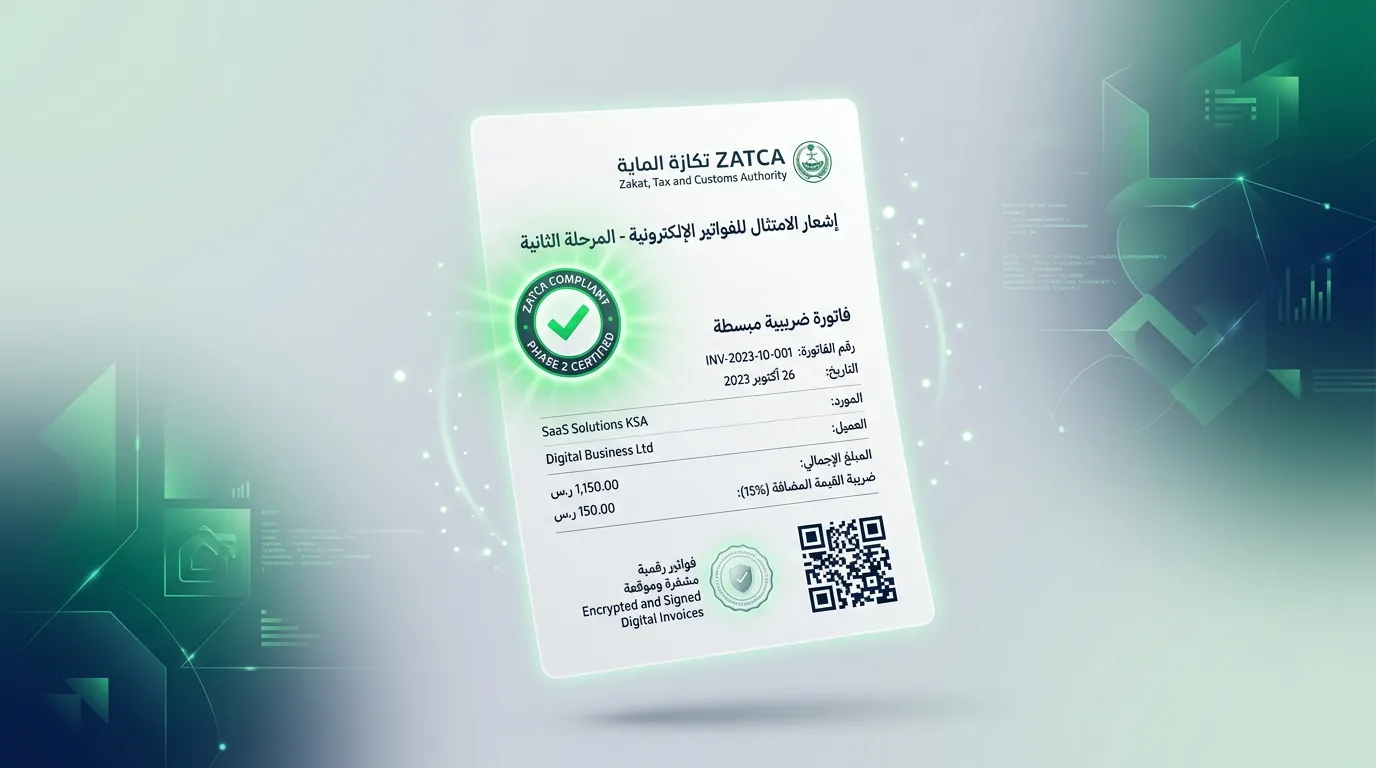
For Simplified B2C invoices, the printed QR code must use Tag-Length-Value (TLV) binary encoding converted into Base64:
- Tag 1: Seller Name
- Tag 2: Seller VAT Registration Number
- Tag 3: Timestamp (ISO 8601 UTC)
- Tag 4: Total Invoice Amount (with VAT)
- Tag 5: VAT Total Amount
- Tag 6: Invoice SHA-256 Hash
- Tag 7: ECDSA Cryptographic Digital Signature
- Tag 8: ECDSA Public Key
- Tag 9: ZATCA Cryptographic Stamp Signature (for cleared B2B documents)
5. The Dual Workflows: Clearance (B2B) vs. Reporting (B2C)
A fundamental concept of Phase 2 is that not all invoices follow the same path. ZATCA establishes two distinct operational pipelines:
1. The Clearance Model (Standard B2B / B2G Invoices)
Standard Tax Invoices are issued when selling to another business, corporation, or government ministry:
- The seller prepares the transaction in their ERP/POS.
- The software generates the UBL 2.1 XML and computes the digital hash.
- The software transmits the XML to the ZATCA Clearance API endpoint (/invoices/clearance/single).
- ZATCA validates all business logic, arithmetic computations, and tax rates in real time.
- If valid, ZATCA applies an official cryptographic watermark and returns the cleared XML.
- Only after receiving clearance can the seller legally share the invoice with the buyer.
- Under Saudi tax law, an uncleared B2B invoice is invalid for VAT deduction or corporate expense claims.
2. The Reporting Model (Simplified B2C Invoices)
Simplified Tax Invoices are issued in retail environments (supermarkets, cafes, boutiques, salons) directly to end consumers:
- Speed at the cash register is paramount; cashiers cannot wait for a government cloud response while a customer queue grows.
- The POS system cryptographically signs the invoice locally on the physical device.
- The printed or digital receipt is handed to the consumer immediately with the 9-tag QR code.
- The POS background service queues the invoice and transmits it to the ZATCA Reporting API endpoint (/invoices/reporting/single) within 24 hours.
Credit Notes and Debit Notes
What if a customer returns an item, or an invoice contains a billing mistake?
- Editing or deleting an invoice is strictly illegal.
- The seller must issue an electronic Credit Note (إشعار دائن) or Debit Note (إشعار مدين).
- The note must be formatted in UBL 2.1 XML, cryptographically chained, and must explicitly reference the original invoice's UUID and date.
6. Prohibited Practices & Serious Penalties
ZATCA regulations outline explicit operational violations that carry harsh financial and legal consequences.
Expressly Prohibited System Capabilities
Your software must NOT possess any of the following features:
- Uncontrolled Sequence Numbering: Ability to reset invoice numbers or run parallel, non-synchronized sequence numbers on the same tax branch.
- Database Editing: Direct database access allowing staff to alter past invoice amounts, dates, or tax figures.
- Missing Audit Logs: Deleting or altering system audit logs.
- Anonymous Transactions: Generating invoices without logging the specific cashier ID or user account.
- Multiple Device Key Duplication: Re-using the same cryptographic private key across multiple cash registers without registering each terminal individually with ZATCA.
Penalty Schedule under Saudi Tax Law
Non-compliance under ZATCA regulations triggers escalating penalties:
| Violation Type | Regulatory Penalty | Operational Consequence |
|---|---|---|
| Failure to issue e-invoices | SAR 5,000 to SAR 10,000 | Warning notice & audit inspection |
| Failure to comply with Phase 2 Integration | SAR 10,000 to SAR 50,000 | Inability to clear B2B invoices; loss of corporate clients |
| Altering, deleting, or manipulating records | Up to SAR 50,000+ per instance | Referral to Public Prosecution for fraudulent evasion |
| Failure to notify ZATCA of system malfunctions | SAR 1,000 to SAR 10,000 | Revocation of compliance certificate |
| Repeated commercial concealment violations | Severe criminal fines & license cancellation | Immediate closure of commercial business operations |
7. Step-by-Step Onboarding on the ZATCA Fatoora Portal
Onboarding your business devices to ZATCA Phase 2 requires navigating the official Fatoora developer portal:
Step 1: Portal Authentication
The authorized business administrator logs into the ZATCA Fatoora Portal using the Kingdom's unified National Single Sign-On (Nafath).
Step 2: Registering the Electronic Generation Solution (EGS)
Define the solution unit within the portal. You specify:
- Solution Name and Model (e.g., WaslaSoft Hybrid POS v3.4).
- Physical branch address and Tax Registration Number.
- Unique device serial number.
Step 3: Requesting the Onboarding OTP
The portal generates a cryptographic 6-digit One-Time Password (OTP). This OTP is valid for exactly 60 minutes and binds your physical device to your taxpayer profile.
Step 4: Generating the Cryptographic Key Pair and CSR
On the POS terminal, the software generates an ECDSA secp256k1 private key and formulates a Certificate Signing Request (CSR) incorporating:
- Common Name (CN): Taxpayer Name
- Organization Identifier (UID): 15-digit TRN
- Serial Number: Device Serial Number
- Registered Address: City and Postal Code
Step 5: Compliance Testing (Sandbox Simulation)
The POS submits the CSR and OTP to ZATCA's onboarding API, receiving a temporary Compliance CSID (CCSID). The system must then execute automated test scenarios in the ZATCA sandbox:
- Issue a standard B2B invoice.
- Issue a simplified B2C invoice.
- Issue a credit note.
- Issue a debit note.
Step 6: Obtaining the Live Production CSID (PCSID)
Once all compliance checks pass with zero validation warnings, ZATCA promotes the certificate to a Production CSID (PCSID). Your terminal is now fully certified and legally authorized to issue live tax invoices in Saudi Arabia.
8. Why WaslaSoft Hybrid POS Is the Gold Standard for ZATCA Compliance
Navigating ZATCA Phase 2 alone or relying on fragile third-party middleware is a recipe for operational failure. WaslaSoft provides a battle-tested, certified, and fully integrated ecosystem designed specifically for the Saudi commercial market.
① Direct Native API Architecture (No Middleware Fees)
Many legacy software vendors force clients to purchase expensive third-party connector tools or pay ongoing per-invoice transaction fees to integration brokers. WaslaSoft connects directly from your cash register to ZATCA's REST APIs with zero middleware and zero per-transaction surcharges.
② Offline-First Resilience: The 24-Hour Guarantee
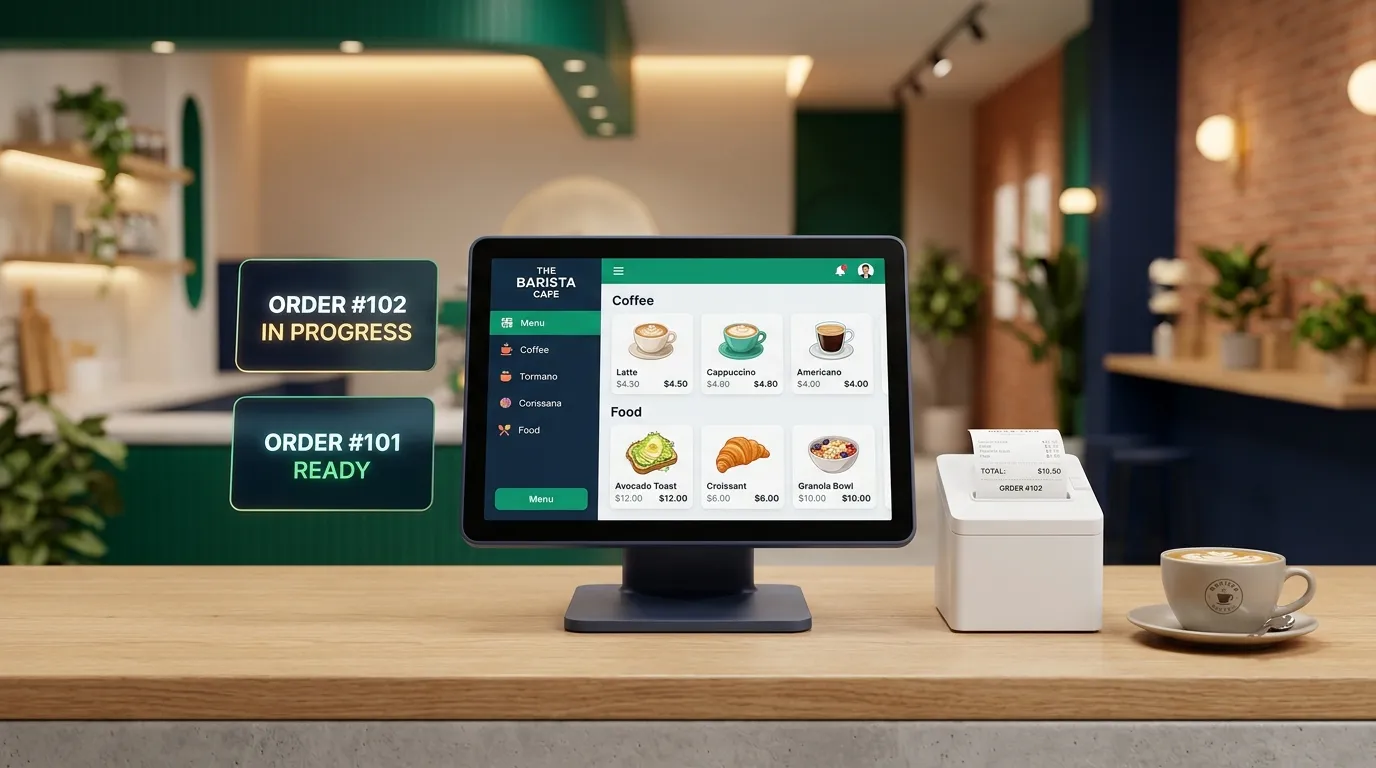
In high-volume supermarkets and restaurants, internet connections occasionally drop. A pure cloud POS freezes, leaving cashiers helpless. WaslaSoft's hybrid offline-first architecture allows cashiers to continue scanning items, taking cash or card payments, and printing cryptographically signed B2C invoices completely offline. The moment your fiber or 5G connection restores, WaslaSoft automatically synchronizes all pending invoices to ZATCA within the mandatory 24-hour window.
③ Automated Cryptographic Lifecycle Management
WaslaSoft automates the generation of ECDSA key pairs, CSR files, and CSID token refreshes directly from the point of sale. When certificates approach expiration, the system alerts management and handles renewal seamlessly without technical headaches.
④ Enterprise Multi-Branch Management
Manage one boutique in Riyadh or fifty supermarket branches across Jeddah, Khobar, and Medina. WaslaSoft provides centralized branch configuration, automated tax ledger reconciliations, and consolidated ZATCA audit reports from a single cloud dashboard.
⑤ Native Arabic/English Bilingual Interface
WaslaSoft is built from the ground up for the GCC region. All cash register screens, kitchen display units, inventory forms, and printed tax receipts are fully bilingual and strictly adhere to Saudi Ministry of Commerce and ZATCA typographic guidelines.
9. ZATCA Phase 2 Compliance Audit Checklist
Before your mandatory wave deadline arrives, evaluate your business readiness against this 7-point checklist:
- VAT Registration Verification: Is your 15-digit TRN active and correctly formatted on all company stationery?
- Address Standardization: Does your business master file contain the standardized Saudi National Address (Building, Street, District, Postal Code)?
- EGS Software Certification: Is your current POS or ERP vendor listed on ZATCA's certified solution provider directory?
- Offline Operation Contingency: Can your cashiers continue issuing compliant receipts if the internet fails during peak rush hours?
- B2B Clearance Workflow: Can your accounts receivable team submit standard invoices for clearance before issuing them to corporate buyers?
- Tamper-Proof Audit Logging: Does your system record every cashier login, void, discount, and return with immutable timestamps?
- Staff Training: Have your accounting, sales, and cashier teams been trained on the strict rules governing credit notes and voided receipts?
Conclusion: Protect Your Business with WaslaSoft
ZATCA Phase 2 e-invoicing is not merely a tax formality; it is a permanent transformation of business operations across the Kingdom of Saudi Arabia. Non-compliance exposes your business to catastrophic fines, operational disruption, and severe reputational damage.
With WaslaSoft Hybrid POS & ERP, ZATCA compliance becomes an invisible, effortless background process that protects your bottom line while accelerating your checkout speed and operational efficiency.
Get ZATCA Phase 2 Ready in 24 Hours.
Don't risk your commercial license on outdated billing software. Contact WaslaSoft today for a free compliance consultation and live demonstration. Our Riyadh and Jeddah teams are standing by to onboard your business seamlessly.