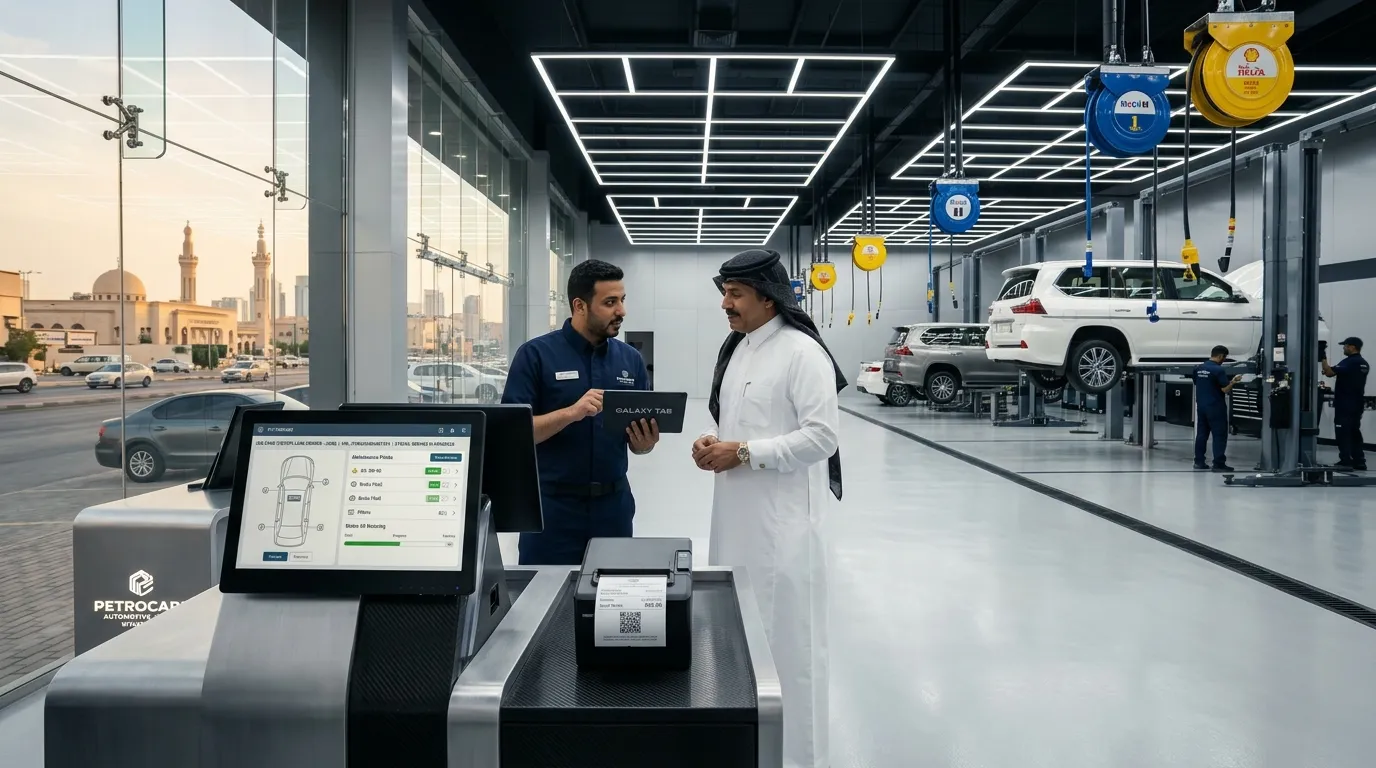
At 4:30 PM on a sweltering July afternoon in Riyadh's Industrial City (Sanaiyah) or Al Quoz in Dubai, ambient temperatures cross 47 degrees Celsius as six vehicles line up outside a five-bay auto service center. A technician under bay number three cracks open a 208-liter drum of synthetic 5W-30 oil, filling an uncalibrated plastic jug by eye, while another mechanic pulls a set of ceramic brake pads from the parts cage to rush a job before evening shift turnover. In the service lounge, a customer reviewing their paper clipboard invoice argues that a cracked fog light bracket occurred on the hydraulic lift, threatening an instant Ministry of Commerce consumer protection complaint.
Automotive service operations in the Gulf run at an intense operational tempo across fifteen million registered vehicles. In extreme desert heat, preventive maintenance, coolant system flushes, transmission fluid renewals, and rapid lube changes are matters of vehicle survival. Drivers depend on quick-lube centers, tire balancing workshops, and full-service mechanical garages for rapid oil changes, brake replacements, and air-conditioning overhauls.
Yet, inside hundreds of regional service bays, operational visibility is fractured. Service advisors scribble customer complaints and odometer readings on paper clipboard tags that get smeared with engine grease. Mechanics grab expensive synthetic oil filters and ceramic brake pads from the parts cage without logging them to an open repair order. Technicians dispense bulk 5W-30 synthetic motor oil using uncalibrated plastic jugs, pouring five liters into an engine while billing the customer for four. Meanwhile, when a car owner picks up their vehicle, they point to a pre-existing parking lot dent on the rear door, threatening to file a Ministry of Commerce consumer protection complaint unless the workshop repaints the panel for free.
Eliminating these financial leaks requires replacing generic cash registers with a specialized automotive point of sale that binds vehicle VIN telemetry, warehouse spare parts requisition gates, bulk fluid metering, and ZATCA Phase 2 E-Invoicing into a single operational architecture. This guide details how leading Gulf auto centers deploy WaslaSoft Retail POS and Multi-Branch ERP to achieve zero-leakage bay management and complete workshop accountability.
The Anatomy of Auto Service Margin Bleed: Where the Money Evaporates
Automotive service operations operate on a dual-revenue engine: gross margin on retail spare parts and lubricants (typically 35% to 55%) and gross margin on technician labor hours (typically 65% to 80%). However, workshop profitability collapses when loose shop-floor procedures allow inventory and labor hours to slip through unbilled.
In un-integrated automotive workshops, profitability bleeds through four primary operational fissures:
Bulk Motor Oil and Fluid Shrinkage (8% to 15% of Lubricant COGS): High-grade synthetic motor oils (such as 0W-20, 5W-30, and 5W-40 meeting API SP and ILSAC GF-6 standards) are purchased in 208-liter steel drums or 1,000-liter intermediate bulk containers (IBCs). In fast-paced quick-lube bays, technicians use manual plastic pitchers. A technician servicing a modern twin-turbo V6 SUV pours 6.2 liters into the crankcase, but tells the cashier: "Just bill him for 5 liters." In other cases, lube techs dispense oil into personal jugs to take home or top off a friend car without an open job card. Over thirty days, a workshop consuming twelve drums of oil discovers that fifteen entire drums are gone, absorbing over SAR 8,000 monthly in unbilled synthetic fluid.
Unbilled Spare Parts and Inventory Cage Leakage (3% to 6% of Parts Turnover): When a mechanic disassembles a vehicle on a hydraulic lift and discovers severely glazed brake pads, time is of the essence. To avoid leaving the vehicle stranded on the lift while waiting for paperwork, the mechanic runs to the spare parts cage, grabs a set of OEM ceramic pads, installs them, and forgets to notify the front service advisor. When the customer arrives to pay, the service advisor looks at the initial intake notes, bills the customer only for an oil change and tire rotation, and hands over the keys. The SAR 380 brake pad set vanishes from the inventory ledger, showing up only as an unexplained loss during quarterly physical inventory counts.
Fraudulent Pre-Existing Body Damage Claims (SAR 3,000 to SAR 8,000 per Occurrence): Vehicles arrive at service centers with pre-existing parking lot dings, scuffed alloy wheels, and stone-chipped windshields. When a workshop relies on paper intake sheets with crude line drawings, a dishonest customer takes advantage: "My rear bumper was completely spotless when I dropped the car off this morning; your lift technician must have reversed into a toolbox." Under consumer protection enforcement standards across Saudi Arabia and the UAE, if the workshop cannot produce timestamped photographic proof captured at vehicle intake, authorities rule in favor of the consumer, forcing the workshop to pay for third-party body shop repainting.
Phone-Tag Bottlenecks on Additional Repair Approvals: A vehicle is hoisted on the shop lift for a scheduled SAR 150 oil change. The technician notices leaking shock absorbers and frayed serpentine belts—repairs worth an additional SAR 1,400. The service advisor calls the customer to explain the findings, but the customer does not answer. The vehicle sits idle on the lift for two hours, blocking the bay from servicing four other waiting customers. If the workshop performs the repair without written proof, the customer refuses to pay upon collection, claiming: "I only authorized the oil change."
The Digital Job Card Architecture: From VIN Intake to Quality Inspection
The core operational asset of any professional automotive workshop is the Digital Job Card (أمر الشغل الإلكتروني). A modern automotive POS must transform the job card into a live, interactive data bridge that tracks the vehicle physical and financial lifecycle:
Core Automotive Digital Job Card Lifecycle:
- Intake & Vehicle Identification: Barcode scanning of the vehicle VIN on the door jamb or registration card (Istimara), auto-populating year, make, model, engine code, and historical service logs.
- Walk-Around Multi-Point Inspection (MPI): 6-point tablet photo capture documenting exterior body condition, tire tread depth, and instrument cluster odometer reading.
- Digital Estimate Generation: Line-item breakdown of required labor operations and spare parts with manufacturer-specified oil volume capacities.
- Customer Interactive Authorization: One-click WhatsApp / SMS approval link with embedded photo evidence of worn components.
- Parts Cage Requisition Lock: Barcode scanning of parts against the approved job card number before physical warehouse release.
- Bay Execution & Technician Tracking: Clock-in / clock-out logging of mechanic labor hours per repair operation.
- Final Quality Control Gate: Supervisor road-test sign-off and torque wrench checklist verification.
- ZATCA Phase 2 Settlement: Instant generation of cryptographic electronic tax invoice with automated service reminder scheduling.
When your service reception runs on WaslaSoft POS for Auto Centers, the service advisor never relies on memory. As the car pulls into the reception bay, the advisor scans the VIN barcode using a rugged mobile tablet. The software queries the central vehicle database, displaying previous service dates, recommended maintenance schedules, and active warranty statuses in under two seconds.
Real-World Implementation Breakdown: What Went Wrong in Riyadh's Sanaiyah & Al Sahafa Centers
To appreciate how operational gaps degrade workshop margins, consider the experience of a prominent auto service chain operating four high-volume locations across the Industrial City (Sanaiyah) and Al Sahafa districts of Riyadh.
In early 2026, the executive board conducted an annual financial review. Across their four locations, the chain serviced an average of 1,800 vehicles per month, generating over SAR 4.2 million in annual gross revenue. However, net profit margin languished at a disappointing 5.4%.
A comprehensive forensic audit uncovered three catastrophic leaks:
- The chain lost SAR 74,200 across twelve months in unmetered bulk motor oil discrepancies. Their physical drum consumption showed 4,800 liters of synthetic oil had vanished compared to closed customer invoices.
- The spare parts warehouse registered a SAR 58,000 deficit in fast-moving items—primarily oil filters, air filters, spark plugs, and brake pads—due to mechanics taking parts without written requisition orders during evening rush hours.
- The company paid out over SAR 36,000 to settle seven contentious consumer protection disputes regarding alleged vehicle scratches and dents, because the paper intake forms lacked verifiable photographic proof.
Our automotive retail engineering team was deployed to conduct a four-day operational audit of their reception drive-thrus, parts cages, and mechanical service bays.
The Root Failure Modes Identified
The audit revealed three critical procedural breakdowns:
The Handheld Plastic Pitcher Trap: In the quick-lube bays, technicians used plastic measuring jugs with faded measurement lines. To finish cars rapidly, lube techs rarely checked manufacturer oil capacities. On a Toyota Land Cruiser V8 requiring 7.5 liters with a filter change, technicians poured eight liters, but billed the customer for seven. Over twenty cars a day per branch, this unmetered generosity destroyed thousands of liters of premium synthetic oil.
The Open Parts Cage Blind Spot: The spare parts storeroom was left unlocked during peak hours so mechanics would not have to wait for the warehouse supervisor. Mechanics grabbed oil filters and brake pads, intending to tell the cashier later. In the noise and rush of diagnosing complex engine codes, technicians forgot to report the parts, resulting in hundreds of vehicles leaving the premises with free unbilled hardware.
The Disputed Carbon-Copy Vehicle Sketch: Service advisors used paper intake sheets with a small car outline, making quick pen circles to mark dents. When an executive customer collecting a luxury German sedan noticed a fresh scrape on the lower front spoiler, they claimed the workshop lift arms caused the damage. Because the paper sketch had no time watermark or photograph, the Ministry of Commerce mandated that the workshop cover the full SAR 4,800 repainting cost.
The Remediation Architecture: Enforcing Zero-Leakage Auto Service Operations
Our engineering team completely overhauled the chain operational protocols, deploying WaslaSoft's specialized Automotive Service & Quick-Lube POS architecture across all four locations. We implemented four mandatory operational safeguards:
WASLASOFT INTEGRATED AUTO SERVICE WORKFLOW:
- Drive-thru VIN Scanner: Instant vehicle identification & manufacturer spec retrieval
- Guided Tablet Walk-Around: 6-point mandatory timestamped exterior photo capture
- Digital Oil Dispenser Reconciliation: Billed oil volume verified against engine spec
- Barcode Parts Requisition Gate: Warehouse parts released ONLY upon active job card scan
- Interactive WhatsApp Estimate Approval: Customer approves additional repairs via smartphone
- Technician Labor Clock-in: Mechanic scans badge to track actual labor vs flat-rate book time
- Quality Inspection Sign-off: Supervisor road-test verification before key release
- ZATCA Phase 2 E-Invoicing: Automated split invoicing for corporate fleets & retail clients
1. Digital Bulk Oil Metering and Engine Spec Binding
We eliminated guesswork in the quick-lube bays:
- WaslaSoft's database was loaded with manufacturer oil capacity tables for over 3,500 passenger and commercial vehicle models sold in the GCC.
- When an advisor selects an oil change for a 2024 Nissan Patrol, the system automatically locks the billed quantity to exactly 6.8 liters of 5W-30 synthetic oil.
- If a technician attempts to bill or dispense more than a 5% variance from factory specifications, the POS prompts for supervisor override authorization.
- Bulk drum inventory is tracked down to the deciliter. Daily shift reports reconcile physical pump meter counters against total billed liters in the software, instantly detecting unmetered dispensing.
2. The Barcode Parts Requisition Lock
We enclosed the parts cage and installed a dedicated WaslaSoft warehouse terminal:
- Mechanics can no longer physically enter the parts storage area.
- To draw an oil filter or brake pad set, the mechanic presents the vehicle digital job card barcode.
- The parts clerk scans the job ticket, scans the part barcode, and the ERP automatically appends the item to the active customer invoice while decrementing stock in real time.
- No part can leave the cage without being tied to an open, authorized repair order.
3. Mandatory 6-Point Photo Intake on Mobile Tablets
We deployed rugged industrial tablets to every service advisor:
- Before any vehicle enters a service bay or is driven onto a lift, the advisor conducts a 90-second walk-around inspection.
- The software enforces six mandatory high-resolution photos: front bumper, rear bumper, left profile, right profile, windshield, and instrument cluster showing exact odometer and fuel level.
- Every photograph is watermarked with an immutable timestamp, GPS coordinates, and vehicle VIN.
- The customer reviews the photos on the tablet screen and provides a digital signature before keys are handed over.
Within four months of deploying this architecture, the Riyadh automotive chain reduced bulk oil shrinkage by 94.1%, eliminated unbilled spare parts leakage, and experienced zero payouts on fraudulent body damage claims, adding over SAR 180,000 annually to net operating profit.
Managing Corporate B2B Fleet Invoicing and ZATCA Phase 2
Auto service centers across the Gulf handle an increasing volume of corporate fleet business—servicing delivery vans, ride-hailing vehicles, and car rental fleets on monthly credit accounts. Managing fleet invoicing under ZATCA Phase 2 mandates requires strict separation between retail and corporate workflows:
Purchase Order (PO) and Fleet Vehicle Authorization: When a corporate delivery van arrives for service, WaslaSoft checks whether the vehicle plate is registered under an active commercial fleet contract (e.g., a delivery logistics company). The software enforces mandatory fields: the driver must provide the corporate fleet PO number and authorized repair budget cap before a job card can open.
Consolidated Monthly Tax Invoicing: Instead of printing individual cash receipts for every van oil change, WaslaSoft accumulates all verified service job cards throughout the calendar month. At month-end, the system generates a certified ZATCA Phase 2 B2B Tax Invoice with a cryptographic stamp, unique UUID, and machine-readable XML payload, complete with an itemized appendix detailing vehicle plate numbers, odometer readings, and repair dates for corporate accounting approval.
Warranty and Return Credit Notes: If a replacement alternator or air-conditioning compressor fails within the 12-month statutory warranty period, the customer returns for a warranty replacement. WaslaSoft handles the accounting seamlessly: the system processes a warranty claim against the original invoice, generates a certified ZATCA electronic credit note to reverse the parts cost, and bills the supplier for the replacement component without distorting the workshop tax returns.
Practical Implementation Checklist for Gulf Auto Center Operators
To transform your auto service garage or quick-lube chain into a high-margin, leak-proof enterprise, follow this phased operational implementation plan:
Deploy Mobile Tablet Intake Checklists:
- Eliminate paper clipboard tags. Equip service advisors with rugged tablets running WaslaSoft to capture vehicle VINs, odometers, and 6-point condition photos at vehicle drop-off.
- Enforce digital customer signatures on intake condition reports to neutralize false damage claims.
Automate Bulk Lubricant Inventory Tracking:
- Bind oil change line items to verified manufacturer engine capacity databases.
- Reconcile physical bulk drum pump meters against closed POS invoices daily to detect unmetered fluid dispensing.
Lock Down Spare Parts Cage Requisitions:
- Strictly prohibit mechanics from drawing parts without an active digital job card scan.
- Track every oil filter, brake pad, and spark plug set down to its unique barcode to eliminate warehouse shrinkage.
Activate Interactive WhatsApp Repair Estimates:
- Enable digital estimate notifications with photo evidence of worn parts to secure rapid customer repair approvals and maximize lift bay turnover.
Enforce ZATCA Phase 2 Fleet Billing Protocols:
- Automate corporate fleet monthly invoicing with PO validation and cryptographic compliance to accelerate B2B accounts receivable collections.
The Bottom Line: Protecting Workshop Margins with Specialized Auto POS
A modern automotive service center is a fast-paced engineering facility where profitability depends on maximizing lift bay efficiency and turning inventory into cash flow. Your service advisors and master mechanics should focus their energy on precision vehicle diagnostics, quality repairs, and customer trust—not arguing over pre-existing bumper dents, searching for missing brake pads, or guessing bulk oil volumes.
By replacing disconnected cash registers and paper clipboards with WaslaSoft's unified auto service POS architecture—integrating digital job cards, bulk fluid metering, barcode parts requisition locks, and ZATCA Phase 2 compliance—you eliminate operational waste and protect your workshop operating margins.
Discover how WaslaSoft Retail and Service POS and WaslaSoft Multi-Branch ERP help automotive repair centers, quick-lubes, and tire workshops across Saudi Arabia, the UAE, and Oman eliminate balance sheet bleed. Schedule an operational demo with our automotive systems specialists today.