
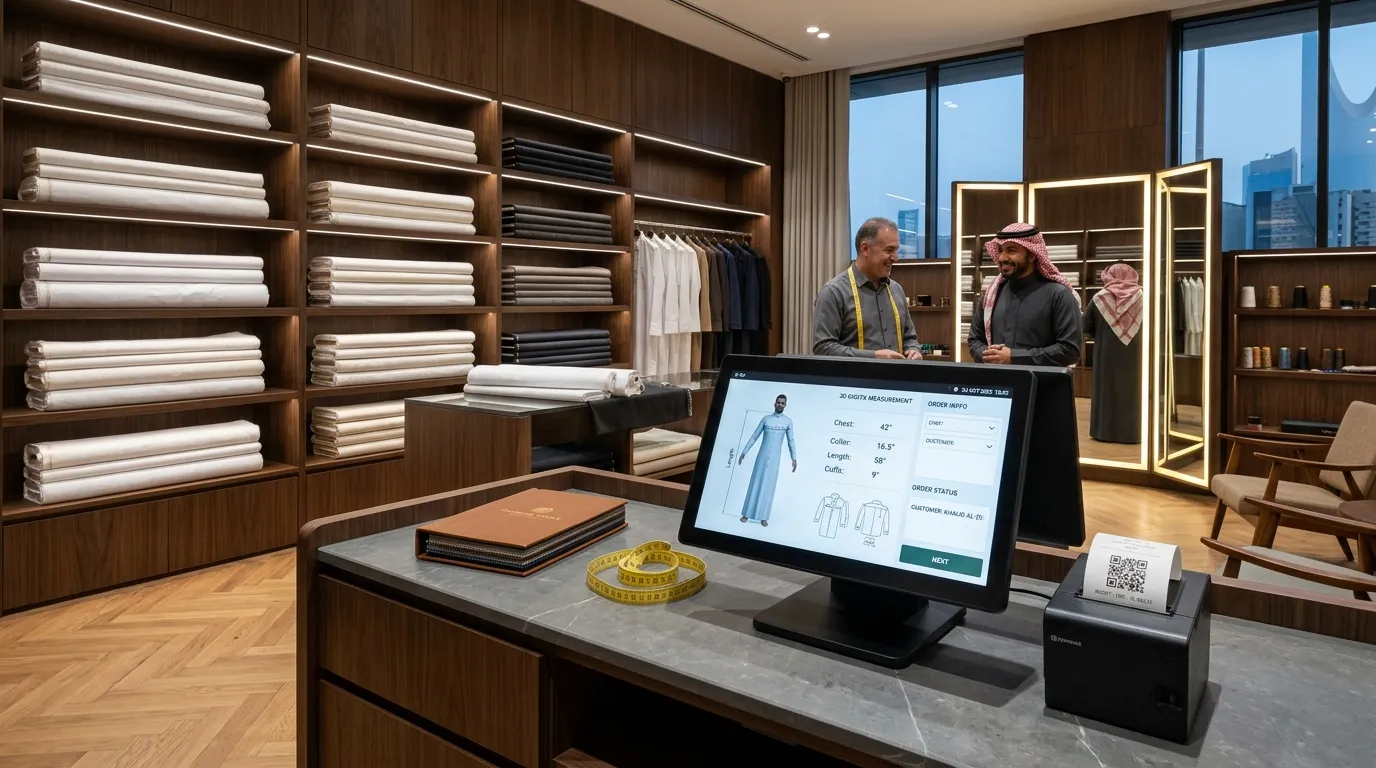
If your bespoke Thobe or Abaya tailoring atelier is absorbing SAR 20,000 to SAR 45,000 every quarter in ruined fabric write-offs, misread measurement cards, and disputed tailor piece-rate wage claims, your workshop is operating on 19th-century paper slips while competing in a multi-billion-riyal modern luxury market.
The bespoke tailoring industry across Riyadh, Jeddah, Makkah, Medina, Al Khobar, Dubai, Doha, and Muscat represents one of the most culturally vital and economically lucrative sectors in Gulf retail. In Saudi Arabia alone, the custom Thobe market exceeds SAR 5 billion annually. Men of all ages commission tailored garments multiple times a year, demanding perfection in collar stiffness, sleeve drape, pocket alignments, and fabric breathability.
Yet, behind the elegant brass fittings and mahogany fabric display racks of modern tailoring showrooms, the operational reality inside backroom cutting workshops is fraught with friction. Tailor fitters record sixteen complex body measurements on crumpled paper cards with ballpoint pens. Master cutters misread handwriting and slice into SAR 350-per-meter Japanese Toyobo or English worsted wool blanks, producing Thobes that pull tightly across the shoulders or fall two inches too short. Fabric rolls (Taqah) disappear into unaccounted scrap piles. Meanwhile, as the intense pre-Eid rush approaches, workshop managers engage in screaming matches with assembly tailors over unverified piece-rate payroll logs, while customers flood the showroom demanding delayed holiday orders.
Transforming a custom tailoring business into a high-margin, scalable enterprise requires connecting the fitting pedestal directly to the cutting table, automating bolt-level textile inventory, and tracking piece-rate artisan labor with digital accountability. This operational guide details how leading Gulf tailoring boutiques deploy WaslaSoft Retail POS and Multi-Branch ERP to eliminate bespoke garment remakes, maximize textile yields, and enforce ZATCA Phase 2 E-Invoicing compliance.
The Anatomy of Tailoring Margin Bleed: Where the Money Evaporates
Custom tailoring combines the inventory risk of manufacturing with the customer expectations of luxury bespoke retail. Unlike ready-to-wear clothing, a custom Thobe cannot be returned to a supplier or marked down on a clearance rack if the customer rejects the fit.
In traditional, un-integrated tailoring operations, profitability bleeds through four primary operational fissures:
Measurement Transcription and Pattern Cutting Remakes (4% to 7% of Revenue): A bespoke Saudi Thobe requires capturing up to sixteen precise anatomical data points, from full body length and shoulder slope to chest girth, neck circumference, armhole depth, and cuff diameter. In manual shops, fitters write these measurements on loose paper tickets. When a cutter interprets a sloppy handwritten 58.5 inches as 56.5 inches, or cuts a standard straight cuff instead of a double French cuff (Kabak), the mistake is discovered only when the customer tries on the finished garment seven days later. The customer refuses delivery, and the shop must absorb 100% of the ruined luxury fabric cost plus duplicate labor to remake the garment from scratch.
Fabric Bolt (Taqah) Yield Leakage (3% to 6% of Textile Inventory): Textiles represent the single largest cost of goods sold (COGS) in a tailoring atelier. Premium white and cream fabrics—such as Japanese Shikibo, Toyobo, Teijin, and fine Italian wools—are imported in bolts measuring 22.5 to 25 meters (or 50 yards). A skilled master cutter should extract six to seven standard adult Thobes from a 25-meter bolt (consuming approximately 3.4 to 3.6 meters per garment depending on customer height and hem flare). In uncontrolled workshops, cutters cut carelessly, waste large off-cuts, or skim fractional yardage into unaccounted remnants (Kusasat). Without bolt-level tracking, shop owners cannot tell whether a fabric roll yielded six Thobes or only five, losing thousands of riyals per bolt in untraceable textile shrinkage.
Multi-Stage Piece-Rate Payroll Disputes and Double-Billing: Most tailoring workshops compensate their craftsmen through piece-rate wages (paying fixed rates per finished component). A single Thobe passes through four distinct artisans:
- The Master Cutter (Fassal)
- The Collar and Cuff Specialist (Yaqat & Asawer)
- The Assembly Stitcher (Khayyat Darz)
- The Finishing and Buttonhole Artisan (Arawi, Azrar & Finishing) When piece-rate production is logged in handwritten paper notebooks, tailors frequently claim credit for garments they never touched, claim wages for discarded remakes, or dispute monthly totals with workshop managers. Shop owners routinely overpay payroll by 8% to 15% due to unverified claims, while struggling to identify which specific tailor was responsible for a crooked collar seam.
- Pre-Eid Delivery Collapse and Over-Booking Bottlenecks: During the forty-five days leading up to Eid Al-Fitr and Eid Al-Adha, Gulf tailoring demand surges by 300% to 500%. In the rush to capture customer deposits, sales consultants accept orders far beyond the physical cutting and stitching capacity of their workshops, verbally promising: "Inshallah, your five Thobes will be ready on the 27th of Ramadan." Without real-time production capacity planning, workshops hit catastrophic bottlenecks. On the final days of Ramadan, hundreds of furious customers besiege the showroom, finding their garments unfinished. Ateliers are forced to issue emergency cash refunds, offer steep discounts, and endure devastating reputational damage on social media.
Digitizing the Tailor Pedestal: The Anatomical Measurement Schema
The foundation of zero-defect bespoke tailoring is eliminating handwritten paper cards. When an executive customer steps onto the fitting pedestal, the fitter must capture their measurements into a standardized digital profile that permanently locks to their customer file:
Core Bespoke Thobe Anatomical Parameter Schema:
- Primary Body Lengths & Widths:
- Full Garment Length (طول الثوب الكامل): Millimeters or inches to the quarter-inch
- Shoulder Width (عرض الكتف): Tip of acromion to acromion
- Chest Circumference (محيط الصدر): Full chest breath measurement
- Waist & Hip Girth (محيط الخصر والوسط): Accounting for seated comfort
- Sleeve Length & Wrist Width (طول الكم ووسع اليد): Shoulder seam to wrist bone
- Bottom Hem Flare (وسع الذيل / الردة): Traditional narrow vs formal wide flare
- Collar Engineering (هندسة الياقة):
- Collar Style: Traditional Saudi Formal, Qallabi (Mandarin), Kuwati V-Cut, or Bahraini
- Collar Height: 3.0 cm, 3.5 cm, 4.0 cm, or 4.5 cm
- Interlining Stiffness: Soft, Medium, Hard, or Double-Reinforced
- Cuff & Pocket Specifications (الكبك والمخابي):
- Cuff Architecture: Plain hem, single button, double French cuff (Kabak), or hidden zipper
- Pocket Configuration: Chest pocket width, side slash pockets, internal smartphone pocket depth
When the fitter inputs these numbers into WaslaSoft on a showroom tablet, the software executes Physiological Bounds Validation. If a fitter accidentally types a sleeve length of 42 inches (physically impossible for human proportions) or inputs a chest measurement that deviates by more than 15% from the customer historical file, the system triggers an instant confirmation prompt: "Measurement Variance Detected: Verify Sleeve Length before proceeding."
Once confirmed, the order generates an Indestructible Barcode Job Ticket. The ticket prints on heavy cardstock or heat-resistant thermal synthetic paper, complete with a machine-readable 2D barcode, and pins directly to the cut fabric bundle as it travels through the workshop.
Real-World Implementation Breakdown: What Went Wrong in Riyadh Boutiques
To understand the operational and financial impact of manual tailoring systems, consider the crisis faced by a prominent five-branch luxury bespoke tailoring group operating across Olaya Street and King Fahd Road in Riyadh.
In early 2026, the executive board reviewed their annual performance following the peak winter and Ramadan seasons. Despite achieving gross revenues of SAR 3.4 million, net profitability stood at an unacceptable 6.2%.
A comprehensive internal audit uncovered four severe financial leaks:
- The group wrote off SAR 88,400 in ruined luxury Japanese fabrics across their central workshop over twelve months. Over 68% of these fabric destructions were traced directly to cutters misreading paper measurement slips or cutting incorrect collar styles.
- Textile bolt reconciliation revealed an inexplicable 5.8% fabric deficit across 420 imported Toyobo and Shikibo bolts, representing over SAR 74,000 in unaccounted fabric shrinkage and scrap.
- During the final five days of Ramadan, the workshop failed to deliver 240 promised Thobes on time. Over 60 customers cancelled their orders, forcing the company to refund SAR 42,000 in cash deposits and give away completed post-Eid garments at a 50% loss.
- Tailor piece-rate payroll logs showed that the workshop had paid out SAR 31,000 in piece-rate stitching wages for garments that were recorded as rejected or remade, paying tailors twice for rectifying their own sewing errors.
Our retail systems engineering team was brought in to conduct an intensive on-site audit of their showroom fitting counters, cutting floor, and assembly lines.
The Root Failure Modes Identified
The audit revealed three critical procedural breakdowns:
The Faded Carbon-Copy Card Bottleneck: Fitters used three-layer carbon-copy paper books. By the time the third yellow sheet reached the workshop cutter in the basement, faint pencil marks were illegible. Cutters frequently guessed whether a faint loop was a 6 or an 8. If the cutter guessed wrong, a 56-inch length was cut for a 58-inch customer.
The "Uncut Bolt Remnant" Blind Spot: When a cutter completed a batch of Thobes, the remaining 1.8 or 2.2 meters of a 25-meter bolt was tossed into plastic floor bins beneath cutting tables. Because the inventory software recorded fabric only when an entire bolt was received, nobody tracked partial yardage. Cutters frequently cut private side-jobs from these unaccounted remnants or discarded usable two-meter pieces that could have produced children's Thobes.
The Unverified Piece-Rate Tick Sheet: Tailors maintained paper tick sheets taped beside their sewing machines, making pencil marks for every collar attached or sleeve sewn. At the end of the week, the workshop supervisor collected the sheets and keyed the numbers into a payroll spreadsheet. Tailors routinely marked extra tallies, and because garments lacked individual serial numbers, supervisors had zero ability to cross-check whether forty collars were actually produced or twenty-eight.
The Remediation Architecture: Enforcing Zero-Defect Tailoring Operations
Our engineering team completely overhauled the group five showrooms and central workshop, deploying WaslaSoft's specialized Bespoke Tailoring & Garment POS architecture. We implemented four mandatory operational safeguards:
WASLASOFT INTEGRATED BESPOKE TAILORING WORKFLOW:
- Fitting Pedestal: Digital tablet body measurement capture with 3D anatomical silhouette
- Fabric Bolt Allocation: Fractional yardage deduction linked to specific fabric bolt serial
- ZATCA Phase 2 Advance Invoicing: 50% customer deposit with cryptographic QR code receipt
- Barcode Job Ticket Generation: Synthetic durable ticket pinned to cut fabric bundle
- Multi-Stage Workshop Scans: Cutter -> Collar/Cuff -> Stitcher -> Finishing & QC
- Automated Piece-Rate Payroll: Instant credit to artisan account upon verified barcode scan
- Automated WhatsApp Fitting Alert: Triggered the moment final showroom QC passes
- Final Delivery & Balance Settlement: 50% remaining balance collected with ZATCA tax invoice
1. Barcode Job Tickets and Stage-by-Stage Workshop Scans
We eliminated paper notebooks. We mounted industrial barcode scanners at every major workshop station:
- When the Master Cutter finishes slicing the fabric, he scans the job ticket at his station. The system verifies that the pattern was cut according to the digital specifications and credits his piece-rate ledger with SAR 16.
- The fabric bundle moves to the Collar & Cuff artisan, who scans the barcode, accesses the exact collar height and interlining stiffness on a touch terminal, crafts the components, and scans the ticket upon completion, earning his SAR 10 piece-rate credit.
- The bundle passes to the Assembly Stitcher, who completes the seams and scans the barcode.
- Finally, the quality control supervisor inspects the finished Thobe against digital measurement tolerances. If a seam deviates by more than half an inch, the supervisor marks the ticket as "Rework Required" and assigns the correction to the specific tailor responsible, without issuing an additional wage credit.
2. Fractional Fabric Bolt Yield Tracking
We restructured textile inventory in WaslaSoft Multi-Branch ERP down to the exact fractional meter:
- Every fabric bolt is assigned a unique barcode upon arrival from the distributor.
- When an order is confirmed, the software calculates exact required yardage (e.g., 3.45 meters for an adult 58L Thobe).
- The cutter scans the fabric bolt barcode before cutting. The system decrements exactly 3.45 meters from the roll's live balance.
- If a bolt reaches its final 3 meters, the ERP automatically flags the remnant as "Children's Thobe Cut" or "Sample Length", allowing the sales team to sell the remnant at promotional pricing rather than letting it rot in scrap bins.
3. Automated Pre-Eid Capacity Management
We activated WaslaSoft's Intelligent Production Scheduling Engine:
- Management sets daily workshop capacity caps (e.g., maximum 85 Thobes cut and stitched per day across all lines).
- During Ramadan, as sales consultants enter orders, the system evaluates available production slots. When the 25th of Ramadan reaches 100% capacity, the software automatically locks that delivery date and shifts suggested pickup dates to open windows, preventing catastrophic holiday over-booking.
Within five months of deploying this architecture, the Riyadh luxury tailoring chain reduced garment remakes by 92.3%, eliminated textile bolt shrinkage, and ended piece-rate payroll discrepancies, increasing annual net profit by over SAR 220,000.
Managing ZATCA Phase 2 Advance Deposit Invoicing
Bespoke tailoring transactions inherently involve staged payments. Handling advance deposits under Saudi ZATCA Phase 2 regulations requires strict compliance:
Advance Payment Tax Invoice (50% Deposit): When a customer selects their fabric and completes their fitting, they pay an initial 50% deposit (e.g., SAR 500 on a SAR 1,000 order). The atelier cannot issue a simple manual receipt. WaslaSoft generates an official ZATCA Phase 2 Advance Payment Tax Invoice with a cryptographic QR code and unique UUID, remitting the 15% VAT on the advance sum in that tax period.
Final Settlement Tax Invoice (Remaining 50% Balance): When the customer returns for final fitting and collection, the cashier scans the barcode on the garment protective hanger bag. WaslaSoft pulls up the order, applies the SAR 500 advance payment credit, collects the remaining SAR 500 balance, and generates a Final Settlement Tax Invoice. This invoice clearly references the initial advance invoice UUID and settles the remaining VAT balance with full cryptographic compliance.
Handling Customer Alterations and Credit Notes: If a minor adjustment is required upon pickup (such as shortening the hem by one centimeter), the POS places the order in "Alteration Workflow", routing the garment back to the workshop with an automated 24-hour turnaround ticket without generating accounting distortions. If an order is legitimately canceled due to material defect, the system generates a certified ZATCA electronic credit note linked directly to the initial invoice.
Practical Implementation Checklist for Gulf Tailoring Ateliers
To modernize your custom tailoring business, eliminate fabric waste, and achieve flawless workshop accountability, follow this phased operational implementation plan:
Digitize the Fitting Pedestal:
- Decommission paper measurement cards. Equip fitters with mobile tablets connected directly to WaslaSoft to capture anatomical measurements with automated validation bounds.
- Establish permanent customer digital profiles that store collar styles, cuff preferences, and historical measurement evolutions.
Deploy Barcode Job Tickets in the Workshop:
- Print durable barcode tickets for every confirmed order and attach them to cut fabric bundles.
- Install rugged barcode scanners at cutting, collar, stitching, and finishing stations to track production stages in real time.
Automate Piece-Rate Wage Calculations:
- Link piece-rate payroll credits directly to verified station barcode scans.
- Eliminate paper tick sheets and unverified verbal claims to ensure zero double-billing for assembly labor.
Implement Fractional Fabric Bolt Yield Management:
- Track textile inventory at the fractional meter level against individual bolt barcodes.
- Monitor fabric yields per roll to detect careless cutting and prevent unauthorized scrap leakage.
Enforce Intelligent Seasonal Capacity Scheduling:
- Establish maximum daily production thresholds in the POS to prevent over-booking delivery dates during peak pre-Eid seasons.
- Activate automated WhatsApp pickup notifications to keep finished stock moving out of showroom collection racks.
The Bottom Line: Protecting Craftsmanship Margins with Specialized Tailoring POS
Bespoke tailoring is an art form rooted in cultural heritage and sartorial excellence. Your master fitters and tailors should focus their talents on pattern balance, luxurious drape, and exquisite collar finishing—not struggling with illegible handwriting, arguing over lost fabric remnants, or mediating chaotic holiday pickup crowds.
By replacing disconnected cash registers and paper tickets with WaslaSoft's unified tailoring POS architecture—integrating digital measurement profiles, fractional fabric bolt tracking, barcode piece-rate payroll, and ZATCA Phase 2 advance invoicing—you eliminate operational waste and protect your atelier operating margins.
Discover how WaslaSoft Retail POS for Tailoring and Fashion and WaslaSoft Multi-Branch ERP help custom Thobe ateliers, Abaya boutiques, and uniform manufacturers across Saudi Arabia, the UAE, and Oman streamline operations. Schedule an operational demo with our bespoke tailoring specialists today.