If your optical boutique or eyewear chain is losing SAR 18,000 to SAR 40,000 every quarter to custom lens lab remakes, transcription errors on progressive prescriptions, and uncollected 50% balance payments on finished eyeglasses, your counter software is treating ophthalmic medical devices like generic retail t-shirts.
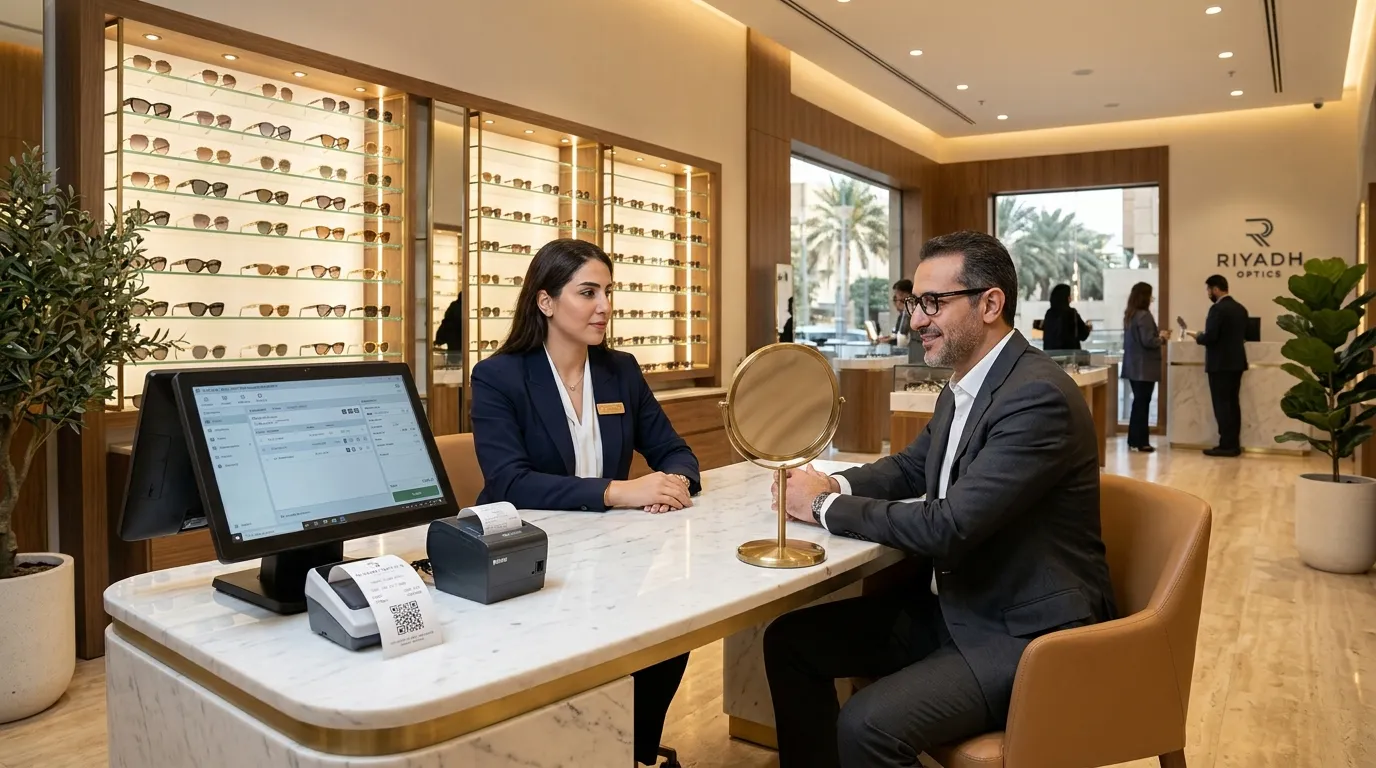
The retail optical and eyewear sector across Riyadh, Jeddah, Dammam, Dubai, Abu Dhabi, and Muscat occupies a unique intersection of healthcare precision and high-fashion luxury. In a single commercial showroom, an optometrist conducts clinical eye refraction exams to correct complex astigmatisms, while a luxury fashion stylist helps a customer select an imported Japanese titanium spectacle frame retailing for SAR 3,800.
Yet, inside hundreds of regional optical shops, the operational bridge between clinical optometry, external lens edging laboratories, and financial accounting is cracked. Optometrists scribble Sphere, Cylinder, and Axis measurements on loose paper cards. Counter staff type optical prescriptions into WhatsApp chats or fragmented emails to local lens surfacing labs, routinely transposing numbers and turning expensive high-index progressive blanks into unwearable scrap. Luxury consignment frames disappear off open display shelves without triggering inventory variance alerts. Meanwhile, cashiers trigger compliance penalties by charging standard 15% VAT on zero-rated medical prescription lenses during ZATCA Phase 2 E-Invoicing audits.
Eliminating these margin leaks requires a specialized optical management system that connects the refraction chair directly to the lens edging lab, automates staged deposit accounting, and segregates medical tax exemptions from luxury fashion sales. This operational guide details how leading Gulf optical retailers deploy WaslaSoft Retail POS and Multi-Branch ERP to achieve zero-defect lab routing and complete regulatory compliance.
The Anatomy of Optical Retail Margin Bleed: Where the Money Evaporates
Gross margins in the eyewear sector appear generous on paper: designer frames often boast markup multiples of 2.5x to 4x, and specialty ophthalmic lens blanks yield healthy margins. However, optical profitability collapses when operational friction and lab remakes enter the equation.
In un-integrated optical operations, margins bleed through four primary operational fissures:
Transcription Remake Costs on Custom Progressive Lenses (3% to 6% of Gross Sales): Unlike standard single-vision stock lenses, custom digital freeform progressive lenses and high-index lenses (1.67 or 1.74 index with anti-reflective, hydrophobic, and blue-cut coatings) require custom surfacing at specialized laboratories such as Essilor, Zeiss, Hoya, or domestic lens labs. Surfacing a premium progressive blank costs the retailer between SAR 450 and SAR 1,200 per pair. When a sales clerk misreads handwritten handwriting—confusing a Cylinder of -1.25 with -1.75, or reversing the Axis from 85 degrees to 58 degrees—the lens is cut incorrectly. When the customer tries on the glasses, they experience immediate peripheral distortion, eye strain, and headaches. The optical shop must absorb the entire lab remake fee out of pocket while apologizing to an irate client.
Luxury Frame Consignment Shrinkage (2% to 4% of Inventory Value): Top-tier luxury eyewear brands (including Cartier, Maybach, Tom Ford, Gucci, and Lindberg) are frequently supplied by regional brand distributors on consignment or short-term pay-per-scan terms. Spectacle frames are compact, lightweight, and displayed on open boutique wall shelves where shoppers touch and try on models freely. In busy boutiques, unrecorded customer theft, staff misplacement, or swapping a luxury frame with a cheaper display model causes severe inventory write-offs when the distributor representative arrives for quarterly consignment reconciliation.
Abandoned Custom Jobs and Staged Deposit Accounting Chaos: Because a pair of prescription eyeglasses is customized to an individual's unique facial pupillary distance and optical power, an abandoned pair of glasses cannot be restocked or returned to the vendor. Traditional optical shops collect a 50% deposit at the initial refraction exam, but fail to maintain automated follow-up workflows. If a customer delays collecting their glasses for three months, the store sits on negative cash flow: the lab invoice was paid in full on day seven, while the customer remaining 50% balance remains uncollected in a dusty drawer.
Mixed-Tax Classification Penalties Under ZATCA Phase 2: Under Saudi tax statutes and GCC VAT frameworks, registered medical devices—including prescription corrective lenses, therapeutic contact lenses, and prescription frames—are categorized as zero-rated (0% VAT). Conversely, non-prescription fashion sunglasses, cosmetic colored contact lenses, optical cleaning solutions, and eyewear chains carry the standard 15% VAT rate. When an untrained cashier generates a single invoice for a pair of medical reading glasses alongside a pair of luxury fashion sunglasses under a blanket 15% tax code, the store illegally overtaxes the customer on healthcare items. If they apply 0% to the entire transaction, the business under-declares VAT liability, facing severe ZATCA audit fines and retroactive tax assessments.
Digitizing the Optometric Refraction Workflow: From Chair to Lab
The clinical foundation of every eyewear sale is the Ophthalmic Refraction Record. A specialized optical POS must treat refraction data not as freeform text, but as strictly typed, validated clinical parameters:
Core Ophthalmic Clinical Parameter Schema:
- Right Eye (OD) & Left Eye (OS):
- Sphere (SPH): Spherical power (-20.00 D to +20.00 D in 0.25 steps)
- Cylinder (CYL): Astigmatic correction (-6.00 D to +6.00 D in 0.25 steps)
- Axis: Astigmatic angle (1 degree to 180 degrees integer)
- Near Addition (ADD): Reading power for bifocal/progressive lenses (+0.75 D to +3.50 D)
- Prism & Base: Binocular alignment correction (Prism diopters and Base direction: In/Out/Up/Down)
- Facial Fitting Telemetry:
- Monocular Pupillary Distance (Mono-PD): Millimeter distance from pupil center to nasal bridge (e.g., Right 31.5 mm, Left 32.0 mm)
- Segment Height (Seg Ht): Vertical distance from lower pupil margin to bottom of frame bevel
- Pantoscopic Tilt & Vertex Distance: Frame tilt and eye-to-lens millimeter clearance
When the optometrist concludes an eye exam in WaslaSoft, the software executes automated Clinical Bounds Checking. If a technician accidentally inputs an Axis of 195 degrees (mathematically impossible, as optical axes terminate at 180 degrees) or types a positive cylinder when the practice operates on minus-cylinder notation, the POS flags the error before the file can be saved.
Once the client selects their designer frame, the sales consultant inputs the chosen lens index (e.g., 1.67 Aspheric) and required coatings. With one click, WaslaSoft generates an Electronic Lab Job Ticket. The system routes the digital specifications directly to the partner optical lab API or exports a standardized PDF work order with a machine-readable 2D barcode, completely eliminating manual human re-typing.
Real-World Implementation Breakdown: What Went Wrong in Riyadh & Jeddah Boutiques
To understand the financial cost of operational disconnects, examine the crisis faced by a boutique optical chain operating six high-end showrooms across Tahlia Street in Riyadh and the Al Rawdah district in Jeddah.
In the fourth quarter of 2025, the chain conducted an executive management review. Despite generating an impressive SAR 1.85 million in gross quarterly sales across their designer eyewear lines, net profit plummeted to under 4%.
The audit uncovered three alarming operational leaks:
- The chain spent SAR 62,400 in a single quarter on lens remake charges from their primary surfacing laboratory in Riyadh. Over 74% of these remakes were traced directly to sales consultants misreading handwritten doctor prescription cards and submitting transposed Axis and Cylinder numbers.
- The company incurred a SAR 24,000 inventory write-off during an annual audit of their high-end consignment frames, unable to account for 38 missing titanium and gold-plated frames from display cases.
- More than 110 completed pairs of custom progressive eyeglasses—representing over SAR 135,000 in uncollected 50% customer balances—had been sitting in backroom pickup drawers for over 75 days, tying up working capital and distorting cash flow.
Our retail systems engineering team was brought in to conduct an intensive on-site audit of their clinical handover, lab ordering, and front-desk billing procedures.
The Root Failure Modes Identified
The audit revealed three critical procedural breakdowns:
The WhatsApp Lab Order Bottleneck: After an optometrist completed an exam, they pinned a paper prescription card to the chosen spectacle frame. At the end of each evening shift, a junior counter assistant gathered twenty frames, photographed each prescription card using their personal smartphone, and sent the images to an external lens lab coordinator via WhatsApp. In dim lighting, handwritten numbers were frequently misread. A doctor's minus sign looked like a smudge, leading the lab to grind a +1.00 Cylinder instead of a -1.00 Cylinder. In other instances, photos were sent without the patient's Monocular Pupillary Distance, forcing lab technicians to guess an average 63 mm PD, guaranteeing visual distortion on high-power progressive lenses.
The Open Display Frame Shrinkage Problem: Showroom sales consultants allowed customers to walk around the boutique holding four or five designer frames simultaneously. When customers decided on one frame, consultants rarely counted the remaining models back into display slots. Because physical inventory counts were performed only once every six months using paper clipboards, missing luxury frames were discovered months after the theft or loss occurred, making forensic video review impossible.
Absence of Automated Order Tracking and Pickup Reminders: When finished eyeglasses arrived from the lab, technicians placed them in cloth pouches and wrote customer names on sticky notes. Staff called customers manually during quiet morning hours. If the customer did not answer, the sticky note remained untouched. Without automated SMS or WhatsApp order tracking alerts, customers simply forgot they had eyeglasses waiting, leaving the boutique with unpaid balances and uncollected custom stock.
The Remediation Architecture: Enforcing Zero-Defect Optical POS Workflows
Our systems team overhauled the six showrooms, replacing their generic retail cash register with WaslaSoft's specialized Optical & Eyewear POS architecture. We implemented four mandatory operational safeguards:
WASLASOFT INTEGRATED OPTICAL RETAIL WORKFLOW:
- Clinical Refraction Chair: Digital optometrist entry with automated SPH/CYL/Axis bounds validation
- Frame & Lens Pairing: Barcode scan of designer frame + automatic lens blank & coating calculation
- ZATCA Phase 2 Advance Invoicing: 50% customer deposit with cryptographic QR code receipt
- Automated Electronic Lab Routing: Digital job ticket with 2D barcode pushed to lens surfacing lab
- Lab Work-in-Progress (WIP) Tracking: Status updates from Blank Surfacing to Bevel Edging to Store QC
- Automated Customer Pickup Notification: WhatsApp & SMS trigger with interactive appointment link
- Final Dispensing & Fitting: Pupillary height check + ZATCA final settlement invoice for remaining 50%
- Consignment Ledger Reconciliation: Automated frame stock-draw alerts for distributor account credits
1. Direct Digital Lab Job Routing with 2D Barcode Tickets
We completely eliminated WhatsApp prescription ordering. The optometrist enters refraction findings directly into WaslaSoft on a tablet mounted beside the refraction unit:
- The software enforces mandatory fields: Sphere, Cylinder, Axis, Monocular PD, and Segment Height must be populated before a progressive lens order can be finalized.
- When the order is saved, WaslaSoft generates an Electronic Lab Work Order with a unique tracking barcode. The order transmits directly into the partner surfacing laboratory ERP via secure API.
- Laboratory edging machines read the digital parameters straight from the barcode, eliminating human data re-entry at the manufacturing line.
2. Automated Staged Invoicing and Customer WhatsApp Pickup Alerts
We restructured counter payment workflows in strict alignment with ZATCA Phase 2 standards:
- At order initiation, the customer pays a 50% deposit. WaslaSoft generates an official Advance Payment Tax Invoice with a cryptographic QR code, clearly stating the remaining 50% balance due upon collection.
- When the finished glasses arrive at the showroom and pass optician inspection, the staff member scans the job barcode to set the status to "Quality Check Passed — Ready for Collection."
- This scan instantly triggers an automated WhatsApp message to the customer: "Dear Mr. Al-Otaibi, your custom eyeglasses are ready for collection at our Tahlia Street boutique. Click here to book your personalized fitting session."
- When the customer arrives, the optician scans the job barcode, applies the advance payment credit, collects the remaining 50% balance, and prints the certified final ZATCA tax invoice in under twenty seconds.
Within four months of implementing this automated workflow, the boutique optical chain reduced lens remake costs by 89.2%, recovered over SAR 120,000 in previously stalled customer balances, and reduced luxury frame consignment discrepancies to near zero.
Mastering ZATCA Phase 2 Mixed-Tax Invoicing: 0% vs 15% VAT
Managing tax compliance in optical retail requires handling transactions where healthcare exemptions meet luxury fashion:
| Optical Item Description | Product Classification | Regulatory Healthcare Status | Statutory VAT Rate |
|---|---|---|---|
| Zeiss DriveSafe 1.67 Progressive Lenses | Prescription Corrective Eyewear | Registered Medical Device | 0% (Zero-Rated) |
| Acuvue Oasys 1-Day (90 Pack) | Prescription Contact Lenses | Registered Medical Device | 0% (Zero-Rated) |
| Tom Ford Optical Frame (with Rx) | Prescription Frame | Registered Medical Device Appliance | 0% (Zero-Rated) |
| Cartier Rimless Fashion Sunglasses | Non-Prescription Sunglasses | Luxury Fashion Accessory | 15% (Standard Rate) |
| FreshLook Colored Cosmetic Lenses (Plano) | Cosmetic Eye Care | Consumer Beauty Good | 15% (Standard Rate) |
| Anti-Fog Lens Cleaning Spray (60ml) | Optical Cleaning Accessory | General Consumer Accessory | 15% (Standard Rate) |
How WaslaSoft Automates Tax Segregation
WaslaSoft enforces tax classification at the database level:
- When a customer purchases a pair of prescription eyeglasses (frame + prescription lenses) alongside a pair of designer non-prescription sunglasses and cleaning spray, the POS segregates the tax bases automatically.
- Medical Zero-Rating: The prescription frame and custom lenses are coded with Tax Category Z (Zero-Rated) with official medical device reason code
VATEX-SA-32. - Luxury Fashion Standard Rate: The designer sunglasses and cleaning spray are coded with Tax Category S (Standard 15% Rate).
- The printed receipt displays a crystal-clear itemized tax breakdown showing the exact zero-rated and 15% taxable sums, ensuring that neither the customer nor the business is exposed to ZATCA tax audit discrepancies.
Practical Implementation Checklist for Gulf Optical Retailers
To protect boutique operating margins and eliminate prescription remake losses, follow this phased operational implementation plan:
Digitize Refraction Exam Entry:
- Eliminate paper prescription slips. Equip optometrists with tablet interfaces connected directly to WaslaSoft to enter refraction parameters at the exam chair.
- Enforce automated validation rules that prevent mathematically impossible Axis or Cylinder values from being saved.
Establish Direct API or Barcode Lab Routing:
- Connect your central POS directly to your lens surfacing laboratories.
- Print standardized job tickets with 2D barcodes that lens cutting and edging technicians scan directly at the laboratory bench.
Automate Staged Deposit and Pickup Alerts:
- Mandate a 50% deposit at order confirmation, issuing certified ZATCA Advance Payment Tax Invoices.
- Deploy automated WhatsApp notifications that trigger the instant eyeglasses pass final showroom quality inspection to minimize uncollected finished stock.
Lock Down Luxury Frame Inventory:
- Track designer frame consignment stock on an isolated vendor ledger with bridge, eye, and temple size attributes.
- Conduct weekly rolling cycle counts of luxury frames using wireless handheld barcode or RFID scanners to detect showroom shrinkage immediately.
Enforce Strict Zero-Rated vs 15% VAT Separation:
- Audit your inventory master catalog to verify that prescription medical corrective devices are locked to 0% VAT, while non-prescription sunglasses and cosmetic accessories carry standard 15% VAT.
The Bottom Line: Protecting Eyewear Margins with Specialized Optical POS
An optical boutique is both a healthcare clinic and a luxury styling destination. Your optometrists and optical stylists should spend their working hours diagnosing vision needs, explaining lens coating benefits, and styling clients with flattering designer frames—not deciphering messy handwriting on paper cards, arguing over lab remake invoices, or hunting for lost consignment inventory.
By replacing disconnected cash registers and manual clipboards with WaslaSoft's unified optical POS architecture—integrating digital prescription validation, automated lab job routing, automated WhatsApp pickup notifications, and ZATCA Phase 2 mixed-tax compliance—you eliminate operational waste and protect your boutique operating margins.
Discover how WaslaSoft Retail POS and WaslaSoft Multi-Branch ERP help optical chains and boutique eyewear retailers across Saudi Arabia, the UAE, and Oman eliminate inventory shrinkage and achieve flawless compliance. Schedule a consultation with our optical systems team today.