If your community pharmacy is losing SAR 15,000 to SAR 30,000 every quarter to expired drug destructions, rejected insurance co-payments, and manual SFDA RSD reporting discrepancies, your front-of-house point of sale is failing to bridge clinical compliance with inventory accounting.
Operating an independent pharmacy or a retail chain across Riyadh, Jeddah, Dammam, Dubai, or Muscat is unlike running any conventional retail business. You are not simply managing high-turnover inventory; you are operating a regulated healthcare dispensary. Every unit of human medicine that crosses your dispensing counter is subject to strict statutory oversight by authorities like the Saudi Food and Drug Authority (SFDA), the Ministry of Health, and the Council of Health Insurance (CHI).
Yet, inside hundreds of regional pharmacies, the daily reality is plagued by operational disconnects. Cashiers rush through peak evening crowds scanning standard 1D manufacturer barcodes instead of mandatory 2D GS1 DataMatrix identifiers. Near-expiry high-cost medications hide behind newer stock on dispensary shelves until their contractual distributor return window expires. Insured patients dispute unexpected out-of-pocket deductibles because front-line staff cannot decipher complex formulary co-pay rules in real time. Meanwhile, mixed-cart purchases combining zero-rated prescription drugs with 15% VAT cosmetics trigger frequent accounting discrepancies during ZATCA electronic tax audits.
Eliminating these margin leaks requires treating the pharmacy point of sale not merely as a cash register, but as an integrated regulatory, clinical, and inventory control terminal. This guide breaks down how high-performing Gulf pharmacies configure their WaslaSoft Retail POS and ERP architecture to master SFDA RSD compliance, automate near-expiry distributor credit returns, and process multi-tier insurance co-payments without slowing checkout speed.
The Anatomy of Pharmacy Margin Bleed: Where the Money Vanishes
Profit margins in the pharmaceutical retail sector are constrained. Prescription drug prices are strictly regulated and capped by government drug pricing committees across Saudi Arabia, the UAE, and Oman. Pharmacies cannot arbitrarily raise retail margins on life-saving cardiovascular drugs, insulin, or antibiotics to absorb operational waste. Consequently, your net profitability depends almost entirely on retail operational efficiency, eliminating inventory shrinkage, and capturing margin on front-of-shop cosmetics and personal care.
In un-integrated pharmacy operations, profitability bleeds through three primary operational fissures:
Expired Stock Destruction (3% to 5% of Working Capital): Pharmaceutical distributors enforce strict return windows. Leading regional distributors—including Tamer, Cigalah, Naghi, and Farouk—typically accept unsold inventory for full credit notes only if the return is initiated between 90 and 180 days prior to the stamped expiration date. When a pharmacy staff member fails to notice that an expensive biologic, cancer therapy, or specialty dermatological cream is four months from expiry, that stock crosses the contractual cutoff. Once past that date, the distributor refuses the return, turning a SAR 2,500 inventory asset into zero-value medical waste that requires paid biological destruction documentation.
NPHIES and Private Insurance Deductible Rejections (2% to 4% of Claim Volume): Processing insurance claims manually or through standalone insurer web portals forces the pharmacist to switch between tabs while the customer waits. In the hurry to clear the counter, cashiers frequently miscalculate the patient deductible (such as a 20% co-pay capped at SAR 50 or SAR 100), dispense a brand-name medication when the insurance policy mandates generic substitution, or fail to record the required pre-authorization code for chronic disease regimens. When the pharmacy finance team batches these claims at the end of the month, private payers reject the non-compliant lines. Recovering SAR 350 from a patient who walked out of the store three weeks ago is impossible.
Mixed-Tax Classification Fines Under ZATCA Phase 2: Under Saudi tax statutes, registered human pharmaceuticals and qualified medical appliances are zero-rated (0% VAT). However, dietary supplements, herbal remedies, dermocosmetics, toothpastes, baby formula, and hair care products carry the standard 15% VAT rate. When a customer purchases a prescription antibiotic alongside a high-end French facial serum, the point of sale must calculate distinct tax bases on the exact same receipt. If an entry-level cashier rings up a cosmetic item under a generic medical code to speed up checkout, the store under-reports VAT liability, exposing the commercial registration to severe ZATCA audit penalties and retroactive tax assessments.
Understanding SFDA Track & Trace (RSD / Tatmeen) at the Point of Sale
The Saudi Food and Drug Authority launched the electronic tracking system known as RSD (Rashad) to ensure the integrity of the Kingdom's pharmaceutical supply chain from manufacturer to consumer. Under SFDA mandates, no pharmacy can legally dispense a human prescription drug without transmitting the transaction to the RSD central database.
The mechanical backbone of RSD is the GS1 2D DataMatrix code. Unlike a standard retail 1D barcode—which only identifies the product SKU (GTIN)—the 2D DataMatrix printed on every pharmaceutical box contains four distinct identifiers:
DataMatrix Content Structure:
- AI (01) GTIN: 14-digit Global Trade Item Number identifying the medication name, strength, and packaging.
- AI (17) Expiration Date: YYMMDD format indicating the exact statutory shelf life.
- AI (10) Batch / Lot Number: Alphanumeric identifier linking the unit to manufacturer production runs.
- AI (21) Serial Number: Globally unique 20-digit alphanumeric serial assigned to that individual box.
When your receiving team checks in forty cartons of medication from a distributor warehouse, an advanced pharmacy system scans the 2D DataMatrix directly into WaslaSoft Multi-Branch ERP. The software instantly records not only that forty units of amoxicillin arrived, but captures the forty individual serial numbers, their specific batch identifier, and their exact expiration date without manual keyboard entry.
At the checkout counter, when the pharmacist scans the package using a calibrated 2D area-imager scanner, the POS performs two simultaneous checks:
- Local Clinical Check: Is this specific serial number unexpired, un-recalled, and currently present in store inventory?
- RSD Dispatch Notification: The POS queues an automated API call to the SFDA RSD gateway to mark serial number AI(21) as "Dispensed to Patient" at the moment the ZATCA Phase 2 E-Invoicing receipt prints.
If a customer attempts to return a box of medication, the system checks whether the returned serial number matches the exact unit issued on the original sales receipt. This completely eliminates a widespread pharmacy fraud pattern where customers purchase medications from low-cost, un-refrigerated discount vendors and attempt to return them to premium community pharmacies for cash refunds.
Real-World Implementation Breakdown: What Went Wrong in Al Khobar
To understand why technical integration alone is insufficient without operational enforcement, consider the experience of a prominent twelve-branch pharmacy group operating across the Eastern Province of Saudi Arabia.
In January 2026, the executive management team conducted an annual financial audit and discovered an alarming SAR 184,000 inventory write-off across eight locations, attributable entirely to expired specialty medications and un-reconciled RSD inventory discrepancies. The pharmacy chain had invested in modern dual-screen POS hardware and 2D barcode imagers eighteen months prior, yet their inventory ledger was riddled with phantom stock: the system indicated eighty boxes of a high-value cholesterol injection were on the shelf, but physical audits found only expired units that distributors refused to credit.
Our retail solutions engineering team conducted a comprehensive four-day operational audit across their busiest branch in Al Khobar. We observed the evening dispensary shift from 6:30 PM to 11:00 PM, analyzing cashier workflow, scanner configurations, and distributor return routines.
The Root Failure Modes Identified
The audit revealed three critical procedural and technical breakdowns:
The 1D Barcode Bypass Habit: During peak evening hours—when up to thirty customers crowded the dispensary counter—cashiers found that scanning the tiny 2D DataMatrix on small ampoules and ophthalmic drops occasionally required two seconds of focus alignment under the scanner. To shave time, senior staff members had memorized the shortcut: they simply scanned the linear 1D barcode printed on the opposite side of the box, or manually typed the quick-lookup code on the touch keyboard. Because the 1D barcode only transmitted the generic GTIN, the POS registered the financial sale and calculated the price, but failed to capture the serial number, lot number, or expiration date. Over six months, thousands of medications were sold without decrementing specific batch records, leaving older batches mathematically "active" in the software while physical boxes aged unnoticed on backroom shelves.
Absence of First-Expiry, First-Out (FEFO) Picking Prompts: When new inventory arrived from the distributor, stock clerks placed newly delivered boxes on the front of dispensary shelves rather than rotating older stock forward. Because the previous point of sale did not enforce First-Expiry, First-Out (FEFO) dispensing rules, a pharmacist reaching into the shelf for insulin or blood pressure tablets naturally grabbed the front box—often with an expiration date eighteen months away—leaving units expiring in four months buried in the back of the drawer.
Disjointed Vendor Return Notifications: The pharmacy management team relied on quarterly manual wall-chart reviews to identify near-expiry items for distributor return. By the time a stock clerk manually combed through 4,200 active SKUs, noted lot numbers, and submitted return requests, the 90-day vendor return window had already closed for 65% of the at-risk inventory. The distributor sales reps legitimately rejected the return requests, leaving the pharmacy with unsellable inventory.
The Remediation Architecture: Enforcing Zero-Leakage Pharmacy Workflow
Our systems team restructured the pharmacy chain's operational protocols, upgrading their front-of-house workflow to WaslaSoft's specialized pharmacy and dispensary engine. We implemented four mandatory procedural and technological safeguards:
WASLASOFT INTEGRATED PHARMACY DISPENSING ARCHITECTURE:
- Prescription or OTC Product Presented at Dispensing Counter
- High-Speed 2D GS1 DataMatrix Area Scanner reads GTIN, Lot/Batch, Expiry, and Serial Number
- Automated Regulatory & Tax Branching:
- Prescription Pharmaceutical: SFDA RSD 2D Serial Validation + Zero-Rated 0% VAT Base
- Dermocosmetics / Personal Care: Standard Linear Barcode / GTIN + Standard 15% VAT Base
- NPHIES Healthcare Clearinghouse API Gate: Real-time active policy check & patient co-payment split
- ZATCA Phase 2 Cryptographic Gate: Single unified tax invoice with dual-tax breakdown & QR code
- Automated SFDA RSD Central API Dispatch: Unit serial registered as dispensed to patient
1. Mandatory 2D GS1 DataMatrix Validation at POS Checkout
We configured the checkout interface to strictly prohibit manual barcode entry or linear 1D scanning for any registered pharmaceutical SKU. When a cashier scans an item flagged as a regulated medicine, the software requires a full 2D GS1 DataMatrix string. If the scanner reads only a 1D GTIN, the screen locks with a high-contrast amber prompt: "Regulated Pharmaceutical: 2D DataMatrix Scan Required." The cashier must scan the 2D code, automatically parsing the batch lot, serial number, and expiration date into the transaction manifest. If the scanned serial number has already expired according to system records, the item is instantly locked from sale, preventing illegal dispensing of expired drugs.
2. Automated Rolling 180 / 120 / 90-Day Vendor Return Trays
Instead of relying on staff memory to catch aging medicines, WaslaSoft maintains a dynamic Vendor Expiry Return Dashboard. Every batch checked into inventory automatically populates a rolling calendar based on distributor-specific contractual agreements:
- T-180 Days (Early Warning): The system flags high-value, slow-moving medications on the purchasing manager's screen, suggesting inter-branch stock transfers to high-volume locations (e.g., transferring slow-moving oncology or pediatric items from a residential branch to a flagship hospital-adjacent location).
- T-120 Days (Distributor Return Manifest Generation): The system generates an automated electronic debit note proposal grouped by authorized distributor (e.g., Cigalah, Tamer, Naghi). With one click, the head pharmacist prints the return manifest with pre-populated batch numbers, serial lists, and original invoice references.
- T-90 Days (Hard Quarantine Gate): Any unit remaining in the dispensary within 90 days of expiry is automatically blocked from customer sale and moved to an electronic "Quarantined for Vendor Return" holding location in the ERP, preventing accidental dispensing while the distributor credit note is finalized.
Within four months of implementing this automated protocol, the pharmacy group reduced expired stock destruction losses by 91.4%, saving over SAR 168,000 annually in unrecoverable inventory write-offs.
Mastering Multi-Tier Insurance Splits via NPHIES Integration
Community pharmacies across Saudi Arabia handle an increasing volume of private health insurance prescriptions through the NPHIES (National Platform for Health and Information Exchange Services) unified portal. Under Council of Health Insurance regulations, managing insurance billing requires real-time eligibility checks, formulary validation, and patient co-payment splits.
When an insured customer arrives at the counter, relying on manual web portals creates severe bottlenecks:
- The pharmacist must open a separate browser tab, login to the insurance portal, and type the patient's National ID or policy number.
- The pharmacist manually checks whether the prescribed medication is approved under the patient's network tier (e.g., VIP, Class A, Class B).
- The pharmacist calculates the co-payment manually (e.g., 20% of the medicine price, but capped at SAR 75 maximum out-of-pocket).
- The cashier rings up the sale in a separate cash register, manually keying in the patient deductible as cash or card, and leaving the 80% balance unaccounted for until months later.
This disjointed workflow causes claim rejections and accounting reconciliation chaos. If the patient has already exceeded their annual outpatient benefit cap, or if the prescribed drug requires an active chronic pre-authorization, the insurance company simply rejects the claim during monthly batch settlement.
How WaslaSoft Solves NPHIES Co-Payment Accounting
WaslaSoft connects directly to NPHIES and private insurance clearinghouses through secure enterprise APIs:
- Instant Eligibility & Formulary Verification: The pharmacist scans the patient digital insurance card or inputs their National ID / Iqama. The POS queries NPHIES in sub-second latency, displaying the active policy status, exact co-payment percentage, deductible cap, and approved generic alternatives.
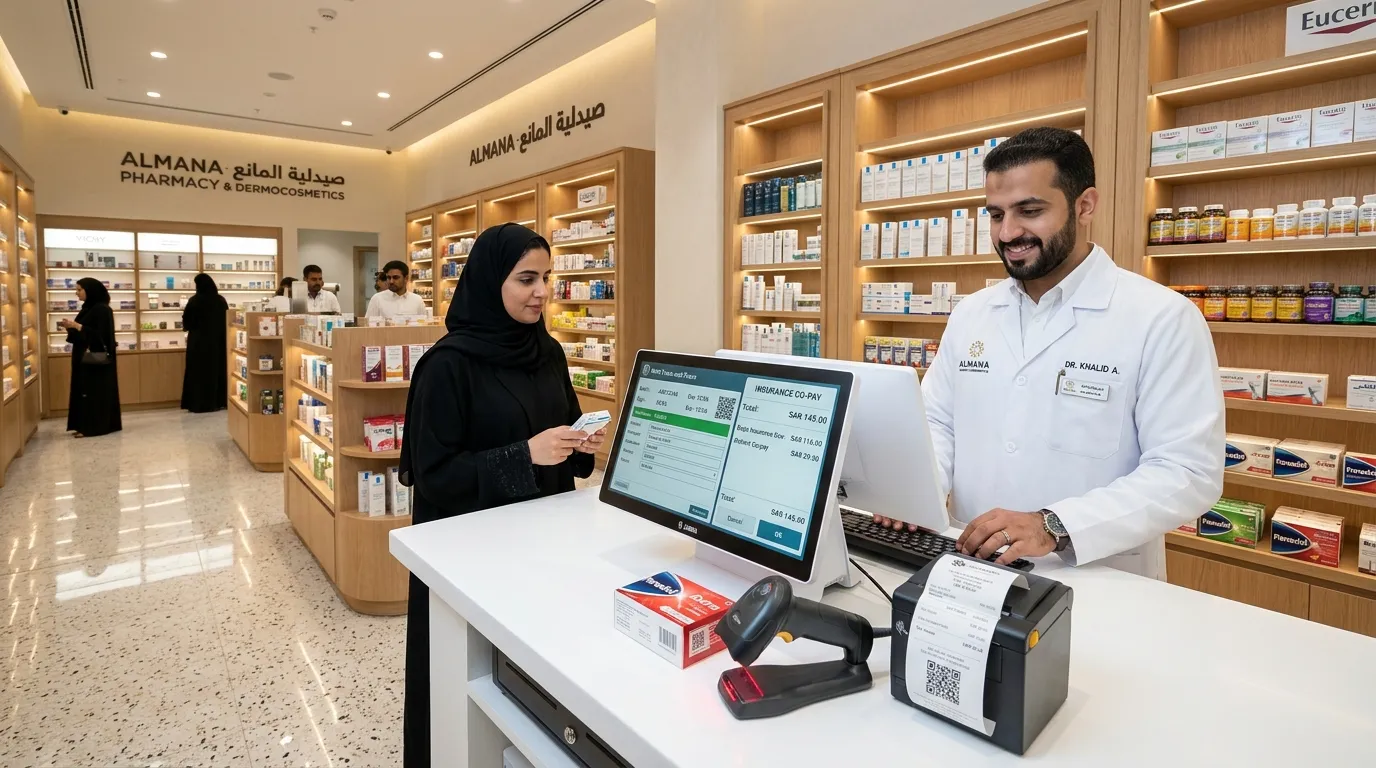
- Automated Split-Tender Settlement: When the items are scanned, the POS automatically splits the financial transaction into two distinct ledger postings:
- Patient Share (Out-of-Pocket): Calculated instantly with statutory deductible caps applied, payable via cash, credit card, or mada.
- Payor Share (Accounts Receivable): Transferred automatically to the specific insurance company subsidiary ledger (e.g., Bupa Arabia, Tawuniya, Medgulf), complete with the electronic authorization reference code.
- Real-Time Dispensing Feedback: If a specific drug is rejected by the payor rules engine (for instance, an un-prescribed cosmetic skin wash), the POS highlights the line in red and notifies the pharmacist before the customer leaves the counter. The pharmacist can instantly offer the customer the option to purchase the non-covered item as a direct private retail transaction, completely preventing unrecoverable bad debt.
The Mixed-Tax Cart Challenge: 0% vs 15% VAT Under ZATCA Phase 2
One of the most complex accounting obligations facing Saudi community pharmacies is managing mixed-tax shopping carts under ZATCA Phase 2 e-invoicing mandates.
A typical neighborhood pharmacy transaction frequently looks like this:
| Item Description | Category | Regulatory Status | Statutory VAT Rate |
|---|---|---|---|
| Augmentin 1g Tablets (14s) | Prescription Antibiotic | SFDA Registered Medicine | 0% (Zero-Rated) |
| Glucophage 500mg (50s) | Chronic Diabetic Medication | SFDA Registered Medicine | 0% (Zero-Rated) |
| La Roche-Posay Anthelios SPF50 | Dermocosmetic Sunscreen | General Cosmetic / Skincare | 15% (Standard Rate) |
| Oral-B Electric Toothbrush Refills | Personal Oral Hygiene | General Consumer Good | 15% (Standard Rate) |
If your point of sale treats the entire basket as a uniform transaction, you face an audit trap:
- If the cashier applies 15% VAT to the entire bill, you are illegally overcharging the customer on life-saving prescription medicines, violating SFDA consumer protection rules.
- If the cashier marks the bill as tax-exempt because it contains prescription drugs, the pharmacy under-declares 15% VAT on the cosmetic and hygiene items, triggering automatic ZATCA audit flags, tax evasion fines, and penalty interest.
Integrated Line-Item Tax Calculation in WaslaSoft
WaslaSoft eliminates this risk by binding tax classification directly to the central master product database:
- Automated Tax Code Assignment: Every pharmaceutical product imported via SFDA official drug lists is permanently coded with Tax Category Z (Zero-Rated, Reason Code VATEX-SA-32 for qualified medical products). All non-pharmaceutical merchandise is hardcoded with Tax Category S (Standard 15% Rate).
- Dual-Base Invoice Printing: When the receipt generates, the thermal printer prints a certified ZATCA Phase 2 electronic invoice that clearly breaks down:
- Total Zero-Rated Taxable Base (0%): SAR 88.50 (VAT: SAR 0.00)
- Total Standard Taxable Base (15%): SAR 210.00 (VAT: SAR 31.50)
- Gross Invoice Total: SAR 330.00
- Cryptographic QR Compliance: The printed QR code embeds all mandatory Phase 2 TLV tags, ensuring that when a customer or ZATCA field inspector scans the receipt using the official ZATCA mobile verification app, the split tax bases validate without discrepancy.
Practical Implementation Checklist for Gulf Pharmacy Operators
To transform your community pharmacy or retail drugstore chain into a leak-proof, fully compliant retail dispensary, follow this phased operational checklist:
Hardware Standardization:
- Equip every dispensary counter with high-speed 2D area-imager barcode scanners capable of reading high-density GS1 DataMatrix codes off curved vials, shiny blister packs, and metallic foils in low light.
- Deploy customer-facing dual screens so patients can verify prescription names, quantities, and their calculated insurance co-payment before payment processing.
Master Catalog & Tax Classification Audit:
- Cleanse your local item database against the official SFDA registered pharmaceutical registry. Ensure every prescription drug is linked to its verified GTIN and locked to 0% VAT.
- Audit all front-of-shop categories (dermocosmetics, sports nutrition, organic snacks, personal care) to verify that the standard 15% VAT rate is strictly enforced.
Establish FEFO Shelf Discipline:
- Enforce First-Expiry, First-Out physical shelf rotation during daily restocking. Never place new delivery shipments in front of existing dispensary stock.
- Configure WaslaSoft to display warning prompts whenever a cashier attempts to dispense a batch that is not the oldest active batch on hand.
Activate Automated Vendor Return Trays:
- Set up automated rolling return alerts at T-180, T-120, and T-90 days prior to expiration.
- Schedule weekly vendor return runs where stock clerks pull items flagged in the T-120 tray, print electronic debit note manifests, and dispatch them to distributor sales reps before return deadlines expire.
Integrate NPHIES Insurance Clearing:
- Eliminate standalone insurer portal tabs. Route all insurance eligibility checks, formulary rules, and deductible calculations directly through WaslaSoft's unified API engine to prevent non-reimbursable claims.
The Bottom Line: Protecting Healthcare Margins with Purpose-Built Retail Tech
A community pharmacy is a vital neighborhood healthcare anchor. Your pharmacists should spend their consultation hours explaining dosage regimens, checking drug-drug interactions, and building patient trust—not battling disjointed web portals, manually calculating insurance deductibles, or hunting for expired ampoules buried behind storage drawers.
By replacing disconnected legacy cash registers with an enterprise pharmacy POS architecture that combines automated SFDA RSD 2D scanning, automated distributor expiry return gates, real-time NPHIES split billing, and ZATCA Phase 2 mixed-tax compliance, you protect your bottom line while delivering an uncompromised standard of patient care.
Explore how WaslaSoft Retail POS and WaslaSoft Multi-Branch ERP help community pharmacies and retail healthcare chains across Saudi Arabia, the UAE, and Oman eliminate inventory shrinkage and achieve flawless compliance. Schedule a consultation with our healthcare systems team today.