If your refrigerated delivery van drivers are still writing manual paper credit notes for rejected milk, cheese, or frozen poultry at the supermarket receiving dock, you are bleeding between 4% and 7% of your gross monthly distribution revenue into untraceable food spoilage write-offs.
At 1:15 PM on a blazing August afternoon in an industrial logistics park outside Riyadh, the ambient asphalt temperature is 49°C. A refrigerated medium-duty delivery van pulls up to the concrete receiving bay of a major hypermarket. The driver cuts the engine, steps out into the dry heat, and swings open the rear insulated barn doors to unload sixteen cartons of fresh vacuum-packed poultry and forty crates of pasteurized yogurt.
The supermarket receiving clerk steps forward holding an infrared laser thermometer and a calibrated stainless steel probe. He points the laser at the surface of the top poultry carton.
The digital display reads: +7.8°C.
The receiving clerk immediately crosses his arms. "The maximum legal limit for fresh chicken under Saudi Food and Drug Authority rules is +4.0°C. Your van is warm. I am rejecting the entire delivery."
The driver panics. He argues that the cooling unit was running all morning, that he was stuck in traffic on the Northern Ring Road for forty minutes, and that opening the doors at six previous grocery stops let the cold air out. The receiving clerk does not care. He refuses to sign the delivery manifest, hands back the goods, and demands an immediate credit note.
The driver loads the warming chicken back into the cargo bay, pulls out a carbon-copy paper receipt book, scribbles a manual return note for SAR 6,400, and drives off. For the next four hours, those perishable cartons sit in the back of the van under the afternoon sun while the driver finishes his route. By the time the vehicle returns to the central distribution depot at 6:00 PM, the poultry is warm, sour, and completely unsellable. The warehouse manager has no choice but to throw the entire load into the bio-waste incinerator.
This expensive disaster plays out every single day across thousands of cold-chain delivery routes in Saudi Arabia, the UAE, and the wider GCC. It drains distributor profit margins, damages retailer relationships, and exposes wholesale businesses to heavy regulatory fines.
In this practical guide, we examine why manual cold-chain route accounting fails in extreme desert climates, how wireless Bluetooth temperature telemetry integrates with mobile point of sale devices, and how structured digital Return Merchandise Authorization (RMA) workflows permanently eliminate unverified credit note write-offs.
The Three Costly Pitfalls of Gulf Cold-Chain Van Distribution
Direct Store Delivery (DSD) of perishable food products in the Gulf is one of the most operationally demanding logistics environments on earth. Operating under extreme ambient heat while making dozens of daily retail stops creates three structural vulnerabilities that traditional paper accounting cannot control.
1. The "Thirty Door Openings" Temperature Spike
A standard urban delivery route in Riyadh, Jeddah, or Dubai requires a driver to complete between 25 and 35 delivery drops during an eight-hour shift.
Every time the driver arrives at a neighborhood grocery store (Baqala) or supermarket, the rear insulated doors of the van are opened for three to seven minutes while goods are sorted, counted, and wheeled into the store. In 45°C ambient summer heat, cold air dumps out of the cargo bay in seconds, replaced by blistering desert air.
Even if the vehicle's secondary refrigeration compressor (such as Carrier or Thermo King) is functioning properly, the cooling cycle takes fifteen to twenty minutes to pull the compartment temperature back down to the target 2°C to 4°C. When drops are spaced ten minutes apart in dense urban traffic, the cargo compartment never recovers its setpoint temperature. Product core temperatures slowly creep upwards, until a strict receiving clerk at Stop #18 rejects the entire shipment.
2. The Unverified Doorstep Credit Note Bleed
When a retail store rejects products due to temperature, near-expiry dates, or packaging damage, how does the transaction get recorded?
In manual fleets, the driver pulls out a paper return pad and writes a handwritten credit note. This creates severe operational loopholes:
- Sweetheart Returns: Drivers issue unofficial credit notes to friendly store managers for products that were actually damaged inside the store's own display coolers, absorbing retail customer damage onto the distributor’s books.
- Phantom Shortages: Store receivers claim they received 18 crates instead of the 20 listed on the invoice. Without digital barcode scanning at the tailgate, the driver writes an unverified shortage credit slip just to get the receiving clerk's signature.
- The Evening Depot Mystery: When the driver returns to the central warehouse at sunset with twenty crushed or warm crates, the warehouse receiving team has no way of verifying whether the goods were rejected at 9:00 AM or 4:00 PM, whether the packaging was torn by the driver's rough handling, or whether the cooling unit failed mid-route.
In our fleet benchmarks across FMCG distributors in Saudi Arabia, unmanaged paper returns bleed an average of 4.5% to 7.2% of gross route revenue into unverified damage write-offs every month.
3. Aggressive SFDA & TGA Regulatory Mandates
Food transport in the Kingdom of Saudi Arabia is heavily regulated by two powerful government entities:
- The Saudi Food and Drug Authority (SFDA - هيئة الغذاء والدواء): Enforces mandatory biological food safety thresholds, product temperature logging, and cold-chain integrity from farm to retail shelf.
- The Transport General Authority (TGA - الهيئة العامة للنقل): Mandates that all commercial refrigerated transport vehicles link to the national tracking platform (Wasl) and maintain verified temperature datalogging telemetry.
Operating non-compliant vehicles or delivering temperature-compromised food exposes distributors to on-the-spot regulatory fines ranging from SAR 5,000 to SAR 20,000 per vehicle, impoundment of delivery trucks, and cancellation of commercial transport operating licenses.
Field Implementation Case Study: 28-Van Chilled Dairy & Poultry Fleet (Riyadh & Al-Kharj)
To understand how automated cold-chain software resolves these vulnerabilities, examine our deployment for a prominent regional distributor managing twenty-eight refrigerated delivery vans servicing over 850 supermarkets, hypermarkets, and institutional catering kitchens across Riyadh and the Al-Kharj agricultural corridor.
The Starting Baseline
The distributor operated modern refrigerated Mercedes-Benz and Isuzu light-duty trucks, but their route sales system relied on standalone vehicle GPS trackers and manual paper invoicing books.
The operational pain points were threatening business viability:
- Damaged & Spoiled Product Losses: The company absorbed an average of SAR 46,200 monthly in spoiled product write-offs and customer dispute deductions.
- High Return Rate: Product return credit notes represented 5.8% of gross sales, eating up over a third of the company's net operating margin.
- Receiving Bay Delays: Drivers spent an average of 26 minutes per stop arguing with supermarket receiving clerks over temperature readings, manual paper manifests, and stamp authorizations.
- Regulatory Penalties: The fleet had received two formal non-compliance warnings from municipal and SFDA field inspection patrols regarding uncalibrated vehicle temperature logs.
The WaslaSoft Architecture
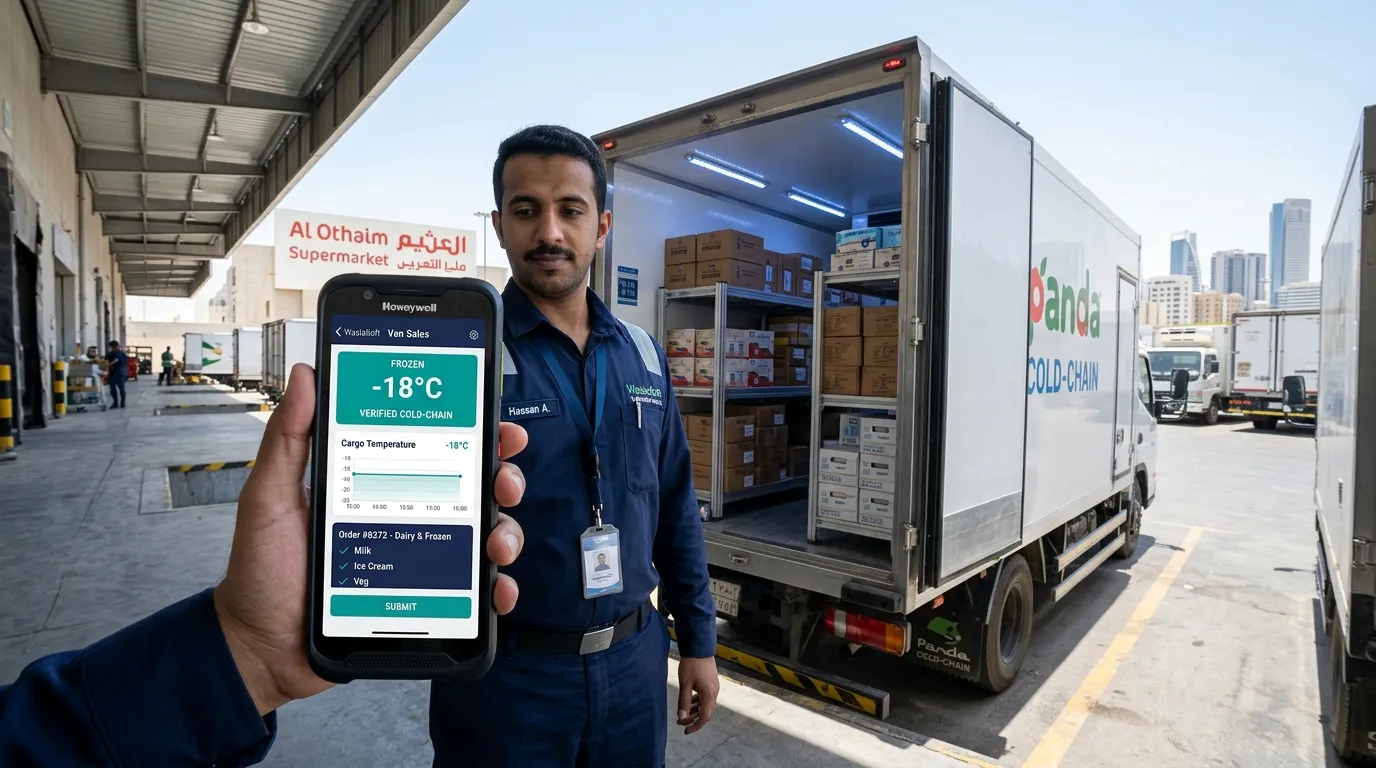
We deployed WaslaSoft Van Sales & Mobile Route Accounting POS across all twenty-eight vehicles, paired with Honeywell rugged Android mobile terminals, portable Bluetooth thermal belt printers, and onboard Bluetooth temperature dataloggers:
- Continuous Bluetooth Cold-Chain Telemetry: Wireless low-energy Bluetooth temperature beacons installed inside the cargo bay broadcast live temperature and humidity readings directly to the driver's Android handheld terminal every thirty seconds.
- Temperature-Stamped ZATCA Tax Invoices: When the driver completes a delivery and prints a ZATCA Phase 2 tax invoice, the system automatically imprints the exact real-time cargo temperature onto the printed thermal receipt and digital invoice metadata.
- Mandatory Photo-Documented Return Authorization (RMA): Drivers cannot issue a credit note for damaged or rejected stock without scanning the specific crate barcode and photographing the damaged product package on the mobile screen.
- Real-Time Supervisor Approval Gate: Credit note requests exceeding SAR 500 automatically alert the route sales supervisor via mobile notification for instant one-click approval before the driver can finalize the transaction.
Van Sales Perishable Delivery: Manual Paper vs. WaslaSoft Cold-Chain Telemetry:
• Old Manual Workflow:
Van Arrives at Receiving Bay → Clerk Questions Cargo Temperature → Disputed Manual Thermometer Readings → Driver Scribbles Handwritten Credit Note → Rejected Food Heats in Van for 5 Hours → SAR 46,200 Monthly Loss
(Bay Dwell Time: 26 Minutes | Return Rate: 5.8% | Audit Dispute Risk: Extreme)• WaslaSoft Cold-Chain POS Integration:
Continuous Bluetooth Telemetry → Delivery Invoice Auto-Imprints Verified Compartment Temperature (-18°C / +3°C) → Clerk Inspects Instant Digital Manifest → Photo-Verified Damage RMA in Under 6 Minutes
(Bay Dwell Time: 6 Minutes | Return Rate: 0.7% | Audit Dispute Risk: Zero)
What Went Wrong: The Al-Diriyah Frozen Chicken Nugget Thaw
Real technology rollouts in demanding logistics environments must survive physical stress. Documenting what failed during our second week of live field testing in Riyadh illustrates why software rules must account for human operational realities.
During the second week of testing, ambient temperatures in Riyadh touched 48°C. Three delivery vans were assigned to service an extended route through the historic Al-Diriyah district, covering dozens of traditional small-format grocery stores (Baqalas) along narrow residential streets.
To complete twenty-eight drops before afternoon prayer, the driver of Van #14 began propping the rear cargo door partially open with an empty plastic crate between closely spaced stops, avoiding the physical effort of unlatching the heavy insulated handles every two minutes.
Inside the cargo bay sat twelve commercial cartons of frozen breaded chicken nuggets valued at SAR 12,000, destined for a major hypermarket at the end of the route.
Because the doors were left cracked open in the desert heat, the cargo bay temperature climbed from its setpoint of -18°C up to -8.5°C over ninety minutes. The frozen nuggets did not completely liquefy, but the breading softened, and interior condensation formed inside the transparent inner bags.
When the van finally backed into the hypermarket receiving dock at 1:45 PM, the receiving supervisor inserted a digital needle probe into the core of the center carton.
The reading was -7.2°C—far above the mandatory -18°C frozen threshold.
The hypermarket supervisor immediately rejected the entire SAR 12,000 consignment. The driver, terrified of reporting the incident to management, printed a manual paper credit slip, reloaded the cartons, and drove back to the central depot at 5:30 PM. By that time, the chicken had fully thawed and begun fermenting in the summer heat. The entire SAR 12,000 shipment was condemned and hauled to the city dump.
How We Solved the Crisis Permanently
Our logistics engineering team implemented two automated procedural and software fail-safes that night:
- Real-Time Handheld Temperature Threshold Alarms: We updated the WaslaSoft driver application so that if the cargo compartment temperature rises above safe operating thresholds (above +4°C for chilled or above -15°C for frozen) for more than six consecutive minutes, the driver’s handheld terminal sounds an aggressive, high-decibel audible alarm and locks the screen with a full-screen red warning banner: "CRITICAL TEMPERATURE BREACH: Cargo Compartment Above Safe Limits. Close Doors and Inspect Cooling Unit."
- Immediate Head-Office Spoilage Escalation: If an alarm remains unaddressed for more than twelve minutes, an automated SMS alert transmits to the central fleet dispatcher and route supervisor with the vehicle's exact GPS coordinates, allowing dispatchers to call the driver immediately and redirect the van to the nearest commercial cold storage facility before product core temperatures suffer irreversible damage.
- Tailgate Door-Contact Sensor Linkage: We installed magnetic door-contact sensors linked to the Bluetooth datalogger, recording the exact timestamp and duration of every single door opening. If a driver leaves the cargo doors propped open while the vehicle is stationary, the event is permanently flagged on the supervisor’s route audit report.
Since these automated telemetry alarms and door-contact sensors were deployed, not a single cargo temperature breach has gone uncorrected, and bulk temperature rejections across the 28-van fleet dropped to zero.
Four Operational Pillars of Zero-Loss Cold-Chain Distribution
To scale a fresh or frozen food distribution business profitably in the GCC, management must enforce four non-negotiable operational controls:
1. Proof-of-Temperature Documentation on Invoices
Under commercial contracting law, the moment a retailer signs an invoice and receives goods into their store, liability transfers from the distributor to the retailer.
If a retail store's display cooler breaks down twelve hours after delivery and forty cartons of yogurt spoil, a dishonest store owner will often attempt to claim the distributor delivered spoiled goods.
WaslaSoft closes this legal vulnerability:
- The Bluetooth datalogger records continuous ambient temperature readings inside the truck.
- When the driver prints the delivery receipt on the portable thermal belt printer, the invoice automatically prints the official temperature record: "Verified Cargo Temp at Delivery: +2.8°C (Compliant)."
- The store receiver signs the delivery manifest acknowledging both the quantity received and the verified arrival temperature, terminating distributor liability the moment the van drives away.
2. Tailgate Photo-Verification of Damaged Stock (RMA)
Damaged packaging claims (crushed boxes, leaking containers, broken seals) are a primary source of shrinkage. In traditional fleets, drivers accept customer claims verbally and promise to "adjust it on the next invoice."
WaslaSoft enforces a strict digital Return Merchandise Authorization (RMA) workflow:
- The driver cannot create a credit note without opening the camera tool on the handheld terminal.
- The driver must take a high-resolution photo of the damaged carton showing the visible defect and the printed batch production code.
- The photo, timestamp, and GPS coordinates upload immediately to the central office portal. If a store clerk claims twelve cartons of cream were crushed, but the photo shows only two leaking containers, the credit note is instantly corrected before payment settlement.
3. Real-Time Vehicle Inventory Re-Balancing
When deliveries are rejected or modified mid-route, what happens to the truck inventory?
In disconnected fleets, truck inventory becomes a fictional number by midday. Drivers make off-the-books stock swaps between customers, creating inventory chaos that takes hours to untangle at evening depot check-in.
WaslaSoft maintains live, real-time perpetual truck inventory:
- If a supermarket rejects five cartons of cheese, those five cartons are immediately re-entered into the van's active available-to-sell inventory.
- If the driver visits another supermarket three stops later that needs five extra cartons, the driver can sell and invoice those items legally on the spot.
- At the end of the shift, the evening depot reconciliation matches Loaded Stock minus Delivered Invoices plus Authorized Returns down to the individual barcode in under ten minutes.
4. ZATCA Phase 2 Electronic Credit Note Compliance at the Doorstep
Under Saudi ZATCA electronic invoicing regulations, generating credit notes for returned goods requires strict compliance:
- Every credit note must reference the original tax invoice number and date.
- The credit note must contain its own unique cryptographic stamp and sequential UUID index.
- The document must embed the certified 9-tag QR code containing the seller VAT number, timestamp, and adjusted tax amounts.
WaslaSoft automates this entire regulatory burden at the customer tailgate. The driver simply selects the original invoice from the customer’s purchase history on the handheld screen. The system auto-populates all ZATCA metadata, generates the cryptographic hash chain, and prints the fully certified electronic credit note in seconds.
Measurable Results After 90 Days
After operating WaslaSoft Van Sales with integrated cold-chain datalogging across all twenty-eight vehicles for three months, the operational and financial impact transformed the business:
| Fleet Distribution Metric | Before WaslaSoft | With WaslaSoft Cold-Chain POS | Net Business Impact |
|---|---|---|---|
| Damaged & Spoiled Return Losses | SAR 46,200 / month | SAR 7,700 / month | Saved SAR 38,500 monthly across 28 vans |
| Product Return Credit Note Rate | 5.8% of gross sales | 0.7% of gross sales | 88% reduction in return deductions |
| Receiving Bay Dwell Time | 26 minutes per stop | 6 minutes per stop | Vans complete 4 additional stops daily |
| Tailgate Temperature Disputes | 18 disputes per week | Zero undetected disputes | Verified temperature on invoice receipts |
| Evening Depot Gate Clearance | 1 hour 45 minutes / van | 10 minutes per van | Immediate 3-way inventory reconciliation |
| SFDA Cold-Chain Inspection Audits | 2 warning citations | 100% clean audit pass rate | Full regulatory compliance protection |
For businesses operating multi-branch supermarket chains, meat markets, or central commissary kitchens, explore our specialized guides on stopping weighing scale barcode fraud in butcheries and roasteries and our comprehensive manual on eliminating recipe yield variance in central bakery commissaries.
5 Practical Steps to Secure Your Cold-Chain Van Sales Fleet
- Install Wireless Bluetooth Dataloggers in Every Cargo Bay: Discontinue reliance on dashboard gauges that display cooling compressor settings rather than actual cargo air temperatures. Install calibrated Bluetooth beacons positioned near the rear doors where heat ingress is highest.
- Imprint Arrival Temperature on Every Customer Receipt: Configure your mobile POS software to automatically read the Bluetooth sensor and print the verified compartment temperature on the customer delivery invoice to terminate liability at the door.
- Mandate Tailgate Photo Evidence for Damaged Returns: Prohibit drivers from issuing credit notes without photographing the damaged packaging and scanning the batch barcode on their mobile terminals.
- Enforce Door-Open Duration Threshold Alarms: Program driver handheld terminals to sound an audible alert if the cargo doors remain open for more than five minutes or if the bay temperature climbs above statutory thresholds.
- Conduct Instant 3-Way Reconciliations at the Depot Gate: Every evening, match Loaded Stock against Delivered Invoices and Physically Returned Crates before drivers leave the facility. Never let inventory discrepancies roll over to the next morning.
Final Verdict
Operating a refrigerated van distribution fleet in the extreme heat of the Gulf is a relentless test of mechanical discipline and inventory control.
Allowing drivers to navigate routes with uncalibrated cooling units, handwritten paper receipt pads, and unverified return credit notes is a financial hemorrhage that erodes your hardest-won distribution margins. By equipping your fleet with real-time Bluetooth cold-chain telemetry, automated invoice temperature stamping, and photo-verified digital credit note workflows, you eliminate spoiled product losses, protect your company against regulatory fines, and build a trusted distribution brand that tier-one retailers rely on every single day.