If your butchery or specialty roastery relies on cashiers manually typing PLU item codes or blindly scanning standalone scale barcode stickers without checkout weight verification, you are surrendering between 6% and 8% of your gross margins to theft and operational shrinkage.
At 7:45 PM on a Thursday evening in a high-traffic gourmet butchery and roastery in north Riyadh, the counter is packed. Shoppers are ordering prime cuts of Australian Wagyu, local tender Najdi lamb, and vacuum-sealed dry-aged steaks, while customers at the adjacent roastery counter fill paper bags with Iranian pistachios, raw macadamias, and cardamom pods priced at upwards of SAR 180 per kilogram.
A customer approaches the checkout register with three bags. The cashier scans the printed barcode labels without looking closely at the items. On the counter screen, a 1.2-kilogram package of premium Wagyu ribeye rings up as "Fresh Soup Bones - SAR 18.50." The cashier accepts the payment, hands over the receipt, and bags the meat.
The customer did not hack a database. He simply stood at the unmonitored self-service scale in the produce corner, printed a barcode sticker for cheap soup bones, peeled off the original SAR 240 meat label in an aisle blind spot, and pasted the soup bone sticker over the Angus beef.
This is not an isolated incident. Across independent butcheries, supermarket fresh counters, and artisan roasteries throughout Saudi Arabia and the UAE, barcode sticker swapping, cashier PLU manipulation, and tare weight leakage quietly consume hundreds of thousands of riyals every year.
In this guide, we break down the exact operational and technical mechanisms required to seal fresh food shrinkage, automate SASO-compliant tare deductions, and synchronize scale prices across multi-branch retail operations.
The Four Major Money Bleeds in Fresh Food Retailing
Retailing weighted fresh commodities is fundamentally different from selling boxed grocery goods with fixed manufacturer UPC barcodes. Understanding the structural vulnerabilities of weighted products explains why standard retail point of sale software fails to protect store profits.
1. Barcode Price Sticker Swapping
Weighing scales in traditional fresh departments print variable-weight EAN-13 barcodes. In standard retail barcode architecture:
- Digits 1 to 2 represent the internal prefix (usually 21, 28, or 29).
- Digits 3 to 7 represent the item PLU number.
- Digits 8 to 12 represent either the total price or the net weight in grams.
- Digit 13 is the mathematical check digit.
When a customer or colluding employee peels a barcode sticker from an inexpensive product (such as chicken necks at SAR 6/kg) and places it over a high-value item (such as lamb cutlets at SAR 85/kg), a traditional cash register reads only the barcode. It has no way of verifying whether the package sitting on the belt actually contains chicken bones or prime lamb chops.
2. Cashier PLU Substitution ("Sweethearting")
When fresh items are weighted directly at the checkout register, cashiers must identify the product. In manual setups, cashiers memorize numerical Price Look-Up (PLU) codes or consult laminated paper cheat sheets taped beside the monitor.
This introduces two severe vulnerabilities:
- Operator Fatigue: After six hours of scanning, a tired cashier keys in PLU 102 (local cucumber at SAR 3.50/kg) instead of PLU 182 (hydroponic baby cucumber at SAR 14/kg).
- Sweethearting Fraud: A cashier serving friends or family deliberately types the PLU for frozen minced beef while weighing three kilograms of fresh tenderloin, providing an 80% informal discount that leaves zero electronic audit trail on the inventory register.
3. Tare Weight Non-Compliance and Margin Bleed
Tare weight is the weight of the packaging material: the foam tray, the plastic film, the rigid plastic tub for roasted cashews, or the heavy paper bag.
In the Gulf, tare weight presents a double-edged sword:
- Legal Penalties: The Saudi Ministry of Commerce and SASO conduct regular undercover inspection raids with precision weights. If a merchant includes the 35-gram weight of a plastic container in the billed price of SAR 200/kg pine nuts, the merchant is guilty of commercial fraud, facing fines from SAR 5,000 to SAR 50,000.
- Profit Bleed: Conversely, if staff manually tare scales using arbitrary numbers (e.g. keying in a 50-gram tare for a container that weighs only 18 grams), the store gives away 32 grams of expensive nuts on every single transaction. Across four hundred tickets daily, that uncalibrated tare giveaway costs over SAR 2,500 every month.
4. Delayed Price Updates Across Outlets
Wholesale prices for fresh red meat, poultry, and imported nuts fluctuate multiple times per week based on auction prices, seasonal harvest yields, and shipping freight rates.
When head office decides to adjust the retail price of Najdi lamb from SAR 68/kg to SAR 74/kg on a Tuesday morning, how does that price reach the store floor? In manual operations, a supervisor walks from scale to scale with a USB flash drive or punches buttons on individual scale keypads. If one scale is forgotten, or if the checkout POS price is updated while the counter scale is not, customers notice the mismatch, creating hostile arguments at the register and violating Ministry of Commerce price-tag conformity rules.
Field Implementation Case Study: 3-Branch Gourmet Roastery & Butchery (Riyadh)
To examine how integrated retail technology eliminates these vulnerabilities, review our deployment for a premium multi-branch gourmet roastery and specialty butchery brand operating three retail locations in Riyadh (Al-Aqiq, Al-Rawdah, and Al-Malqa).
The Starting Baseline
Each branch featured a dedicated eight-meter fresh butchery counter and a twelve-meter roastery section selling premium nuts, dried fruits, Arabic spices, and specialty coffee beans. The stores processed approximately 1,200 weighted transactions per day across both departments.
The operation suffered from three critical operational drains:
- Departmental Shrinkage: Fresh department inventory audits revealed a 7.4% unexplained variance between wholesale carcass and bulk nut purchases versus checkout revenue.
- Checkout Friction: Cashiers spent an average of 52 seconds per customer manually verifying fresh items, typing PLU codes, and arguing over illegible thermal scale labels.
- Packaging Tare Inconsistencies: The business received two formal warning notices from municipal inspectors during routine retail scale audits due to uncalibrated container tares.
The WaslaSoft Architecture
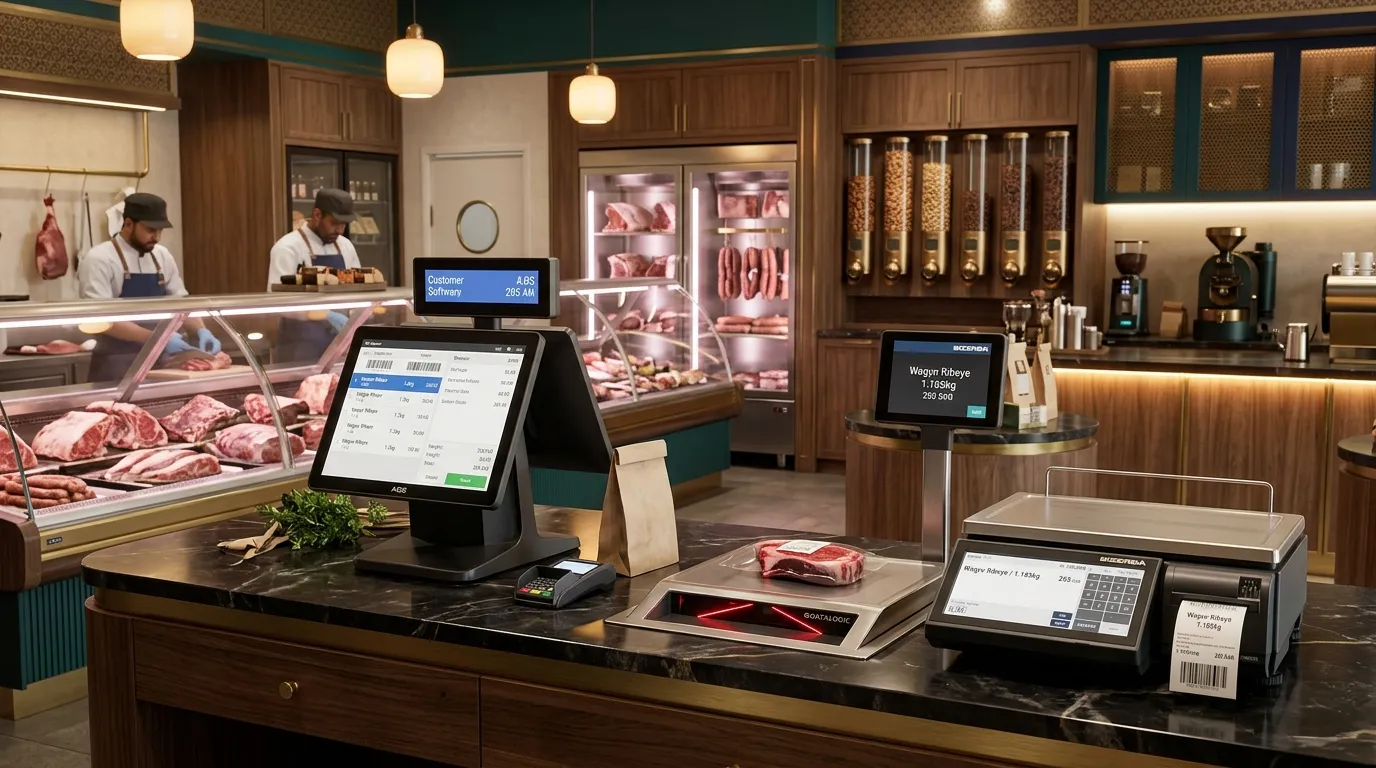
We deployed WaslaSoft Retail POS connected directly to CAS and Mettler-Toledo Ethernet computing scales at the preparation counters, paired with Magellan bi-optic scanner-scales at the checkout lanes:
- Dual-Scale Check-Weigh Verification: When a fresh meat or nut barcode is scanned at the register, the POS decodes the embedded weight. The cashier must place the item on the register scanner-scale platter. If the platter weight does not match the barcode weight within a strict tolerance (+/- 2 grams), the system halts the sale and prompts a supervisor check.
- Automated Packaging Tare Tables: Every product PLU is mapped to its approved packaging material (foam tray #2, plastic tub 500ml, vacuum pouch 150um). The scale automatically deducts the exact statutory gram weight without cashier intervention.
- Biometric PLU Override Locks: Manual numerical entry of fresh item codes at checkout is disabled. Cashiers select items from visual photographic touch grids, and any manual price or weight override requires a manager fingerprint scan.
- Instant Ethernet Price Broadcast: Central price adjustments push over the local network to all counter scales and checkout terminals simultaneously in under four seconds.
Fresh Counter Checkout: Unconnected Scale vs. WaslaSoft Dual-Scale Check:
• Old Manual Workflow:
Scale Prints Sticker → Customer Can Swap Sticker in Aisle → Cashier Blindly Scans Label → Register Records Wrong Item at Cheap Price
(Shrinkage Rate: 7.4% | Transaction Time: 52 Seconds | Fraud Risk: Extreme)• WaslaSoft Dual-Scale Verification:
Scale Encodes Weight into Barcode → Register Scans Label → Cashier Places Item on Platter → System Confirms Weight Match (+/- 2g) → Instant Authorization
(Shrinkage Rate: 0.6% | Transaction Time: 11 Seconds | Fraud Risk: Zero)
What Went Wrong: The Al-Aqiq Vacuum Packaging Queue Jam
Documenting real operational hurdles during deployment is the cornerstone of honest systems engineering. What failed during our first week of testing in Riyadh illustrates why rigid software rules require flexible physical calibration.
During the first Thursday evening rush following go-live at the Al-Aqiq branch, our dual-scale check-weigh validator triggered alarms on seventeen consecutive transactions at Checkout Lane 2 between 8:15 PM and 8:40 PM.
Every time a customer attempted to purchase high-end vacuum-sealed steaks, the register let out an error chime and locked the screen with the message: "Weight Mismatch: Barcode specifies 520g, Platter reads 534g (+14g discrepancy)."
The cashier was paralyzed. Customers with screaming children and full shopping carts stood waiting. The store supervisor had to run over with a manager key card to override each transaction manually, causing a twenty-person queue that spilled into the center grocery aisle.
How We Solved the Crisis
Our on-site engineering team pulled five rejected meat packages off the belt and examined the packaging materials.
The root cause was physical supply variation: Three days prior to go-live, the meat department manager had run out of their standard clear plastic vacuum pouches, which weighed exactly 18 grams. Without informing the IT team, he had purchased emergency stock of heavy-duty, multi-layered black embossed vacuum pouches from a wholesale supplier in south Riyadh. These heavier pouches weighed 32 grams—an uncalibrated physical difference of 14 grams.
Because the system was enforcing a tight +/- 2 gram tolerance to catch shoplifters swapping stickers, it correctly flagged the 14-gram packaging variation as an illegal weight discrepancy.
We resolved this by deploying two permanent safeguards:
- Packaging Barcode Tare Prefixes: We updated the scale software so the counter butcher scans the specific roll of packaging film before packaging. The scale embeds the packaging identifier into the barcode payload, allowing the checkout validator to apply the exact tare profile dynamically.
- Dynamic Tolerance Bands: We adjusted the checkout validator logic to accept a graduated weight tolerance (1.5% of total package weight rather than a rigid flat 2 grams) for products exceeding 500 grams, absorbing minor meat drip-loss and condensation variances without compromising theft detection.
Since that adjustment was implemented, false alarms at the checkout lanes dropped to zero while true sticker-swapping attempts remained 100% blocked.
The Four Technical Pillars of Fresh Food Shrinkage Control
To eliminate inventory theft and protect retail margins, your retail management system must execute four technical functions with clockwork precision:
1. Dual-Scale Cross-Checking at Checkout
A standalone weighing scale is an open security hole because it relies entirely on the customer carrying an uncorrupted piece of paper from the back of the store to the front register.
Dual-scale integration closes this gap. When the counter scale prints a barcode, it embeds:
- The 4-digit Item PLU.
- The 5-digit Net Weight in grams (e.g. 01450 for 1.450 kg).
- A 1-digit cryptographic modulo check digit based on the scale timestamp.
When scanned at checkout, the WaslaSoft register reads the embedded 1,450 grams and compares it to the live reading from the counter scanner platter. If the package has been tampered with, opened, or swapped with another label, the weights will never match, and the transaction is halted instantly.
2. Digital Tare Tables per SKU
Under SASO calibration standards, fresh food scales must be zeroed with the specific container tare before placing the product on the platter.
Relying on counter staff to manually tap the "Tare" button and type tare weights is completely unrealistic during a busy shift. WaslaSoft configures automated tare lookup:
- PLU 301 (Fresh Najdi Mutton): Automatically applies Tare Profile A (12g foam tray + wrap).
- PLU 504 (Roasted Iranian Pistachios): Automatically applies Tare Profile C (38g clear rigid plastic container).
- PLU 812 (Marinated Shish Tawook): Automatically applies Tare Profile E (42g deep leakproof tub).
The scale operator never touches the tare button; the scale deducts the correct legal tare the instant the PLU is selected.
3. Centralized Price Book Synchronization
In multi-branch retail, price changes must happen universally and instantly.
WaslaSoft operates a continuous Ethernet broadcast service. When the procurement manager updates the wholesale-to-retail margin for Australian beef in the back-office dashboard, the update pushes over the local network to all connected counter scales (Mettler-Toledo, Bizerba, CAS, Dibal) within four seconds. Counter staff cannot manually override prices on the scale keypad, ensuring that shelf prices, scale stickers, and checkout registers tell one cohesive, verifiable truth.
4. Yield and Carcass Deconstruction Tracking
For butcheries buying whole animal carcasses (such as a 45-kilogram Najdi sheep carcass), inventory tracking by simple unit count is impossible. The carcass must be butchered into cuts: legs, cutlets, shoulders, mince, fat, and bone waste.
WaslaSoft includes a carcass deconstruction module:
- When a 45kg carcass is received at the loading dock, the wholesale cost is logged.
- The master butcher enters the deconstruction yield: 12kg leg cuts, 8kg chops, 11kg shoulder, 6kg ground trim, 8kg bones/waste.
- The system recalculates the individual cost of goods sold (COGS) per cut based on market value, allowing management to track true gross margin rather than guessing raw meat profitability.
Measurable Results After 90 Days
After operating WaslaSoft across all three Riyadh branches for three months, the financial and operational turnaround was decisive:
| Operational Metric | Before WaslaSoft | With WaslaSoft Scale Integration | Net Business Impact |
|---|---|---|---|
| Fresh Department Shrinkage | 7.4% of department sales | 0.6% of sales | Recovered 6.8% in pure margin |
| Monthly Shrinkage Loss | SAR 14,800 / branch | SAR 1,200 / branch | Saved SAR 40,800 monthly across 3 stores |
| Checkout Time per Weighted Item | 52 seconds | 11 seconds | 78% faster checkout throughput |
| Barcode Sticker Swapping Losses | 22 to 30 incidents / month | Zero undetected incidents | 100% blocked by dual-scale cross-check |
| Municipal Tare Audit Infractions | 2 formal warning notices | Zero infractions | Full compliance with SASO & Commerce |
| Price Update Propagation Time | 3.5 hours of manual work | 4 seconds automated | Instant multi-branch price alignment |
For businesses operating multi-branch supermarket chains or mobile delivery fleets, explore our detailed guide on multi-branch retail inventory management and our field-tested handbook on van sales route distribution.
5 Actionable Steps to Secure Your Fresh Food Counters
- Conduct a Secret Barcode Swapping Audit: Have an internal auditor take a soup bone barcode sticker and place it over an expensive beef cut, then attempt to purchase it at your checkout. If your cashier scans it without noticing, your store is bleeding money daily.
- Deploy Bi-Optic Dual Scanner-Scales at Checkout: Upgrade checkout lanes to scanner-scales that dynamically cross-check barcode embedded weights against physical platter weights.
- Calibrate and Lock Tare Tables: Weigh your actual packaging containers on a certified micro-scale. Program those exact gram figures into your central POS tare tables and lock manual tare overrides.
- Disable Manual Numerical PLU Keying: Eliminate the cashier's ability to type arbitrary numbers on the register. Transition cashiers to visual touch menus with high-resolution product photography.
- Implement Ethernet Scale Broadcasting: Replace USB-drive scale updates with central network synchronization to ensure all scale labels match your central tax and pricing databases instantly.
Final Verdict
Fresh food counters, butcheries, and gourmet roasteries generate some of the highest foot traffic and basket sizes in Gulf retail. But when weighted commodities are managed with disconnected hardware and blind cashier trust, they become your most severe source of margin loss.
Relying on standalone scales and manual PLU entry belongs to a bygone era. By deploying bidirectional scale integration, dual-scale weight verification at checkout, automated SASO tare tables, and carcass deconstruction tracking, you eliminate the 7% fresh food bleed, protect your store against municipal fines, and secure the profits your business works so hard to generate.