
Ask any retail founder in Riyadh, Dubai, or Muscat about the happiest day of their professional career, and they will almost certainly say: The day we opened our first store.
Ask them about the most stressful year of their life, and the answer is just as predictable: The year we expanded to three branches.
There is a deceptive trap in modern retail. Running one successful boutique, electronics shop, perfume counter, or home decor showroom feels manageable. You are on the sales floor. You know your bestsellers by heart. You can look at a shelf and instantly know if two bottles of oud or three silk dresses are missing. Your staff can ask you questions directly.
Then you sign leases for Branch #2 in Jeddah and Branch #3 in Khobar.
Suddenly, you are no longer a shopkeeper; you are running a distributed supply chain company. And if your technology stack consists of generic cash registers, disconnected Excel spreadsheets, and frantic WhatsApp voice notes between store managers, your dream expansion quickly turns into an inventory nightmare.
In this practical, battle-tested 2026 guide, we strip away the corporate buzzwords and examine the real, unvarnished realities of multi-branch retail management across the GCC: how inventory actually leaks, why annual stocktakes are a dangerous trap, how to manage variants without driving staff crazy, and how high-performing retail brands scale without losing their sanity.
1. The Branch Multiplier Trap: Why Scaling Exposes Every Hidden Crack
When you operate one retail store, you have 1 inventory pool and 1 checkout counter.
When you scale to three stores and a central warehouse, you do not have 3x the complexity—you have 10x the complexity:
- The "Phantom Stock" Dilemma: A customer walks into your Riyadh Olaya boutique asking for a size 38 linen dress. Your computer screen says you have 2 in stock. Your sales associate searches the backroom for twenty embarrassing minutes while the customer waits, only to return empty-handed. Where did the two dresses go? Were they stolen? Sold under the wrong barcode? Transferred to the Mall of Arabia branch without paperwork?
- The Hoarding Phenomenon: Branch managers quickly learn which items are hot sellers. Without centralized controls, managers in high-traffic stores will quietly over-order and hoard popular inventory, while other branches lose sales because their shelves sit empty.
- The 3 AM Stocktake Nightmare: Store teams spend an entire Friday night with clipboards, counting hangers until their eyes blur. By Sunday morning, the physical count differs from the computer count by SAR 45,000, and nobody can pinpoint where the leak happened.
Scaling successfully requires accepting a fundamental truth: You cannot manage what you cannot track in real time.
2. The Myth of the Annual Stocktake: Why Micro-Cycle Counts Win
For decades, traditional retailers followed an exhausting ritual: once a year (or once a quarter), they closed their doors, paid overtime to exhausted staff, and counted every single item in the store.
Here is the brutal truth about annual stocktakes: They are financial autopsies.
By the time an annual stocktake tells you that 150 wireless headphones or 40 bottles of fragrance went missing, those items have been gone for eight months. The cashier who stole them resigned six months ago. The supplier who shorted your shipment is no longer answering emails. You cannot fix the past; you can only write off the loss against your net profit.
High-performing retail chains replace traumatic annual shutdowns with Daily Rolling Micro-Cycle Counts:
- Every morning before opening, the POS assigns a single category or shelf section to the opening supervisor (e.g., today: Men's Leather Wallets; tomorrow: Charging Cables; the day after: Silk Scarves).
- The staff member uses a handheld wireless barcode scanner to count just those 30 to 50 items. It takes less than 10 minutes.
- The system immediately flags variances between the physical count and the perpetual stock record.
- If a variance exists, management investigates that exact 24-hour window, reviewing shift logs and register audits while memory is fresh.
Within 60 days of implementing rolling cycle counts, unexplained inventory shrinkage drops by up to 75%.
3. Matrix Variants Without the Headache: Sizes, Colors, and Seasons
If you sell fashion, footwear, cosmetics, or lifestyle goods, your biggest daily operational headache is the Matrix Variant.
Consider a single women's abaya design. That single design comes in:
- 4 Sizes (52, 54, 56, 58)
- 3 Colors (Midnight Black, Forest Green, Sandstone)
- 2 Fabric Weights (Summer Crepe, Winter Wool)
That is 24 distinct SKU variations for one single dress.
In an amateur POS setup, the owner creates 24 separate items with long, confusing names. Cashiers inevitably scan whichever tag is closest, or manually pick the first item they see on the touchscreen. Over three months, your computer system reports that you have negative 50 Black Size 54 dresses and positive 60 Green Size 58 dresses, even though the total count is roughly correct.
How a Professional Matrix Engine Solves This
WaslaSoft organizes variants in a clean, visual parent-child hierarchy:
- One Parent Style: Master Item code, base retail price, and supplier info.
- The Dynamic Matrix Grid: Color on the vertical axis, Size on the horizontal axis.
- Distinct Barcode Aliases: Every individual size/color combination receives a unique EAN/UPC barcode that prints on thermal garment tags.
- Foolproof Checkout: The cashier simply scans the garment barcode. The system instantly deducts the exact size and color, records the correct margin, and updates the stock level across all branch dashboards.
4. The Art of Inter-Branch Transfers: No More Lost Shipments
Moving merchandise between branches is where inventory discrepancies explode. A typical scenario: Branch A packs two boxes for Branch B and hands them to a driver. A week later, Branch B claims they only received one box. Who is telling the truth?
To stop transfer leakage, high-performing retailers enforce a Closed-Loop 2-Step Transfer Protocol:
| Transfer Stage | Responsible Party | System Action in WaslaSoft |
|---|---|---|
| 1. Transfer Requisition | Branch B (Requesting) | Creates digital request based on low stock alerts |
| 2. Transfer Dispatch | Branch A (Sending) | Scans items into transfer box; items enter In-Transit state |
| 3. Physical Shipping | Internal Driver or Courier | Manifest printed with unique tracking barcode |
| 4. Transfer Reception | Branch B (Receiving) | Staff must physically scan every barcode to receive |
| 5. Variance Resolution | Operations Manager | Discrepancies generate instant alerts for investigation |
Items never simply disappear into a black hole. Until the receiving store scans each item, the stock remains accounted for under the transit ledger.
5. Trust vs. Verification: Controlling Cashier Shrinkage
Most retail employees are honest, hardworking individuals who want to do a good job. But when software lacks basic audit controls, temptation and bad habits thrive.
Over 70% of retail shrinkage does not walk out the front door in a shoplifter's bag; it trickles out at the cash register:
- Sweethearting: A cashier scans two items for an acquaintance, then slips three expensive items into the shopping bag without scanning them.
- Phantom Returns: A dishonest cashier finds a discarded customer receipt from the trash bin, initiates an item return on the system, and pockets the cash refund.
- Price Overriding: Staff manually alter a price from SAR 450 to SAR 250, charge the customer SAR 450 in cash, and pocket the SAR 200 difference.
The Antidote: Granular Role Permissions & Blind Closeouts
- Manager PIN Approvals: Item voids, transaction cancellations, and price edits require a supervisor PIN code with a mandatory reason selection (e.g., Damaged Packaging, Price Match Guarantee).
- Blind Shift Reconciliations: When cashiers finish their shift, they count their cash, card slips, and vouchers and type the totals into the POS. The screen does not show them what the computer expects. They cannot slip money into their pocket to match an artificially low balance.
- Time-Stamped Audit Trails: Every single button press, drawer opening, and discount application is logged with user ID, timestamp, and transaction number, creating an unshakeable culture of accountability.
6. The Boring Magic of Automated Purchase Orders (ROP)
Too many retail founders manage reordering by walking around the store with a coffee, looking at shelves, and trusting their gut feeling.
The result is always the same: Overstocking slow-moving dead capital while running out of cash to buy fast-selling bestsellers.
A modern retail ERP replaces guesswork with mathematical precision:
- Lead Time Tracking: How many days does it take between placing an order with your supplier in Italy or China and the goods arriving on your shelves in Riyadh? If lead time is 21 days, waiting until you have 3 items left guarantees a stockout.
- Safety Stock Thresholds: The minimum buffer stock needed to absorb sudden demand spikes during weekends or national holidays.
- The Reorder Point (ROP) Formula: Reorder Point = (Average Daily Sales × Lead Time in Days) + Safety Stock
- One-Click Supplier Purchase Orders: When stock reaches the ROP threshold, WaslaSoft automatically generates a draft purchase order for the authorized vendor, ready for manager approval.
7. Customer Loyalty That Actually Moves the Needle
Traditional loyalty punch cards fail because modern Gulf shoppers do not want to carry a dozen plastic cards in their wallet.
What works across Saudi Arabia, the UAE, and Oman is Zero-Friction Mobile Loyalty:
- Mobile Number Identification: At checkout, the cashier politely asks: May I have your mobile number for your digital receipt and loyalty rewards? Over 90% of customers happily agree.
- Tiered VIP Status: Customers automatically progress from Silver to Gold to Platinum based on lifetime spend, unlocking exclusive perks like private seasonal sales or complimentary tailoring.
- Instant SMS & WhatsApp Balance Notifications: Shoppers receive immediate confirmation of points earned and available cashback credit, prompting repeat visits.
- Integrated Customer History: When a VIP shopper visits any branch, the sales associate can see their size preferences, favorite brands, and past purchases, delivering a deeply personal luxury shopping experience.
8. Compliance as a Silent Background Asset: ZATCA Phase 2
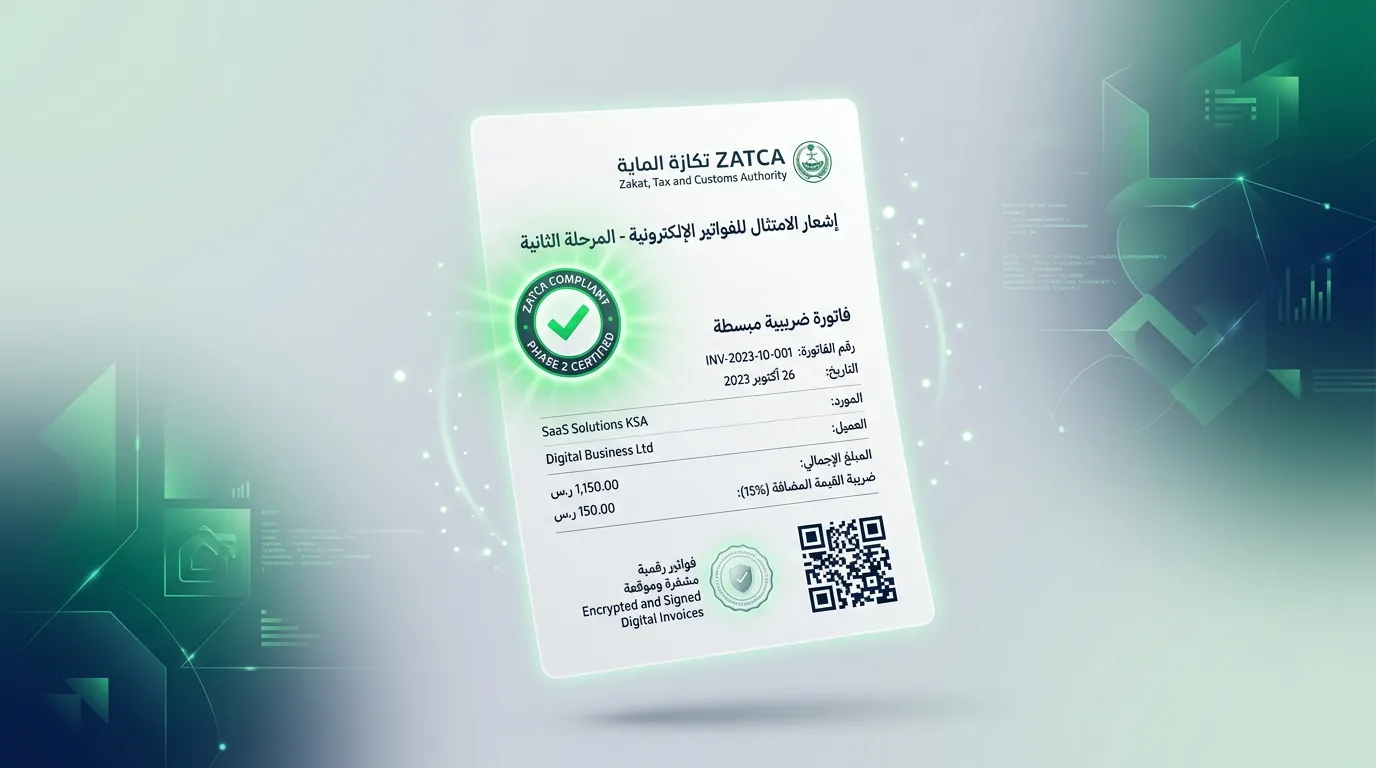
For retailers in Saudi Arabia, regulatory compliance under the Zakat, Tax and Customs Authority (ZATCA) is not an option—it is the law.
During a busy Saturday evening rush at a shopping mall, your cashiers cannot afford to wait for complex tax calculations. Every receipt must be a fully compliant Simplified Tax Invoice (B2C):
- Generated in under 0.8 seconds.
- Cryptographically signed using ECDSA secp256k1 algorithms.
- Formatted with a compliant 9-tag Base64 QR code that passes all official ZATCA scanning verifications.
- Transmitted reliably to the ZATCA Fatoora reporting portal within the statutory 24-hour window.
With WaslaSoft, compliance is not an extra task for your staff. The system handles all cryptographic stamping, hash chaining, and cloud reporting automatically in the background, allowing your team to focus 100% on serving shoppers.
9. The 7-Point Reality Check for Growing Retailers
Before you open your next branch, take an honest look at your current operational foundation:
- Can you see the exact stock balance of every branch from your phone right now?
- Do your variants (sizes and colors) have unique, scan-ready barcodes?
- Are inter-branch transfers tracked through a formal dispatch-and-receive verification?
- Do cashiers perform blind shift reconciliations at the end of every day?
- Do you conduct 10-minute micro-cycle counts instead of relying solely on annual audits?
- Does your POS keep selling and printing receipts even if the mall internet connection fails?
- Are all your invoices automatically compliant with ZATCA Phase 2 e-invoicing laws?
If you answered No to more than two of these questions, opening another branch will multiply your headaches, not your profits.
Conclusion: Build Your Retail Empire on Solid Ground
Expanding a retail brand across Saudi Arabia and the GCC is one of the most rewarding journeys in business. When your operations run smoothly, opening new stores accelerates your brand equity, multiplies your buying power with suppliers, and delivers immense financial rewards.
Don't let amateur cash registers, untracked inventory leaks, or chaotic spreadsheets stand between you and your growth potential.
With WaslaSoft Hybrid Retail POS & ERP, your inventory remains crystal-clear, your staff operate with complete accountability, and your business scales with effortless grace across 1, 5, or 50 locations.
Ready to Scale Your Retail Brand with Confidence?
See how WaslaSoft streamlines multi-branch inventory, variant management, and ZATCA compliance. Book your free personalized retail demonstration today and speak with our retail advisors in Riyadh and Jeddah.