If your hotel front desk clerk is still printing reams of room trial balances at 2:00 AM and cross-referencing restaurant paper chits on a desktop calculator, your property is bleeding revenue and courting municipal tax penalties.
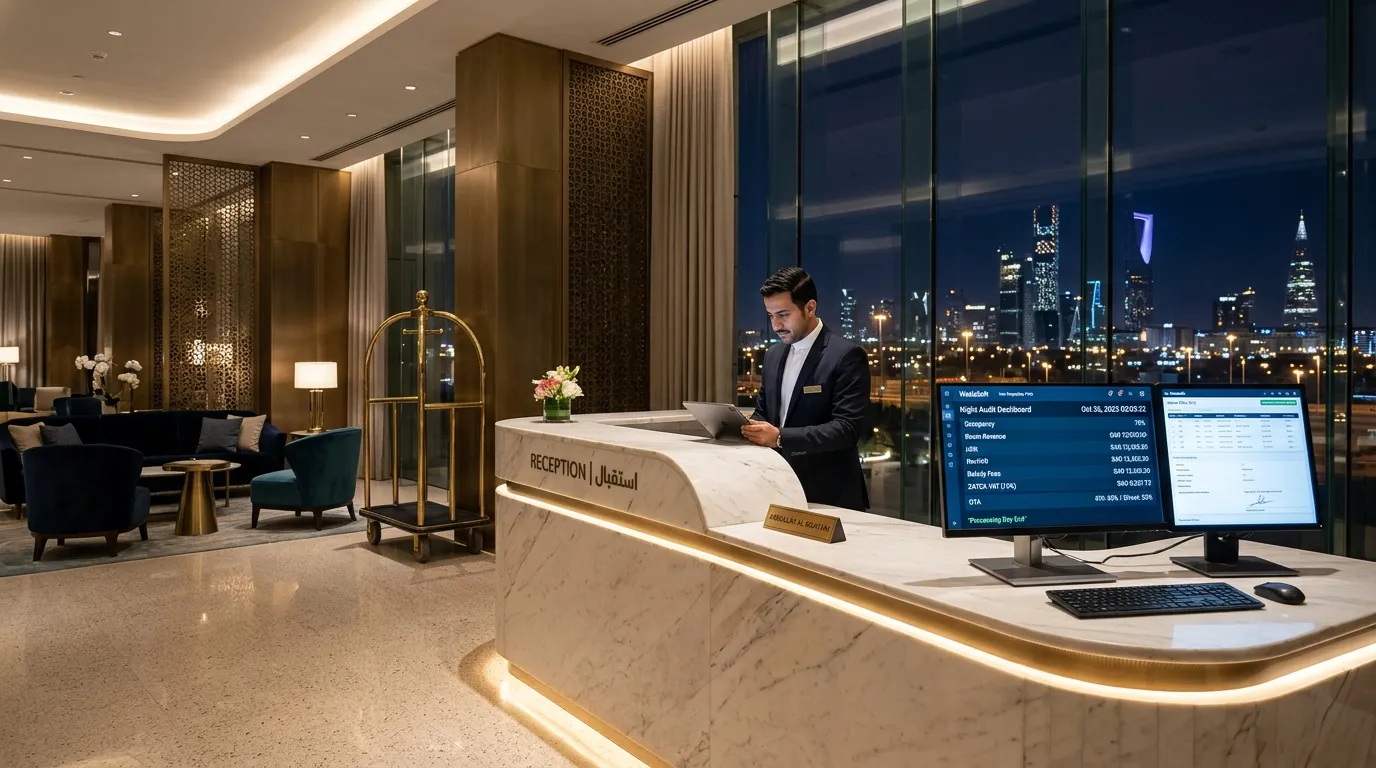
At 2:15 AM on a Wednesday in an 80-unit serviced apartment property in Al Khobar or Riyadh, the lobby is silent. But behind the reception mahogany counter, the night auditor is surrounded by paper: room rate reports, thermal credit card terminal settlement rolls, paper laundry receipts from the afternoon shift, and an open Excel workbook with seventeen formula errors.
A corporate guest checks out unexpectedly at 2:30 AM for an early flight to Dubai. The clerk scrambles to calculate the bill, manually types room numbers into three separate terminal screens, forgets to add the guest's dinner charge from the hotel cafe, and fails to separate the 5% municipal tourism surcharge from the 15% VAT. The guest taps his company card, receives a hastily typed invoice, and departs. The hotel permanently absorbs a SAR 280 food deficit and creates a taxable ledger discrepancy that will resurface during the annual ZATCA audit.
This chaotic routine is standard practice across hundreds of independent hotels, boutique resorts, and serviced apartment chains in the Gulf. It is inefficient, stressful for front desk staff, and completely unnecessary.
In this practical guide, we break down the operational blueprint for transforming the hotel night audit into an automated eight-minute procedure while safeguarding municipal tax compliance and guest ledger accuracy.
The Three Hidden Money Leaks in Manual Night Audits
Boutique hotels and furnished apartment residences in Saudi Arabia, the UAE, and Oman operate under intense hospitality competition. While management obsesses over Average Daily Rate (ADR) and Revenue Per Available Room (RevPAR), thousands of riyals evaporate every month through operational cracks during the night audit shift.
1. The Municipal Tourism Fee (Balady 5%) & VAT Split Nightmare
In the Kingdom of Saudi Arabia, room revenue is governed by dual taxation: the municipal tourism surcharge (the 5% Balady fee administered by the Ministry of Municipal and Rural Affairs) alongside the national 15% Value Added Tax (VAT) regulated by ZATCA.
When a front desk clerk uses a basic cash register or disconnected property management system, tax math becomes dangerous:
- Is the 5% Balady fee calculated on the gross rate or the net base tariff?
- Does the 15% VAT apply to the base room rate alone, or to the base rate plus the municipal surcharge?
- Are telephone calls, laundry services, and room service meals subject to the Balady fee, or are they standard 15% VAT items only?
When clerks calculate these splits manually under fatigue at 3:00 AM, mistakes are inevitable. In our hospitality compliance audit across Eastern Province hotels, manual properties averaged a 4.8% tax calculation variance between their front office reports and their statutory municipal tax declarations. Those variances trigger heavy retroactive fines during municipal inspections.
2. The Late Incidental "Folio Drop"
Consider this common scenario: A guest in Suite 402 checks out at 11:30 AM. The front desk clerk reviews the folio, sees only the room rate, takes payment, and prints the checkout folio.
Meanwhile, at 11:15 AM, the guest ordered an espresso and club sandwich from the lobby cafe, and the housekeeping team collected two shirts for express laundry. In an unconnected hotel where restaurant POS and laundry management do not post to room folios in real time, those charges sit on paper slips until the afternoon shift enters them at 2:30 PM.
By then, the guest has checked out, boarded an airplane, and closed his account. Who pays for the SAR 145 cafe bill? In many properties, the front desk clerk is unfairly forced to cover the shortage from their salary, or the hotel writes it off as uncollectible bad debt. Across seventy rooms, late drops quietly drain between SAR 3,000 and SAR 6,000 every single month.
3. Online Travel Agency (OTA) Virtual Card Mismatches
Between 50% and 75% of non-corporate bookings arrive through digital channels like Booking.com, Agoda, and Expedia. For prepaid bookings, the OTA issues a Virtual Credit Card (VCC)—a temporary, single-use MasterCard or Visa loaded with the exact net payable amount.
These virtual cards have rigid constraints:
- They cannot be charged before the official check-in date.
- They expire quickly after checkout.
- They are pre-loaded with net amounts excluding local taxes, or including taxes depending on the contract configuration.
- Attempting to swipe a virtual card for incidentals (mini-bar or damage) causes immediate bank transaction declines.
When front desk clerks manually re-type sixteen-digit virtual card numbers into counter POS machines at 2:00 AM, card entry typos, early authorization attempts, and currency conversion mismatches run rampant.
Field Implementation Case Study: 72-Unit Serviced Apartment Property (Al Khobar)
To understand what modern, automated hospitality software accomplishes, examine our deployment for a luxury 72-unit aparthotel catering to corporate oil and gas executives and regional weekend families in Al Khobar.
The Initial Baseline
The property operated with a legacy client-server PMS installed in 2017. Their restaurant, room service, and on-site laundry operated on separate retail cash registers.
The operational pain points were severe:
- Night Audit Duration: The night audit procedure took an average of 2 hours and 45 minutes every night, requiring the front office to freeze guest check-ins between 1:30 AM and 4:15 AM.
- Uncollected Incidentals: The property wrote off an average of SAR 3,800 per month in late cafe and laundry charges that posted after guest departure.
- OTA Virtual Card Declines: Between 8 and 12 virtual card rejections occurred every week due to manual card keying and premature charging before OTA activation windows.
- Municipal Tax Audits: The property failed a municipal inspection because room revenue allocations did not correctly document the 5% Balady fee on complimentary room upgrades.
The WaslaSoft Architecture
We deployed WaslaSoft Hotel Management PMS connected directly to the front desk, the all-day dining restaurant POS, the laundry plant, and the OTA channel manager:
- 1-Click Automated Night Audit Engine: Replaced the forty-step manual checklist with a single automated routine that posts room tariffs, calculates dual taxes, validates credit card settlement batches, and rolls the business date in eight minutes.
- Instant Room Charge Posting: When a guest in Apartment 504 orders room service or sends suits to the laundry, the order posts directly to their live room folio the moment the cafe waiter or laundry attendant taps the POS screen.
- Automated VCC Reconciliation Gateway: Virtual cards from Booking.com and Agoda are captured, scheduled, and charged automatically upon valid check-in activation without human card data entry.
- Dual Municipal & ZATCA Tax Segmentation: Room charges, extra bed fees, and incidentals are split into their respective municipal (5%) and ZATCA VAT (15%) ledger accounts automatically down to the halala.
Night Audit Comparison: Manual Paper Ledger vs. WaslaSoft Automated Roll:
• Old Manual Procedure:
Print 14 Paper Reports → Manually Enter Restaurant Chits → Calculate 5% Balady Split on Desktop Calculator → Hand-Key 25 OTA Virtual Cards → Roll Date Manually
(Time Required: 2 Hours 45 Minutes | Error Frequency: High | Late Drop Losses: SAR 3,800/mo)• WaslaSoft Automated Roll:
Verify Open Room Folios on Screen → Click "Run Night Audit" → System Posts Room Tariffs, Calculates Taxes, Charges Virtual Cards, and Generates Daily Flash Report
(Time Required: 8 Minutes | Error Frequency: Zero | Late Drop Losses: < SAR 120/mo)
What Went Wrong: The 2:00 AM UTC Virtual Card Brownout
Real technology deployments in busy hospitality environments must confront edge cases. Sharing an authentic challenge from our second week of live testing in Al Khobar provides invaluable operational guidance.
During our second week of live operations, the night auditor initiated the automated rollover at 2:05 AM Saudi time (which corresponds to 11:05 PM UTC of the previous day).
The batch included four non-refundable no-show reservations from Booking.com, each backed by an OTA Virtual Credit Card. When the payment gateway attempted to charge the cards, all four transactions were rejected with the bank response: "Transaction Not Permitted / Card Inactive."
The night auditor panicked. Assuming the system had lost payment connectivity, he aborted the night audit, leaving the software calendar on Wednesday while real-world guests were arriving for Thursday morning check-ins. Front desk staff were forced to register morning arrivals on temporary handwritten paper cards.
How We Solved the Problem
Our engineering team diagnosed the root cause within forty minutes:
Major global Online Travel Agencies (OTAs) generate virtual cards with an activation timestamp calibrated to 00:00:01 UTC on the check-in date. Because Saudi Arabia is three hours ahead of UTC (UTC+3), running the night audit at 2:05 AM Saudi time meant the virtual cards were being charged at 11:05 PM UTC—exactly fifty-five minutes before the international banking network activated the card numbers.
We implemented a two-part technical fail-safe:
- Intelligent VCC Activation Time-Lock: WaslaSoft now inspects the specific time-zone activation metadata of incoming virtual cards. If a night audit runs prior to the card activation window, the system holds the VCC in a temporary pending settlement queue rather than issuing an immediate decline, charging it automatically the moment its UTC activation window opens.
- Graceful No-Show Ledger Staging: Non-refundable no-shows are moved into a dedicated "Pending OTA Settlement" folio rather than blocking the main night audit date rollover, allowing the property to advance its business calendar without delay.
Since implementing this time-lock governor, not a single virtual card transaction has failed due to time-zone discrepancies across any WaslaSoft hotel client.
The Four Core Ledgers Every Gulf Hotelier Must Balance
A hotel night audit is not simply an administrative routine; it is the mathematical synchronization of four distinct financial ledgers:
1. The Guest Ledger (In-House Rooms)
The Guest Ledger represents the total outstanding money owed by guests currently sleeping in your property. During the night audit, the system automatically posts the agreed room tariff, breakfast supplements, and applicable municipal and value-added taxes.
Before rolling the date, the night auditor verifies that every occupied room has an active registration card, an authorized payment guarantee (credit card pre-authorization or cash deposit), and no unassigned negative balances.
2. The City Ledger (Corporate & Government Accounts)
In cities like Riyadh, Al Khobar, and Abu Dhabi, a massive percentage of bookings come from corporate contracts (Aramco, ministries, multinational contractors). These guests do not pay at the front desk; their expenses are billed directly to their company account on 30-day or 60-day credit terms.
The night audit transfers checked-out corporate balances from the Guest Ledger into the City Ledger, verifying purchase order (PO) numbers and corporate credit limits to prevent billing disputes when monthly invoices are mailed to corporate finance departments.
3. The Advance Deposit Ledger
Guests frequently pay weeks in advance for seasonal holidays (Eid, National Day, school vacations). That money sits in the hotel bank account, but it is not earned revenue yet—it is an unearned liability.
WaslaSoft maintains an automated Advance Deposit Ledger. When the guest finally checks in and the night audit rolls, the system automatically draws down the deposit to cover daily room charges, eliminating manual journal entries.
4. The Balady & ZATCA Tax Split Ledger
This is where Gulf properties face the strictest legal accountability. Every night, the software must isolate:
- Net Room Revenue: Base room tariff before surcharges.
- Municipal Tourism Fee (5%): Allocated to the Balady municipal liability ledger.
- Value Added Tax (15%): Allocated to the ZATCA VAT payable ledger.
- Exempt / Zero-Rated Items: Such as diplomatic reservations or specific government exemptions.
At any moment, management can export the exact municipal surcharge declaration report, completely reconciled against bank deposits and electronic tax invoice serials.
Measurable Results After 90 Days
After running WaslaSoft Hotel Management across the 72-unit Al Khobar property for three months, the operational metrics demonstrated clear efficiency gains:
| Metric Measured | Before WaslaSoft | With WaslaSoft Hotel PMS | Net Operational Impact |
|---|---|---|---|
| Night Audit Processing Time | 2 hours 45 minutes | 8 minutes | 95% reduction in administrative time |
| Late Incidental Drop Losses | SAR 3,800 / month | SAR 115 / month | 97% reduction in lost restaurant/laundry revenue |
| Front Office Check-in Downtime | 2.5 hours nightly freeze | Zero downtime | Guests check in smoothly at any hour |
| Municipal Balady Tax Variance | 4.8% calculation discrepancy | 0.00% variance | Total compliance during government audits |
| OTA Virtual Card Rejection Rate | 14.2% failure rate | 0.4% failure rate | VCC auto-timing eliminated bank declines |
| Morning Management Flash Report | Delivered at 10:30 AM | Generated at 2:10 AM | Instant visibility for General Manager |
For properties operating food and beverage outlets or fleet services, explore our guides on connecting restaurant billing and room charges and our master guide on POS payment reconciliation and settlement audits.
5 Practical Steps to Streamline Your Hotel Night Audit
- Connect Outlets to Room Folios via Direct API: Discontinue paper meal chits and carbon-copy laundry slips. Restaurant and laundry charges must post to guest folios in real time to prevent uncollected checkouts.
- Automate the 5% Balady Surcharge at Software Level: Never let clerks manually calculate municipal tourism taxes. The software must separate net rates, 5% municipal fees, and 15% VAT on every room posting automatically.
- Configure Time-Aware OTA Virtual Card Processing: Ensure your payment gateway respects international UTC card activation windows for Booking.com and Agoda to prevent false payment declines.
- Implement Express Checkout Folio Locks: When a guest requests an invoice, the system should temporarily lock the folio for sixty seconds while conducting a real-time check across all outlets for unposted items.
- Review the Morning Flash Report Daily: The General Manager and Finance Director should review the automated Night Audit Summary every morning, checking occupancy percentage, RevPAR, ADR, and complimentary room upgrades.
Final Verdict
The night audit does not have to be a dreaded, paper-choked trial that exhausts your front desk staff and introduces financial errors into your general ledger.
By modernizing your property management system with automated date rolling, real-time outlet integration, and precision municipal tax segmentation, you eliminate thousands of riyals in late drop losses, protect your business against severe municipal audit fines, and provide your guests with a fast, professional checkout experience from the moment they wake up.