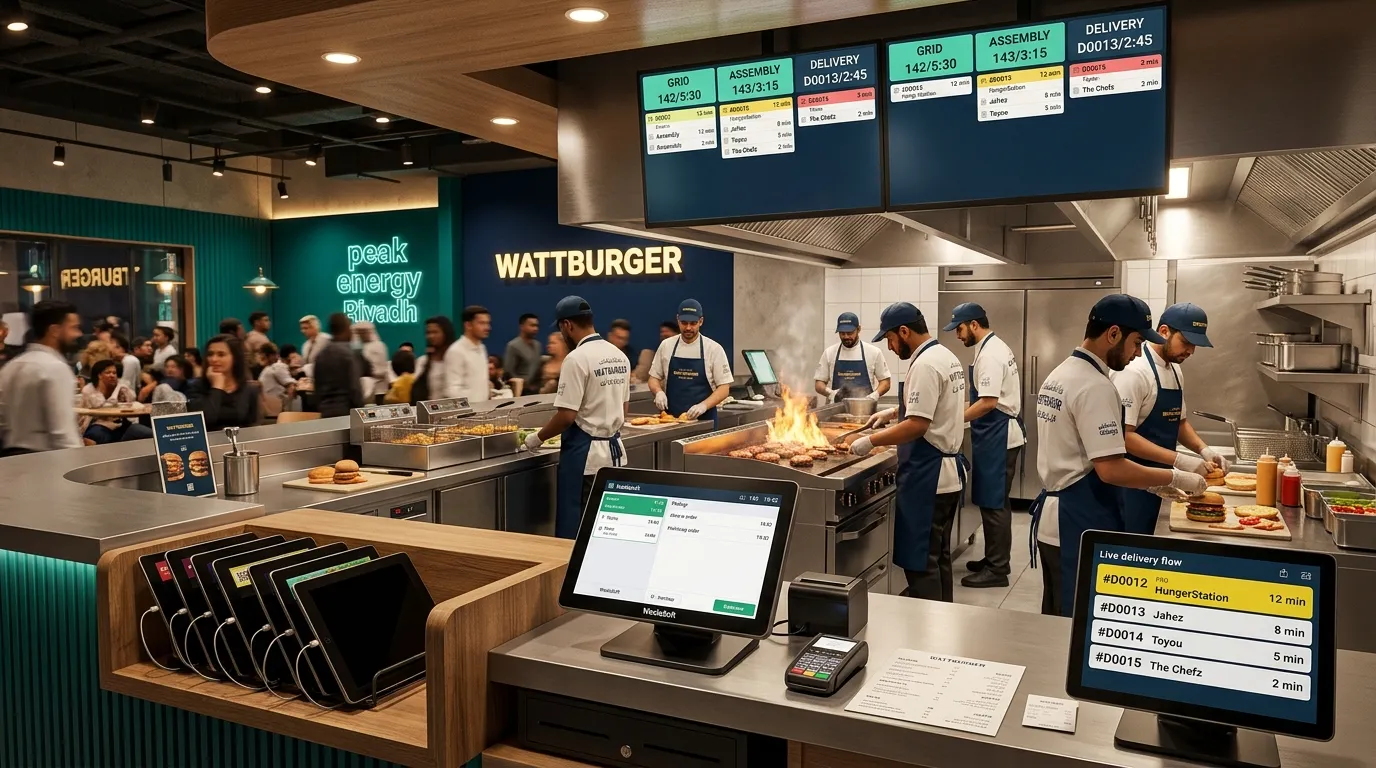
If your front counter cashier is staring at a ringing Jahez or HungerStation tablet and manually typing that order into your point of sale terminal, you are paying a monthly salary to inject human error into your kitchen.
During an 8:30 PM Friday dinner rush in Riyadh or Dubai, speed is life. Yet walk into almost any burger joint, shawarma shop, or high-volume casual dining concept across the Gulf, and you will see the same scene: four or five glowing plastic tablets mounted on the counter, each beeping with a different ringtone. The cashier is sweating. A walk-in customer is waiting to pay for a takeaway combo, but the cashier is hunched over an aggregator tablet, squinting at customer notes, and hurriedly punching items into the register.
This manual bridge between delivery platforms and your kitchen is where restaurant profit margins disappear. It is slow, expensive, and completely unnecessary.
In this article, we break down the operational mechanics of connecting third-party delivery channels directly to your central restaurant management system, drawing directly from real deployment data across multi-branch brands in Saudi Arabia.
The True Cost of the Counter Tablet Farm
Most restaurant operators treat aggregator tablets as an unavoidable cost of doing business. They accept the clutter because delivery channels represent 40% to 70% of total revenue. But what they fail to measure is the hidden operational friction created by manual re-entry.
1. The 3.5-Minute Transmission Lag
When a customer orders a smash burger on Jahez, the ticket does not immediately reach the grill. It sits on the tablet until a staff member notices the chime, accepts the order, and re-keys every item into your local cash register. During peak rushes, tablets ring unanswered for two to five minutes. In our audit of a four-branch burger chain in Riyadh, the average time between customer order confirmation and the first kitchen ticket print was three minutes and twenty-eight seconds. That delay alone pushed dispatch times past delivery driver arrival windows, causing delivery couriers to crowd the front entrance and block paying walk-in guests.
2. The Modifier Disaster Rate
Manual typing under stress breeds mistakes. A customer specifies "no cheese, lactose intolerant" or "extra truffle sauce on the side." The cashier, rushing to clear six beeping orders, punches the standard combo. The kitchen prepares what the kitchen ticket shows: a standard cheeseburger.
The customer receives the wrong order, opens a dispute on the app, and receives an instant automated refund from the delivery platform. The restaurant pays twice: you lose the cost of the food, and you absorb the platform dispute penalty. In our benchmark study, manual re-entry produced an average error rate of 13.8% on orders containing custom modifiers.
3. Out-of-Stock (86) Bottlenecks
When your kitchen runs out of brioche buns or fresh avocado at 9:15 PM, how do your staff react? In a manual setup, the shift supervisor must locate four different tablets, enter merchant passwords, navigate through menus, and toggle the item off one by one. In practice, staff forget one tablet. Inevitably, orders for the missing item continue to arrive from HungerStation or Talabat, forcing staff to call angry customers or cancel orders, triggering punitive algorithm rank drops on the delivery platform.
Field Implementation Case Study: 4-Branch Smash Burger Brand (Riyadh)
To understand what direct integration accomplishes in the real world, examine our deployment for a high-volume smash burger operator with four locations across Riyadh (Al-Malqa, Al-Sulimaniyah, Al-Narjis, and Hittin).
The Starting Baseline
Each branch averaged 420 delivery orders per night on Thursday, Friday, and Saturday. Counters were crowded with four separate hardware devices: Jahez, HungerStation, The Chefz, and Toyou. Two dedicated cashiers per shift did nothing except stare at tablets and punch orders into the cash register.
Despite having dedicated staff, the brand suffered:
- SAR 6,200 per branch monthly in wrong-order food remakes and customer refunds.
- 13.8% modifier discrepancy rate between platform orders and kitchen tickets.
- An average ticket turnaround time of 16 minutes from order placement to packaging.
The WaslaSoft Architecture
We deployed WaslaSoft Restaurant POS connected directly to all major delivery channels through a centralized API gateway, paired with a dual-screen Kitchen Display System (KDS):
- Direct Injection: Orders from Jahez, HungerStation, and other channels feed straight into the POS server as digital payloads without human intervention.
- Station Routing: The moment an order arrives, burger items route instantly to the Grill KDS screen, fries and appetizers route to the Fryer KDS screen, and drinks route to the Beverage packing station.
- Automated Status Sync: When the kitchen marks the ticket as "Ready" on the KDS bump bar, the system automatically pushes a status update back to the aggregator app, alerting the delivery rider to proceed to the pickup counter.
Direct Aggregator Flow vs. Manual Tablet Re-Entry:
• Old Manual Flow:
Customer App → Tablet Chimes → Cashier Re-types Ticket → Paper Printer → Kitchen Line
(Elapsed Time: 3 to 6 Minutes | Error Probability: 13.8%)• WaslaSoft Direct Injection:
Customer App → Cloud API Gateway → Central POS Engine → Split KDS Screens
(Elapsed Time: 4 Seconds | Error Probability: < 0.8%)
What Went Wrong: The Honest Al-Malqa Incident
No technology rollout in a demanding Gulf F&B environment happens without friction. Admitting what failed during deployment is the single most valuable lesson for any operator considering this transition.
During our second weekend of live testing at the high-volume Al-Malqa branch, a localized 4G router stutter occurred at 8:45 PM on a Friday. The internet connection dropped intermittently for fourteen minutes.
In an unoptimized setup, cloud orders during a network drop simply disappear or bounce. Our cloud API gateway correctly captured and queued incoming orders from Jahez and HungerStation. However, because our initial local listener script had no pacing governor, the moment the 4G router reconnected, twenty-six accumulated delivery tickets dumped into the kitchen thermal printer within five seconds.
The result was chaos. The printer ribbon jammed, paper spilled across the floor, and the grill cook found himself staring at 50 patties worth of orders arriving simultaneously with no chronological sequence. Three delivery drivers arrived at the counter demanding orders that had not even started cooking.
How We Fixed It
We pulled our engineering team into an emergency post-mortem that night and rebuilt the local queue handler with two fail-safes:
- Throttled Buffer Release: When an internet connection re-establishes after a drop, accumulated orders are injected into the kitchen system with an intelligent pacing delay (one ticket every 8 seconds), prioritizing orders by their original customer placement timestamp.
- Audible KDS Alert: The Kitchen Display System sounds an audible tone and displays a prominent amber warning banner: "Network Restored: 6 Queued Orders Incoming." This gives the shift supervisor immediate visibility to stage buns and prep the grill before tickets hit the line.
Since introducing the throttling engine, neither the Al-Malqa branch nor any other WaslaSoft client has suffered a printer dump during network brownouts.
Measurable Results After 90 Days
After running the direct integration across all four Riyadh branches for three months, the metrics stabilized with clear operational gains:
| Metric Measured | Before Direct Integration | With WaslaSoft POS Integration | Net Operational Impact |
|---|---|---|---|
| Order-to-Kitchen Transmission | 3 min 28 sec | 4 seconds | 98% reduction in transmission lag |
| Kitchen Modifier Error Rate | 13.8% | 0.7% | Nearly eliminated remake costs |
| Monthly Remake & Refund Losses | SAR 6,200 / branch | SAR 480 / branch | Saved SAR 22,880 monthly across 4 stores |
| Front Counter Hardware Footprint | 4 tablets + cables | 1 central POS display | Completely clean customer counter |
| Staff Labor Requirement | 2 cashiers dedicated to tablets | 0 dedicated tablet staff | Staff reassigned to guest hospitality |
| Average Driver Pickup Dwell Time | 4 min 15 sec | 42 seconds | Drivers pick up immediately without crowding |
For additional insights on kitchen workflow and inventory controls, read our companion guides on reducing food waste in cloud kitchens and our comprehensive restaurant and cafe POS system guide.
Why Some Operators Hesitate (And Why Their Logic Is Flawed)
When we consult with restaurant founders and operations managers across Saudi Arabia, we occasionally hear pushback against removing tablets. Here are the three most common objections—and why they fall apart under scrutiny:
"We want the cashier to manually pace orders when the kitchen gets full."
This is a dangerous illusion of control. When a cashier holds orders on a tablet to "protect" the kitchen, the customer on the app has already been given an estimated delivery time. The courier is already driving toward your store. By holding the order manually, you guarantee that the food will be late, the rider will wait outside, and your store rating will drop.
The professional solution is not cashier stalling; it is automated kitchen throttling managed directly within the POS. If your kitchen backlog exceeds twenty minutes, your POS should automatically update your kitchen preparation time or trigger an automated surge buffer on the aggregator platforms.
"Direct integration means we lose visibility over delivery drivers."
The opposite is true. With individual tablets, drivers arrive and yell their order numbers across a crowded counter. With direct integration, the customer-facing dispatch screen displays the original aggregator order number (e.g. HungerStation #1042 or Jahez #5812) alongside its status: Preparing, Packing, or Ready for Pickup. Couriers look at the screen, confirm their number, collect the sealed bag from the pickup shelf, and leave in under a minute.
"What about menu pricing differences between dine-in and delivery?"
Almost every F&B operator charges 10% to 20% higher on delivery platforms to offset marketplace commission fees. WaslaSoft handles multiple price lists within a single menu structure. A single click updates the recipe cost and base price, while applying distinct price rules for dine-in, takeaway, Jahez, and HungerStation automatically.
The Financial Picture: Reconciliation Without the Nightmare
Ask any restaurant accountant in the GCC what their most hated task is, and they will answer: matching aggregator payout statements against POS sales.
Aggregator platforms do not pay you the gross total of your menu items. They deduct:
- Commission fees (typically 18% to 25%).
- Merchant-funded promotional discount codes.
- Value Added Tax (VAT) adjustments.
- Driver cancellation penalties.
When cashiers type orders into an unconnected cash register, they frequently classify delivery sales under a generic "Delivery" payment button or miscategorize cash-on-delivery orders. At the end of the month, the finance manager faces a massive discrepancy between what the POS reports in sales and what Jahez or HungerStation actually wires into the company bank account.
Direct integration solves this at the database level. Each incoming transaction is tagged with the exact aggregator identifier, merchant commission rate, and expected settlement date. When the bank deposit arrives, the accountant reconciles hundreds of transactions with a single automated ledger match, identifying unpaid orders and improper penalty deductions instantly.
How to Get Started: A Checklist for F&B Operators
If you are ready to eliminate counter tablets and protect your restaurant margins, follow this sequential deployment plan:
- Audit Your Merchant API Access: Contact your account managers at Jahez, HungerStation, Talabat, or Keeta to verify that your brand is authorized for POS direct integration credentials (API keys and Webhooks).
- Standardize Menu SKUs: Ensure that your product names, variant modifiers (sizes, toppings, sauces), and pricing tiers are identical across all digital menus before connecting the bridge.
- Equip the Kitchen with KDS: Replace physical paper printers at hot stations with digital Kitchen Display Systems. Paper ribbons get lost, drenched in cooking oil, and torn during peak rushes; digital touchscreens provide real-time order timers and station-specific routing.
- Conduct a Peak-Load Test: Run a mock surge test with 30 simulated orders during your slowest shift to verify station routing and queue alerts before going live on a Thursday evening.
- Retire the Tablets: Once direct injection is verified, move the aggregator tablets off the front counter. Keep one backup device in the manager office for emergency merchant support, but prohibit staff from using tablets for order entry.
Final Verdict
Running a profitable restaurant in the Gulf today is a battle of fractions. Food ingredient costs are rising, delivery platform commissions remain substantial, and customer expectations for fast, accurate delivery have never been higher.
Continuing to pay cashiers to manually transfer text from a tablet screen to a cash register screen is an expensive anachronism. By connecting your delivery channels directly to your central point of sale, you eliminate human data entry errors, cut minutes off kitchen fulfillment, and give your front-of-house staff the freedom to focus on what actually drives repeat business: welcoming your in-store guests.