If your laundry staff relies on stapled paper tags or manual customer ticket slips, you are guaranteeing that at least two designer abayas or custom-tailored thobes will disappear into thin air every month.
In the Gulf dry-cleaning industry, lost clothing is not a minor customer service hiccup. It is an ongoing, quiet drain on profitability. Walk into almost any traditional laundry in Riyadh, Jeddah, or Dubai at 7:00 PM. A customer is standing at the counter, voice rising in frustration, demanding to know where his bespoke Italian wool suit or his wife's SAR 4,000 embroidered bridal abaya is. The counter attendant is sweating, flipping frantically through three hundred hanging plastic bags on a creaking rail, checking paper slips stapled to plastic coat hangers.
After thirty minutes of fruitless searching, the shop manager offers the standard desperate compromise: a free cleaning credit, or worse, paying out thousands of riyals in cash compensation to prevent a damaging commercial complaint.
This operational disaster is preventable. It is the direct consequence of treating garment tracking as an afterthought rather than the central backbone of your laundry business.
Why Gulf Garment Profiles Break Traditional Laundry Workflows
Commercial laundry in Saudi Arabia and the UAE is fundamentally different from European or American operations. Understanding these differences explains why generic dry-cleaning software fails miserably in this region.
1. The "Identical White Thobe" Dilemma
A typical neighborhood dry cleaner in Riyadh processes between 250 and 600 pristine white men's thobes every day. To the naked eye, twenty thobes hanging on a rack look virtually indistinguishable. They have similar fabric weights, similar mother-of-pearl buttons, and identical collars. If an attendant accidentally attaches Ticket #1042 to a thobe belonging to Customer #1088, the mistake is rarely discovered until Customer #1088 tries on the garment at home and realizes it is three inches too short. The reputation damage is immediate.
2. High-Value Delicate Fabrics
Gulf households invest heavily in luxury attire. A single customer drop-off can easily contain:
- A handmade winter wool thobe valued at SAR 2,500.
- Two silk evening abayas with delicate crystal beadwork valued at SAR 5,000.
- Cashmere ghutras and embroidered bishts passed down through generations.
When you handle garments of this value, relying on a 2-cent metal staple through an inner seam is unacceptable. Metal staples tear fragile silk under the centrifugal force of heavy wash tumblers, rust when exposed to moisture, and fall off during mechanical tumble drying.
3. The Centralized Hub-and-Spoke Sprawl
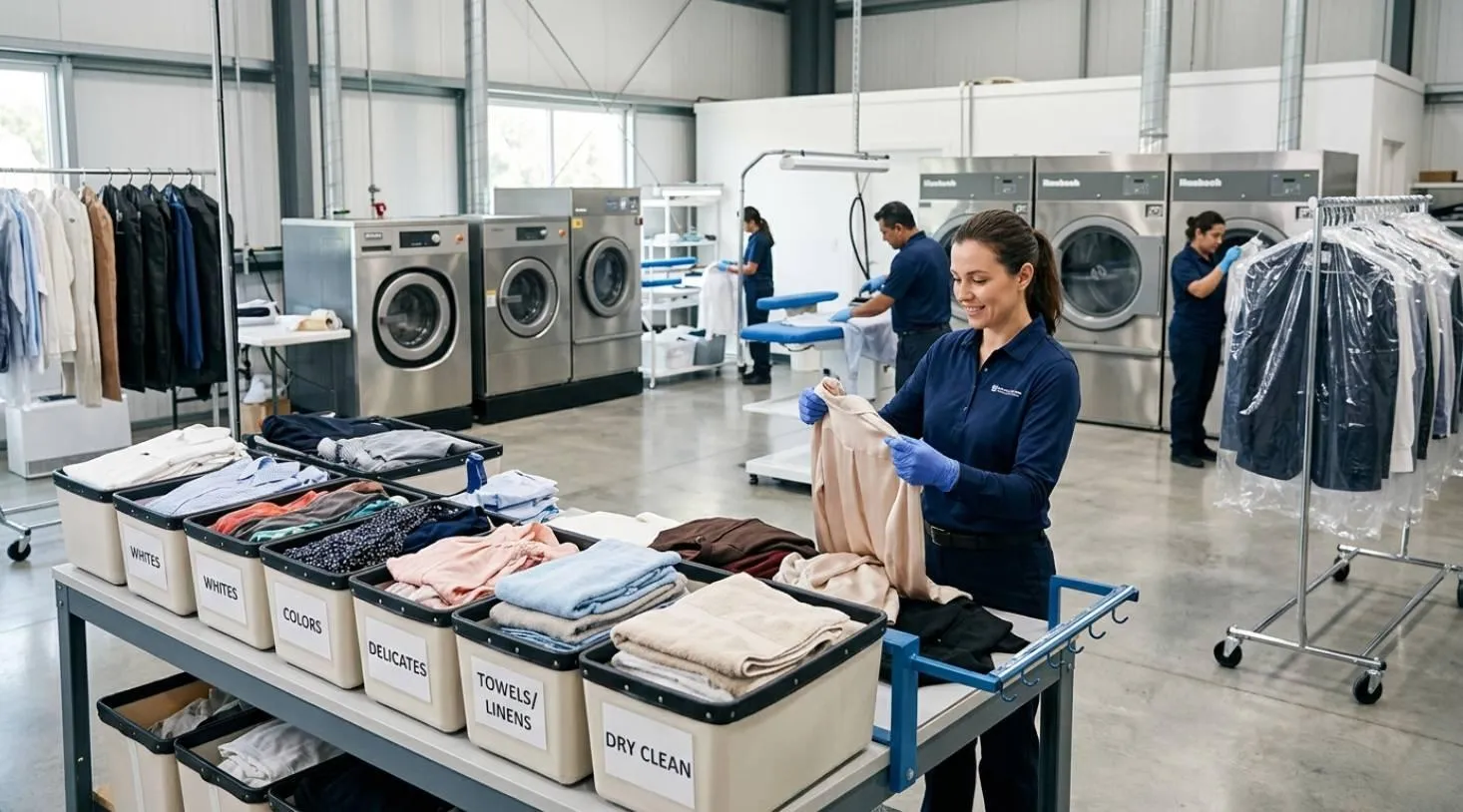
Most profitable laundry brands in the GCC do not wash clothes inside their high-rent retail shops. They operate a Hub-and-Spoke model: four to ten small collection shops spread across residential neighborhoods, feeding garments daily into a large, centralized industrial wash facility located in an industrial zone (such as Riyadh's Second Industrial City or Al Quoz in Dubai).
If you do not have digital piece-by-piece tracking, routing clothes from ten branches into one central wash plant and returning them to the correct store without mix-ups is mathematically impossible.
Field Implementation Study: 7-Branch Central Laundry (Riyadh)
To see how modern tracking technology transforms this operational reality, consider our deployment for a premium dry cleaning brand operating seven collection branches and one central processing plant in Riyadh.
The Initial Baseline
The operation processed an average of 1,800 garments daily. They used a legacy POS that printed paper receipt slips, which staff stapled to garment collars with small paper tags.
The business suffered from three severe operational pain points:
- Compensation Payouts: The brand paid an average of SAR 5,400 monthly in customer lost-clothing settlements and damage claims.
- Assembly Bottleneck: Staff spent an average of 4 minutes per customer order manually hunting through hanging rails to gather matching bundles (e.g. gathering five thobes and three shirts for one customer).
- Driver Routing Chaos: Home delivery drivers frequently arrived at customer villas missing one garment from an order, forcing costly second delivery trips.
The WaslaSoft Architecture
We deployed WaslaSoft Laundry Management POS across all seven retail branches, the central wash facility, and the mobile delivery fleet.
The system replaces manual paper slips with a four-stage digital tracking protocol:
4-Stage Digital Garment Lifecycle:
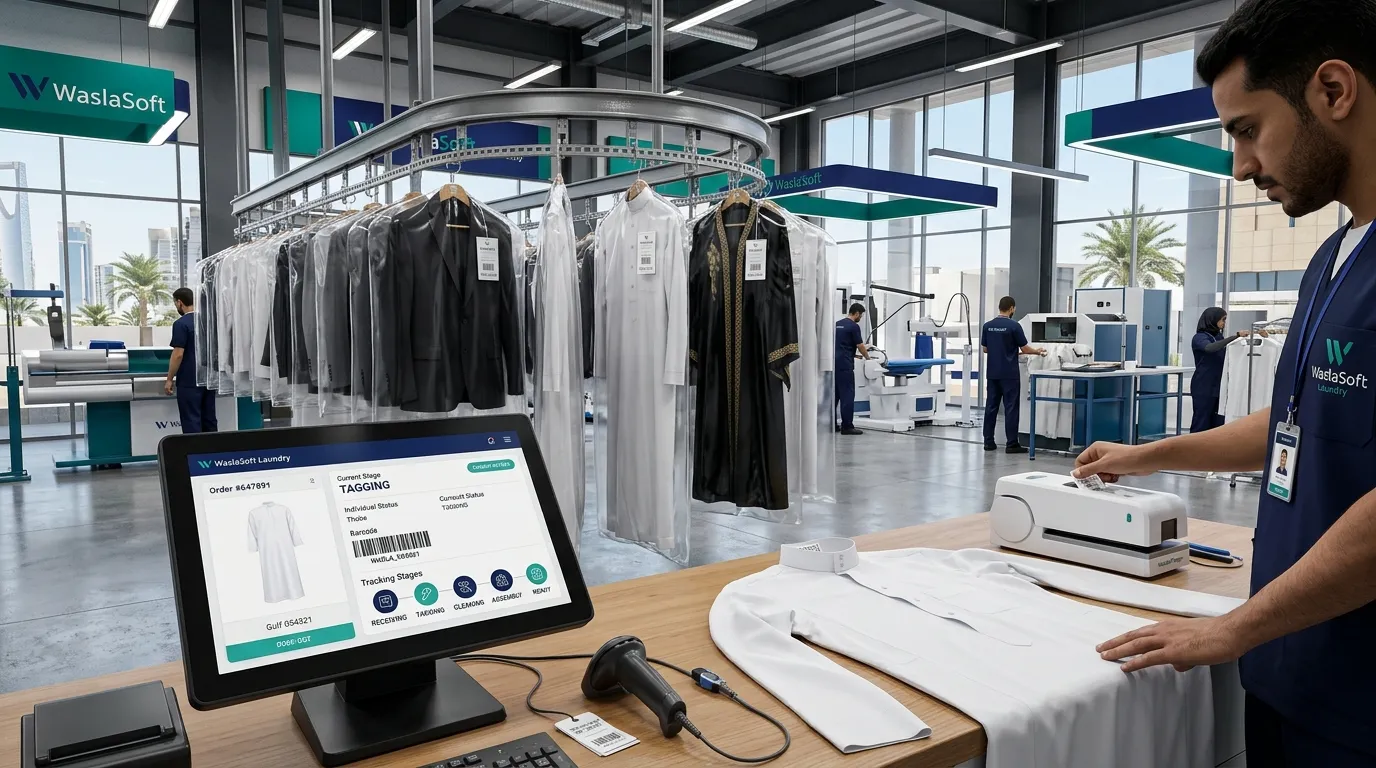
• Stage 1: Intake & Heat-Seal Tagging:
Every item receives a tiny permanent resin barcode patch applied at 190°C.• Stage 2: Sorting & Central Plant Manifest:
Items are scanned into branch transport totes; manifest automatically audits piece counts.• Stage 3: Wash, Dry & Finishing Stations:
Operators scan items before Spotting, Chemical Tumbling, and Steam Pressing.• Stage 4: Motorized Conveyor Assembly:
Scanner identifies order bundle; conveyor spins to the exact customer slot in 4 seconds.
What Went Wrong: The Expensive Bridal Abaya Incident
Every technology deployment involves real-world friction. Sharing what failed during our first week of live testing is essential for any operator planning an upgrade.
During the initial phase of deployment, the laundry owner insisted on testing low-cost, self-adhesive synthetic sticker labels to save on the upfront cost of pneumatic heat-seal press hardware. The manufacturer claimed these stickers were "dry-clean resistant."
On day four of testing at the central wash plant, two customized bridal abayas—valued at a combined SAR 8,000—were loaded into an industrial dry-cleaning tumbler with chemical perchloroethylene solvent running at 65°C, followed by an 85°C steam-finish cycle.
The solvent dissolved the adhesive on the synthetic stickers. Both labels peeled off inside the drum and were sucked into the lint trap. When the garments exited the tumbler, they were completely unlabelled. Meanwhile, two other men's wool jackets had lost their tags as well.
The sorting team was paralyzed. Four high-value garments sat on an inspection table with zero identification. The owner had to halt delivery dispatches for forty-eight hours, personally reviewing customer intake camera footage to match fabric patterns to order numbers.
The Permanent Fix
We discarded the adhesive stickers that same day. We installed industrial-grade pneumatic heat-seal machines at all intake counters. These units apply permanent, flexible polyurethane barcode patches at 190°C under 4 bar of pressure for 9 seconds.
The resin fuses microscopically into the textile weave without altering fabric hand-feel. These tags withstand 100+ cycles of heavy chemical dry cleaning, 90°C water washing, and 180°C steam pressing without peeling or fading.
Since that mandatory hardware standard was enforced, not a single garment in that seven-branch operation has ever lost its identification tag.
The Technology Pillars of Modern Garment Control
To eliminate claims and protect margins, a laundry management system must execute four technical functions flawlessly:
1. Permanent Micro-Tagging at Intake
When an item arrives at the counter or via driver pickup, it is assigned a unique, permanent serial barcode. For regular customers, this tag remains permanently on the garment (inside a collar, hemline, or care label). When the customer returns next week with five thobes, the attendant simply scans the existing tags. The POS auto-populates the customer profile, previous starch preference (e.g. Heavy Starch, Folded), and specific handling notes instantly. Intake time drops from two minutes to twenty seconds.
2. Multi-Stage Checkpoint Scanning
In a traditional laundry, clothes disappear into a black hole between intake and collection. WaslaSoft implements checkpoint scanning:
- Scan 1 (Intake): Item entered, condition notes and pre-existing stains recorded.
- Scan 2 (Plant Arrival): Driver tote scanned at central hub; verified against manifest.
- Scan 3 (Finishing Line): Presser scans garment as it leaves the steam press.
- Scan 4 (Bagging & Assembly): Conveyor slot confirmed and sealed in poly-wrap.
If a customer calls asking about their garments, the service desk does not guess; they see on screen: "Garment 4 of 6 passed Steam Pressing at 3:14 PM; currently in Assembly."
3. Automated Conveyor Assembly
The single biggest labor bottleneck in Gulf dry cleaners is order assembly—gathering all pieces belonging to one ticket before packaging.
With WaslaSoft's motorized conveyor integration, the worker stands at one station. When they scan any garment, the motorized circular rail rotates automatically to the correct numbered slot. Once all items for that order arrive in the slot, the system beeps green and prints the final master bundle ticket. Gathering a seven-item order drops from 4 minutes of walking to under 18 seconds.
4. Doorstep Photo Inspection & Signatures
A significant portion of customer compensation claims are fraudulent or mistaken. Customers frequently drop off garments with pre-existing cigarette burns, frayed cuffs, or missing buttons, and later accuse the laundry of causing the damage.
WaslaSoft's mobile driver app requires drivers to photograph pre-existing flaws at the customer doorstep during pickup. The customer signs the digital manifest on the driver's phone, accepting the condition assessment before the garments ever leave their villa. When an angry customer calls claiming a tear, the manager pulls up the high-resolution intake photo with GPS and timestamp coordinates, resolving the dispute in seconds without paying a single riyal in false claims.
Measurable Results After 90 Days
After running WaslaSoft across all seven branches and the central plant for three months, the operational transformation was decisive:
| Metric Measured | Before WaslaSoft | With WaslaSoft Laundry POS | Net Operational Impact |
|---|---|---|---|
| Monthly Lost Garment Claims | SAR 5,400 / month | SAR 210 / month | 96% reduction in cash payouts |
| Garment Assembly Time | 4 min 12 sec / order | 18 seconds / order | 92% faster order packaging |
| Intake Counter Processing | 2 min 30 sec / customer | 25 seconds / customer | No counter queues during evening rush |
| Central Plant Manifest Discrepancies | 4.2% daily mismatch | 0.02% mismatch | Virtually eliminated hub-to-store mix-ups |
| Driver Deliveries per Shift | 22 drop-offs / van | 38 drop-offs / van | 72% increase in logistics productivity |
| Customer WhatsApp Status Queries | 65 calls / day | 4 calls / day | Automated notifications keep guests informed |
For businesses operating fleet logistics and mobile routes, read our detailed guide on van sales and mobile fleet distribution in the GCC, or review our overview of laundry order tracking fundamentals.
The False Economy of Cheap Laundry Software
Many independent laundry operators resist investing in industrial garment tracking because they look only at initial hardware costs. They buy cheap retail POS software designed for grocery stores, use metal staples, and hire an extra worker to manually sort clothes.
Here is the straightforward financial reality:
- An extra sorting laborer costs between SAR 2,500 and SAR 3,500 per month in salary, housing, and visa fees.
- Customer compensation claims bleed SAR 3,000 to SAR 6,000 per month in cash and lost loyalty.
- That represents an annual leak of SAR 66,000 to SAR 114,000 every single year.
Investing in pneumatic heat-seal taggers, barcode scanners, and specialized laundry POS software pays for itself within the first four months of operation purely through eliminated claims and recovered labor hours.
5 Steps to Transition Your Laundry to Zero-Loss Tracking
- Eliminate Metal Staples Immediately: Replace metal staples and paper tags with industrial heat-seal polyurethane patches. Metal staples damage fabrics, rust, and tear off in tumblers.
- Equip Delivery Drivers with Mobile POS: Give drivers rugged smartphones running the WaslaSoft driver app to log counts, photograph damages, and capture signatures at the doorstep.
- Establish Clear Central Hub Manifests: Never transport loose clothing between collection shops and the central plant. Every transit bag must carry a digital barcode manifest.
- Implement Motorized Conveyor Slotting: Connect your ceiling or floor garment conveyors to the POS system to automate order assembly and eliminate walking time.
- Automate Customer WhatsApp Alerts: Configure automated triggers that message customers when their order enters "Cleaning," "Assembled," and "Out for Delivery," dramatically reducing inbound phone calls.
Final Verdict
In the high-value GCC textile care industry, customer trust is fragile. A loyal customer who spends SAR 800 every month on dry cleaning will abandon your business the moment you lose his favourite thobe or delay his travel suit.
Paper tags and manual sorting belong in the 1990s. By digitizing individual garment lifecycles with permanent heat-seal barcodes, checkpoint scanning, and mobile doorstep verification, you eliminate the SAR 5,000 monthly compensation drain, free up your staff, and build a scalable dry cleaning enterprise that runs with factory precision.