If your supermarket or department store still relies on manual paper price tags across thousands of grocery shelves, you are one customer smartphone photo away from a SAR 10,000 to SAR 50,000 Ministry of Commerce fine for price discrepancy.
At 10:15 AM on a Sunday morning in a busy supermarket in northern Riyadh, a customer places a bottle of imported extra virgin olive oil on the checkout conveyor belt. The cashier scans the barcode. The checkout terminal beeps and registers the price: SAR 48.50.
The customer immediately points toward Aisle 4. "Your shelf says SAR 39.00."
The front end supervisor walks over to verify. Sure enough, tucked into the plastic shelf rail below the olive oil bottles is a paper tag reading SAR 39.00. The promotional flyer expired on Saturday night at midnight, but the night shift stockers missed that shelf tag among twelve hundred other price changes.
Under Saudi Arabia's consumer protection laws enforced by the Ministry of Commerce, the legal outcome is automatic and non-negotiable:
- The store is legally obligated to sell the olive oil to the customer at the lower price of SAR 39.00 immediately.
- The customer opens the "Balagh Tijari" (Commercial Report) mobile app, snaps a photo of the shelf tag and the cashier receipt, and submits a violation report.
- Within hours, Ministry of Commerce inspectors arrive at the store. The business faces a mandatory on-the-spot violation fine starting at SAR 5,000, rising to SAR 50,000 for repeated offenses, with the violation published publicly on official regulatory channels.
This regulatory scenario plays out hundreds of times every week across the Kingdom. It is not caused by malicious intent; it is the mathematical consequence of expecting retail employees to manually print, cut, and insert thousands of tiny paper slips without making a single mistake.
In this practical guide, we examine why manual price tagging fails in high-SKU retail environments, how wireless Electronic Shelf Labels (ESL) eliminate price discrepancy fines permanently, and the exact network architecture needed to synchronize fifteen thousand retail displays with zero lag.
The Four Structural Weaknesses of Paper Shelf Tagging
Supermarkets, hypermarkets, and electronics retailers in the Gulf manage between 12,000 and 35,000 active Stock Keeping Units (SKUs). Maintaining price parity across this volume using paper is physically unsustainable.
1. The 14-Hour Weekly Promotion Bottleneck
Retail chains in Saudi Arabia and the UAE live on rapid promotional rotations. Weekly discount catalogs launch on Wednesday morning and expire on Tuesday evening, supplemented by flash weekend promotions and Ramadan super-sales.
In a store managing 15,000 SKUs, a standard weekly flyer alters the prices of approximately 2,500 to 4,000 products. Managing this transition with paper requires:
- Generating and printing 40 to 60 sheets of perforated cardstock tags on office laser printers.
- Dedicating four store employees for 6 to 8 hours with scissors or guillotine cutters to separate individual tags.
- Sending staff down narrow aisles on Tuesday night to locate individual shelf positions, slide old tags out of plastic channels, and slide new tags in.
Inevitably, staff miss shelves. Tags get dropped behind cereal boxes, misplaced into adjacent product slots, or inserted upside down. During the 12-hour window between price activation in the POS database and physical tag replacement on the floor, the store is operating in open legal violation.
2. The Multi-Branch Pricing Desynchronization
When retail chains operate five or ten branches across Riyadh, Jeddah, and the Eastern Province, central pricing strategies must deploy uniformly.
If head office adjusts the margin on poultry or dairy products in response to wholesale commodity price shifts, the central database updates in milliseconds. But across the branches, branch managers deploy changes at different speeds. Branch A updates its shelf paper tags on Wednesday morning; Branch B starts on Thursday afternoon; Branch C runs out of colored printer cardstock and delays until Friday. Customers who shop across branches notice the variance, erosion of brand trust accelerates, and regulatory exposure multiplies.
3. The Statutory Unit Price Mandate
Under Gulf consumer protection standards, retailers are increasingly required to display not only the total selling price, but also the standardized unit price (e.g. Price per 100 grams or Price per liter).
Calculating and printing secondary unit pricing on tiny paper labels creates substantial visual clutter and frequent printing errors. If the unit price formula is miscalculated on a paper batch, the label fails regulatory inspection even if the total retail price is technically correct.
4. Direct Labor and Consumable Waste
Managing paper tags is a silent operational expense:
- Cardstock and Toner: A busy 4-branch supermarket chain consumes between SAR 18,000 and SAR 26,000 annually in specialty paper stock, perforated label rolls, and heavy-duty printer toner.
- Labor Hours: Four employees spending 8 hours twice a week on price tag maintenance represents over 3,300 man-hours per year per store—hours that should be spent replenishing empty shelves and serving shoppers.
Field Implementation Case Study: 4-Branch Supermarket Chain (Dammam & Al Khobar)
To examine the operational transition to digital shelf pricing, examine our deployment for a prominent regional supermarket and household goods chain operating four large-format stores (18,000 active SKUs per store) in Dammam and Al Khobar.
The Initial Baseline
The retailer operated with modern POS checkout terminals, but their shelf tagging remained 100% paper-based.
The operational pain points were severe:
- Ministry of Commerce Violations: The brand had received three formal violation citations in an eight-month span, paying SAR 35,000 in regulatory fines following customer app reports.
- Promotional Lag: A team of four employees per store spent an average of 14 hours every Tuesday night updating paper promotional tags.
- Price Mismatch Audit: Internal mystery shopper audits revealed an average 3.8% discrepancy rate between physical shelf tags and POS scanner prices across grocery aisles.
- Customer Disputes: Cashiers logged an average of 14 pricing dispute arguments per day at the checkout lanes, slowing checkout throughput and causing walkouts.
The WaslaSoft Architecture
We deployed WaslaSoft Retail POS integrated with enterprise-grade wireless Electronic Shelf Label (ESL) infrastructure across all four retail branches:
- Digital E-Ink Shelf Displays: Replaced all 18,000 paper tags per store with 2.13-inch and 4.2-inch graphic e-ink tags featuring 3-color displays (black, white, and promotional red).
- Ceiling-Mounted RF Base Stations: Installed high-penetration 2.4GHz / Sub-1GHz wireless base stations covering all shopping aisles, walk-in chillers, and produce displays.
- Bi-Directional Real-Time Synchronization: Directly bridged the WaslaSoft inventory database to the ESL broadcast engine. When a price, discount rule, or VAT rate is modified in the POS back office, the change pushes to the shelf tag instantly.
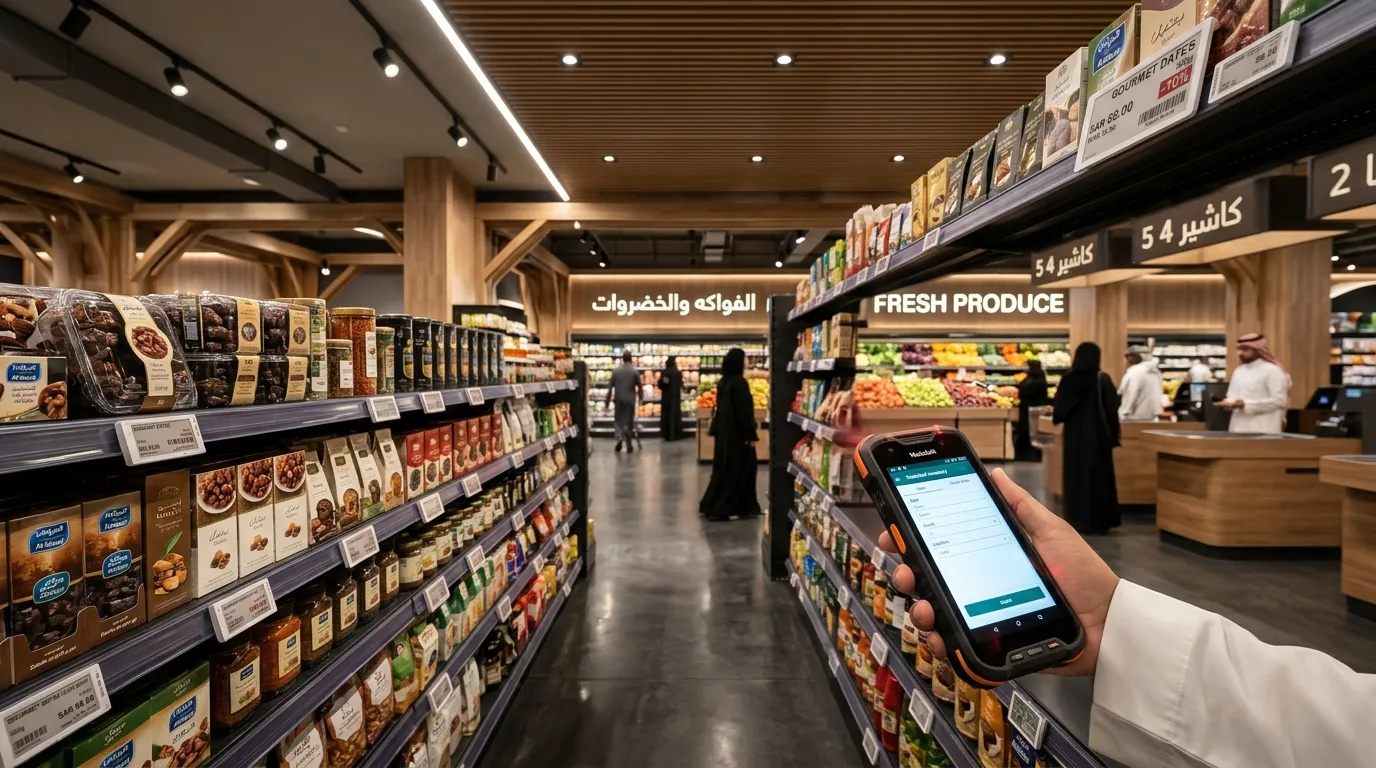
- Mobile Handheld Pairing: Equipping store clerks with Android mobile inventory terminals allows staff to pair an ESL tag to any product barcode in under three seconds simply by scanning the product UPC followed by the tag barcode.
Supermarket Price Update: Paper Tagging vs. WaslaSoft Wireless ESL:
• Old Manual Paper Workflow:
Central Price Change → Export Excel List → Print 50 Sheets of Cardstock → Cut 3,500 Tags → Staff Manually Walk Aisles for 14 Hours → 3.8% Error Rate
(Execution Time: 14 Hours | Error Rate: 3.8% | Regulatory Risk: Extreme)• WaslaSoft Wireless ESL Sync:
Central Price Change in POS → One Click Broadcast → RF Base Stations Transmit Packets → 18,000 E-Ink Tags Refresh Automatically in 42 Seconds
(Execution Time: 42 Seconds | Error Rate: 0.00% | Regulatory Risk: Zero)
What Went Wrong: The Chilled Dairy Aisle Signal Shielding Incident
Real deployments in high-density grocery retail environments inevitably encounter physical physics challenges. Documenting what failed during our first week of live testing in Dammam provides critical guidance for retail operations managers.
On the third night following go-live at the Dammam flagship store, head office scheduled a midnight price adjustment across 3,200 dairy, cheese, and packaged meat SKUs in preparation for a major promotional weekend.
The marketing director approved the promotional broadcast at 11:30 PM. In the dry grocery aisles, cereal boxes and canned goods tags refreshed immediately in crisp red and black.
However, when the store manager conducted his walk-through at 6:30 AM the next morning, he discovered a disaster in Aisle 8 and Aisle 9 (the refrigerated dairy and fresh cold cuts section): over 1,400 shelf tags had failed to update, still displaying full regular prices while the POS checkout registers had already lowered prices to promotional rates.
Customers entering at 7:00 AM began picking up milk and labneh. When cashiers scanned the items at checkout, the prices scanned cheaper than the shelf tag. While this did not violate the Ministry of Commerce rule against overcharging, it confused shoppers, prevented the store from marketing its competitive discounts, and raised fears of what would happen when promotional prices expired and reverted upwards.
How We Solved the Crisis
Our network engineering team conducted an immediate RF spectrum analysis inside the chilled aisles.
The root cause was a combination of physical barriers:
- Electromagnetic Shielding: The heavy stainless steel uprights of the commercial multi-deck refrigerators and the steel backing of the dairy shelving created a localized Faraday cage effect, attenuating 2.4GHz radio waves by over 26 dBm.
- Compressor Motor Interference: When the massive industrial compressors above the walk-in cold rooms cycled on during the night, they introduced electrical noise that degraded wireless packet delivery to battery-powered tags located near the floor level.
We resolved the issue permanently with three technical safeguards:
- Sub-1GHz Low-Frequency Mesh Repeaters: We supplemented the ceiling access points with specialized industrial Sub-1GHz repeater beacons mounted directly within the refrigeration canopies. Sub-1GHz frequencies penetrate dense metal shelving, cold glass doors, and liquid-filled plastic milk jugs far more effectively than standard 2.4GHz signals.
- Bidirectional Acknowledgment Handshake: We modified the ESL firmware routine so that every electronic shelf tag must send an encrypted acknowledgment packet back to the POS server confirming: "Display Buffer Rendered: New Price SAR 14.50 Verified."
- Morning Store Opening Exception Audit: At 6:00 AM every morning, the WaslaSoft POS automatically generates a "Digital Tag Health Summary." If even a single shelf tag has failed to confirm its update acknowledgment, an alert banner flashes on the store manager's mobile app, identifying the exact aisle, shelf row, and product SKU for physical inspection before store doors open to the public.
Since deploying this multi-frequency mesh architecture and acknowledgment audit, not a single electronic shelf tag across all four branches has ever dropped an update packet.
Four Strategic Capabilities Unlocked by Digital Shelf Labels
Transitioning from static paper to digital e-ink infrastructure transforms shelf rails from passive labels into dynamic operational assets:
1. Zero-Friction Dynamic and Happy-Hour Pricing
In fresh food, bakery, and prepared deli counters, inventory spoils quickly. In traditional setups, marking down rotisserie chicken or freshly baked baguettes by 30% at 9:00 PM to clear stock requires staff to print yellow discount stickers and manually slap them over packages.
With WaslaSoft ESL integration, the store can automate daily clearance rules:
- At 8:30 PM, all fresh bakery items automatically drop by 25% on both the shelf tags and the checkout scanner registers.
- The e-ink tag flashes an eye-catching reverse red-on-black banner: "Evening Fresh Clearance - Save 25%".
- The store clears fresh stock, cuts biological food waste, and captures incremental evening revenue without adding a minute of staff labor.
2. Streamlining In-Store Online Order Picking (Dark Store Fulfillment)
With the rapid growth of rapid-grocery delivery apps (such as HungerStation Quick, Jahez, and Nana), retail supermarket pickers walk aisles fulfilling hundreds of online orders daily. Finding a specific brand of organic almond milk among forty similar cartons consumes valuable minutes.
WaslaSoft ESL tags feature integrated multi-color LED indicator lights:
- When a picker’s handheld terminal calls up an order item in Aisle 6, the system triggers the specific shelf tag's bright green LED to pulse for 8 seconds.
- The picker walks straight to the flashing green light, grabs the item, and scans it, cutting order assembly time by over 40%.
3. Real-Time Stock-Out Flags for Replenishment Staff
When an item sells out in a traditional store, the empty shelf space sits unnoticed until a supervisor walks by hours later.
WaslaSoft links shelf tags to real-time inventory levels:
- When inventory for a specific SKU reaches zero, the bottom corner of the e-ink tag automatically renders a small "Out of Stock" discrete glyph.
- Floor stockers walking the aisle can immediately see which empty spaces represent items that are out of stock in the central warehouse versus items that simply need to be brought out from the back storeroom, dramatically accelerating shelf restocking speed.
4. Flawless Regulatory Unit-Pricing Compliance
Under consumer protection regulations, displaying uniform comparative metrics (such as SAR 1.25 per 100g) allows shoppers to compare values across competing package sizes.
WaslaSoft calculates unit pricing automatically from package net weights and renders the text in a crisp, standardized sub-field on the e-ink screen. If a manufacturer alters package size from 450 grams to 400 grams (shrinkflation), updating the master inventory record updates both the selling price and the comparative unit pricing instantly, maintaining 100% legal compliance.
Measurable Results After 90 Days
After running WaslaSoft Retail POS paired with Electronic Shelf Labels across all four Eastern Province supermarket branches for three months, the operational metrics validated the business case:
| Retail Operational Metric | Before WaslaSoft ESL | With WaslaSoft ESL Integration | Net Business Impact |
|---|---|---|---|
| Weekly Tag Update Labor Time | 14 hours / store / week | 42 seconds automated | 99% reduction in pricing labor |
| Shelf-to-Register Price Discrepancies | 3.8% average error rate | 0.00% discrepancy | Zero pricing mismatch across 18,000 SKUs |
| Ministry of Commerce Violation Fines | SAR 35,000 paid over 8 mos | Zero violations / fines | Complete regulatory protection |
| Annual Paper & Toner Consumables | SAR 22,000 / store / year | SAR 0 on paper tags | Saved SAR 88,000 annually across 4 stores |
| Cashier Price Dispute Inquiries | 14 disputes / lane / day | < 1 dispute / month | Faster checkout lanes and happier guests |
| Evening Fresh Waste Clearance Rate | 18% discard rate at closing | 4.5% discard rate | Automated 8:30 PM dynamic discounts |
For retail operations managing high-volume fresh meat, produce, or roastery counters, explore our specialized guide on stopping weighing scale barcode fraud and PLU theft and our foundational manual on multi-branch retail inventory logistics.
5 Practical Steps to Deploy Electronic Shelf Labels in Your Retail Store
- Conduct an RF Site Survey Before Purchasing Hardware: Never install wireless tags without testing radio frequency propagation in chilled and frozen aisles. High-moisture environments and steel display shelving require sub-1GHz repeaters to prevent dead zones.
- Prioritize 3-Color E-Ink Displays: Choose electronic shelf tags with black, white, and red (or yellow) pigments. Red highlighting draws customer attention to promotional savings and satisfies commerce requirements for promotional transparency.
- Establish a Bidirectional Handshake Protocol: Ensure your software does not simply broadcast prices into the void. The system must verify that every tag sends an encrypted confirmation back to the server before marking an update complete.
- Automate Morning Exception Audits: Configure an automated morning audit report that alerts store supervisors at 6:00 AM to any unacknowledged tags or low-battery units before opening doors to shoppers.
- Train Merchandising Staff on 3-Second Tag Pairing: Train floor stockers to link new products to shelf tags using handheld mobile barcode scanners, ensuring that seasonal product shifts take seconds rather than hours.
Final Verdict
Operating a modern supermarket or department store in the Gulf today is a high-stakes balancing act between intense retail price competition and rigorous government consumer protection standards.
Continuing to manage price changes across thousands of products with scissors, paper cardstock, and manual employee goodwill is an unsustainable gamble that invites heavy regulatory fines and damages your brand reputation. By integrating Electronic Shelf Labels directly with your central WaslaSoft point of sale database, you eliminate price discrepancy violations permanently, free hundreds of employee hours every month, and build a dynamic, agile retail enterprise ready to compete at the highest level of modern commerce.