If your multi-branch bakery or central commissary calculates production batches on whiteboards and receives branch replenishment orders via late-night WhatsApp voice notes, you are surrendering between 14% and 18% of your gross food margins to daily pastry scrap and morning stock-outs.
At 4:45 AM on a Monday morning inside a high-volume central baking commissary in Al-Sulaimaniyah, Riyadh, the aroma of caramelizing butter and yeast fills the air. Deck ovens are running at 220°C, commercial spiral mixers are turning forty-kilogram batches of brioche dough, and rolling racks of proofed croissants are staged for the morning bake.
Then the logistics coordinator checks his phone.
The manager of the Olaya branch sent a WhatsApp voice message at 1:15 AM requesting eighty additional plain croissants for a corporate breakfast catering order. The manager of the Diplomatic Quarter branch sent a spreadsheet at 2:30 AM reducing his sourdough order by half. Meanwhile, the night baker notices that the chocolate babka batch yielded only twenty-four loaves instead of the scheduled thirty-six because a junior apprentice miscalibrated the dough divider.
The delivery vans are idling at the loading dock, scheduled to depart at 5:30 AM to beat the Riyadh morning traffic. The commissary supervisor scrambles to reallocate pastries between branches on a clipboard, guessing which store can afford a shortage.
Two hours later, corporate commuters walk into the Olaya cafe at 7:45 AM asking for fresh croissants to accompany their morning flat whites. The display case is half-empty. Customers turn around and walk next door to a competitor. Across town at the Diplomatic Quarter store, forty unsold croissants will sit under display glass until 10:00 PM, destined for the dumpster.
This daily operational friction is standard practice across hundreds of growing bakery chains, patisseries, and specialty cafe brands in the Gulf. It is stressful, unstandardized, and commercially unsustainable.
In this practical guide, we examine why manual bakery commissaries bleed margins, how multi-tier Bill of Materials (BOM) eliminates recipe yield variances, and how automated branch replenishment guarantees full display cases during peak morning rushes with near-zero food waste.
The Four Structural Vulnerabilities of Bakery & Pastry Supply Chains
Running a commercial bakery commissary is fundamentally different from operating a standard burger joint or retail grocery store. Pastry and bakery manufacturing involves fragile biological processes and severe shelf-life constraints that standard restaurant POS software cannot handle.
1. The Strict 18-to-24-Hour Perishability Window
A burger patty can sit in a sub-zero freezer for weeks without losing commercial value. An artisanal sourdough loaf or butter croissant, however, has a peak commercial life of twelve to eighteen hours.
By the evening, crusts soften, laminated layers lose their crispness, and crumb moisture evaporates. In traditional bakeries where branch managers order by gut feel ("send me 120 croissants just in case"), stores average an unsold evening waste rate of 14% to 22%. In a multi-branch network, tossing twenty unsold pastries per store every night destroys between SAR 12,000 and SAR 28,000 in raw ingredient costs every month.
2. High-Cost, Volatile Raw Ingredients
Artisanal baking in the Gulf relies on expensive imported specialty commodities:
- European high-fat dry butter (84% butterfat required for proper lamination) costing SAR 38 to SAR 52 per kilogram.
- Stone-ground French T55 and T65 flours.
- Single-origin Belgian and Swiss chocolate batons.
- Pure Iranian and Sicilian pistachio pralines costing upwards of SAR 140 per kilogram.
When baking ingredients cost this much, a 10% discrepancy in scaling or waste is not an accounting footnote—it is the difference between operating at a healthy 18% net profit margin or sliding into insolvency.
3. Nested, Multi-Stage Recipe Hierarchies
A finished pastry is rarely produced in a single linear cooking step. It requires multiple semi-finished sub-recipes produced across different days:
- Day 1 (Prep): Starter sourdough fermentation (levain), vanilla bean pastry cream, and chocolate ganache.
- Day 2 (Lamination): Detrempe dough mixing, butter block incorporation, three lamination turns, and overnight resting.
- Day 3 (Shaping & Bake): Sheeting, cutting, proofing, egg washing, and baking.
If a bakery system cannot track the inventory and cost of semi-finished components at each intermediate stage, the head baker has no visibility into where raw materials are disappearing. Is the loss happening during dough sheeting trims? During proofing collapse? Or during retail display handling?
4. The 7:30 AM Morning Commuter Window
For specialty coffee and bakery brands in Riyadh, Dubai, and Doha, between 45% and 60% of daily retail turnover occurs during a frantic two-and-a-half-hour morning window (7:00 AM to 9:30 AM).
If the central commissary delivery van arrives twenty minutes late due to dispatch chaos, or if the shipment is missing twenty loaves of sourdough, those retail sales are permanently lost. Morning commuters on their way to ministry offices or corporate towers will not wait for an afternoon delivery van; they buy their coffee and breakfast elsewhere.
Field Implementation Case Study: 6-Branch Artisanal Bakery Chain (Riyadh)
To understand what structured commissary management accomplishes in the real world, examine our deployment for an upscale artisanal bakery and specialty coffee brand operating six retail locations and a central baking commissary in Riyadh (Al-Sulaimaniyah, Hittin, Al-Nakheel, Diplomatic Quarter, Al-Malqa, and Al-Yasmin).
The Starting Baseline
The central commissary produced an average of 3,800 finished baked items daily (sourdough loaves, plain croissants, almond croissants, babkas, and savory danishes). Branch managers placed replenishment orders nightly by sending WhatsApp messages and voice notes to the production head before 11:00 PM.
The operational pain points were crippling:
- Food Scrap and Waste: Daily retail display discards averaged 16.4% across all six stores, representing SAR 34,000 in monthly ingredient write-offs.
- Recipe Yield Variance: Dough batches showed an average 14.8% yield variance between calculated production expectations and actual packed units.
- Morning Rush Stock-Outs: Individual branches ran completely out of core morning items (plain croissants or pain au chocolat) an average of 4.2 mornings per week before 9:00 AM.
- Unverified Internal Transfers: Discrepancies between what the central kitchen claimed they shipped and what store baristas claimed they received caused bitter daily shouting matches between kitchen and store managers.
The WaslaSoft Architecture
We deployed WaslaSoft Restaurant POS & Central Commissary Module connecting the central production kitchen, the logistics fleet, and all six retail cafe POS terminals:
- Automated Algorithmic Branch Replenishment: Eliminated WhatsApp ordering entirely. The system calculates daily replenishment requisitions automatically based on a rolling 4-week sales velocity model, factoring in day-of-week patterns, local events, and remaining previous-day inventory.
- Multi-Level Bill of Materials (BOM) Production Batches: Master recipes for dough, fillings, and finished pastries are linked to automated digital scaling prompts.
- Mandatory Batch Yield & Scrap Gates: Head bakers must enter actual finished baked counts and photograph scrap on commissary tablets before the software generates delivery manifests.
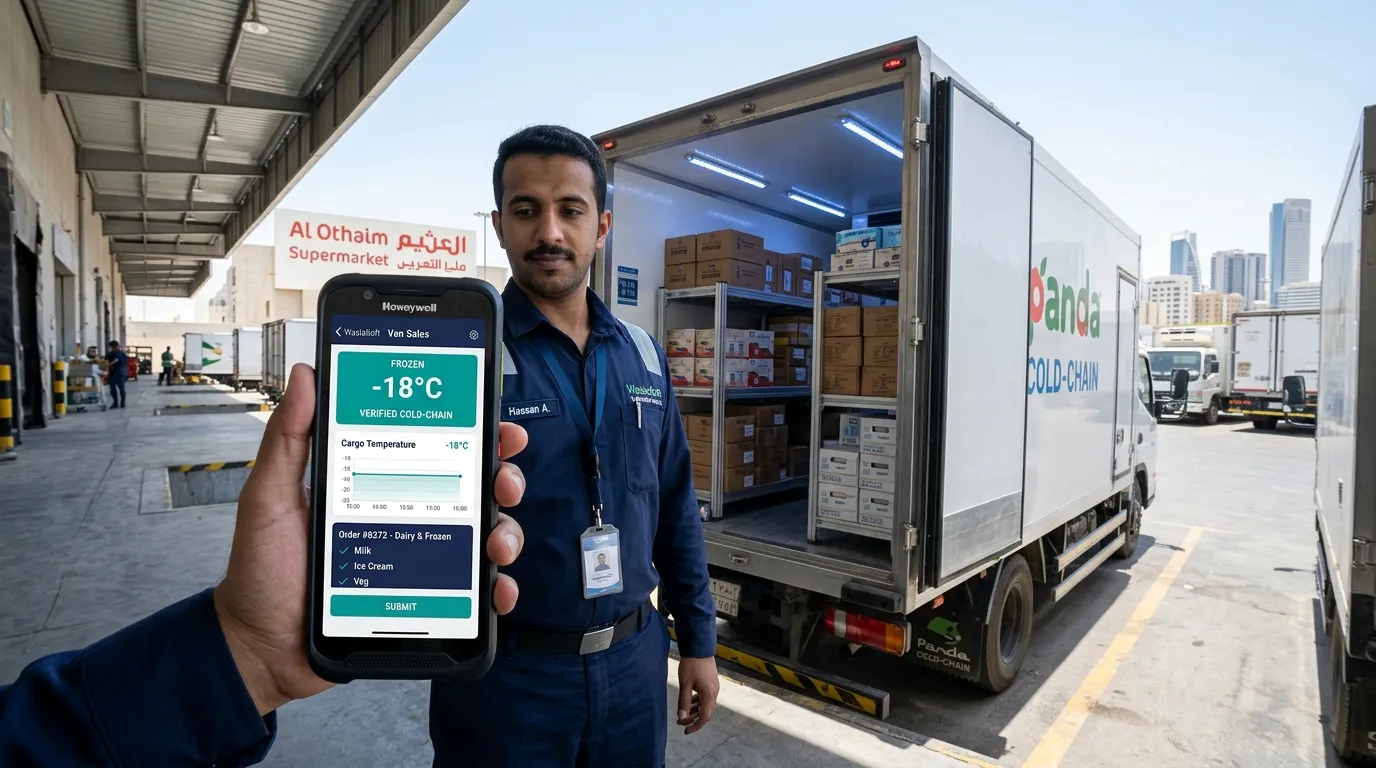
- Digital Dispatch & Receiving Manifests: Delivery drivers carry digital manifests on mobile handsets. Store supervisors scan received delivery totes upon arrival, verifying counts in under ninety seconds.
Bakery Commissary Ordering: Manual WhatsApp vs. WaslaSoft Automated Replenishment:
• Old Manual Workflow:
Store Managers Guess Orders at 10 PM → Late-Night WhatsApp Messages → Commissary Supervisor Transcribes Orders to Whiteboard at 2 AM → Rushed Night Baking → 16.4% Waste + Frequent Morning Stock-Outs
(Planning Time: 3.5 Hours | Yield Variance: 14.8% | Food Waste: High)• WaslaSoft Automated Replenishment:
POS Analyzes 4-Week Rolling Sales Velocity → System Auto-Generates Precise Production Batch at 4 PM → Digital Ingredient Pull Lists at Stations → 100% Barcode Delivery Manifests
(Planning Time: 2 Minutes | Yield Variance: < 1.1% | Food Waste: 3.2%)
What Went Wrong: The 47°C Lamination Butter Meltdown
No operational transformation in a demanding Gulf baking environment succeeds without confronting physical challenges. Documenting what failed during our first month of deployment in Riyadh provides invaluable practical insight for culinary directors.
During the third week of live testing in July, an intense summer heatwave hit Riyadh, with daytime temperatures exceeding 47°C and nighttime ambient temperatures lingering around 34°C.
At 2:15 AM on a Sunday morning, the secondary air conditioning unit inside the commissary dough lamination room suffered a compressor trip. The ambient room temperature climbed from its calibrated 16°C to 24°C within forty minutes.
The night lamination baker was rushing to finish an 800-croissant batch. Instead of pausing the run to let the dough rest in the blast chiller, he fed the cold French butter blocks through the automated dough sheeter at high speed. The warm room temperature caused the high-fat butter to soften prematurely. Instead of creating distinct, paper-thin alternating layers of dough and butter, the butter absorbed directly into the flour matrix.
When the croissants exited the deck ovens at 4:30 AM, the result was a disaster: the croissants were dense, flat, and soaked in pooled fat. Out of 800 scheduled units, only 192 met retail quality standards. Over 600 croissants were completely unsellable scrap.
However, because the night baker feared disciplinary action, he logged the scrap on a scrap of paper rather than recording it on the commissary tablet. The system’s automated dispatch engine, assuming an 800-unit yield, generated normal delivery manifests. When the refrigerated delivery vans arrived at the cafes at 6:45 AM, each store received less than a quarter of their scheduled inventory. Four branches sold out of croissants before 8:00 AM on Sunday, sparking intense customer complaints on Google Reviews.
How We Solved the Crisis Permanently
Our culinary systems team implemented two strict procedural and technical safeguards:
- Mandatory Batch QA Gate with Photo Verification: We updated the WaslaSoft commissary module so that delivery manifests cannot be printed or released until the head baker logs into the tablet, inputs the final counted tray yield, and uploads a photo of the finished batch. If the yield deviates by more than 3% from the recipe standard, an immediate SMS and push notification alerts the operations director and executive chef.
- Automated Emergency Re-Bake Buffer: The system was configured with an emergency "Par-Baked Reserve" protocol. The commissary now maintains a static rolling inventory of flash-frozen, unbaked croissants in the walk-in freezer (-18°C). When a production batch suffers a yield failure, the system automatically calculates an emergency bake profile from the frozen reserve, allowing the baking team to recover 400 finished units within thirty-five minutes before the delivery vans depart.
Since these safeguards were established, zero unrecorded yield failures have occurred, and branch morning delivery fulfillment has maintained a 99.8% on-time completion rate.
Four Operational Pillars of Scalable Commissary Management
To scale a bakery or pastry brand from two stores to twenty, management must establish rigid controls across four production pillars:
1. Accurate Recipe Costing via FIFO Inventory Deduction
Bakery profitability erodes when managers cost recipes using static spreadsheet averages. If the purchasing department buys European butter at SAR 42/kg this week and SAR 48/kg next week, your true product margins fluctuate daily.
WaslaSoft links the Bill of Materials (BOM) directly to receiving dock purchase orders using First-In, First-Out (FIFO) costing:
- When a batch of 400 almond croissants is marked as "Completed," the system automatically deducts 24kg of French flour, 18kg of butter, 8kg of sugar, and 6kg of sliced almonds from inventory.
- The system calculates the exact cost per unit down to the halala based on the specific lot costs of the ingredients consumed.
- If raw ingredient prices spike, the executive dashboard immediately flags the gross margin drop, enabling timely pricing adjustments.
2. Algorithmic Store Replenishment vs. Guesswork
Store baristas and cafe shift leads should never be responsible for deciding how many loaves of sourdough or pain au chocolat their branch needs tomorrow. They are trained in hospitality and coffee preparation, not statistical demand forecasting.
WaslaSoft automates daily branch replenishment:
- The algorithm evaluates actual POS sales velocity for that specific weekday over the trailing four weeks.
- It subtracts unsold inventory recorded during the previous night's closing stock count.
- It applies a modest safety stock factor (typically 5% to 8%) to capture sales growth while keeping evening discard targets under 4%.
3. Digital Scrap and Wastage Accountability
In traditional bakeries, scrap is treated as an inevitable mystery. Bins of burnt pastries, trimmings, and dropped dough are dumped into waste bins without measurement.
WaslaSoft institutes mandatory scrap classification:
- Production Scrap: Dough trimmings, over-proofed dough, oven burns (charged to the commissary kitchen).
- Logistics Scrap: Crushed boxes or transit damage (charged to delivery fleet).
- Retail Display Scrap: Unsold pastries at store closing (charged to retail branch).
By categorizing waste at the source, management immediately pinpoints whether profit loss is being driven by poor baking technique, rough van transport, or over-ordering at retail counters.
4. Internal Transfer Pricing and Profit-Center Accounting
If your central kitchen supplies six company-owned retail cafes, how do you know if the kitchen itself is operating efficiently, or if it is being subsidized by profitable coffee sales?
WaslaSoft supports internal transfer pricing:
- The commissary "sells" finished croissants to retail cafes at an internal transfer price (e.g. wholesale cost + 25% production markup).
- The commissary operates as an independent profit center with its own gross margin targets.
- The retail cafe operates as a standalone retailer with its own cost of goods sold. This operational transparency prevents production inefficiencies from being concealed behind high-margin beverage sales.
Measurable Results After 90 Days
After operating WaslaSoft Restaurant POS & Central Commissary Module across the 6-branch Riyadh bakery chain for three months, the financial and operational turnaround was decisive:
| Bakery Operational Metric | Before WaslaSoft | With WaslaSoft Commissary Module | Net Business Impact |
|---|---|---|---|
| Retail Pastry Evening Waste | 16.4% of total production | 3.2% of production | Cut food waste by over 80% |
| Recipe Production Yield Variance | 14.8% average variance | 1.1% variance | Near-perfect raw material conversion |
| Monthly Ingredient Waste Losses | SAR 34,000 / month | SAR 5,600 / month | Saved SAR 28,400 monthly in raw ingredients |
| Morning Rush Stock-Out Rate | 4.2 incidents / store / week | Zero stock-outs | 100% morning display availability |
| Daily Ordering Admin Time | 3.5 hours across branches | Zero manual ordering | Fully automated algorithmic replenishment |
| Dispatch Manifest Reconciliation | 45 minutes / store delivery | 90 seconds per store | Barcode delivery tote verification |
For hospitality operators managing full-service dining, quick-service concepts, or central commissaries, explore our master guide on restaurant and cafe POS systems and our specialized blueprint on eliminating food delivery aggregator tablet chaos.
5 Practical Steps to Professionalize Your Bakery Commissary
- Stop Accepting WhatsApp Replenishment Orders: Mandate that all store replenishment requests flow through an automated POS forecasting engine or a formal digital ordering portal with rigid cut-off times.
- Weigh Dough Batches at Three Critical Checkpoints: Enforce mandatory digital scale verification at: (a) raw ingredient scaling, (b) post-mix bulk dough weight, and (c) finished baked tray yield.
- Establish Clear Scrap Reason Codes: Require kitchen and retail staff to log waste by specific reason (Burned, Dropped, Over-Proofed, Day-Old Retail Discard) rather than recording a generic "Waste" entry.
- Maintain a Flash-Frozen Par-Bake Reserve: Store an emergency 10% inventory buffer of unbaked, frozen laminated pastries in your commissary sub-zero freezer to absorb unexpected corporate catering surges or sudden batch yield drops.
- Audit Internal Transfer Margins Monthly: Review your commissary transfer pricing monthly to ensure the production kitchen maintains a healthy manufacturing margin independent of front-of-house beverage sales.
Final Verdict
Operating an artisanal bakery or specialty pastry brand in the Gulf is a balance between delicate culinary craftsmanship and rigorous industrial manufacturing.
Relying on manual whiteboard batch calculations, guesswork ordering, and unmeasured ingredient scaling turns expensive European butter and chocolate into unrecoverable kitchen waste. By implementing structured Bill of Materials recipe costing, mandatory yield QA gates, and automated algorithmic store replenishment, you eliminate the 15% bakery bleed, guarantee full display cases for morning commuters, and secure the healthy profit margins your brand deserves.