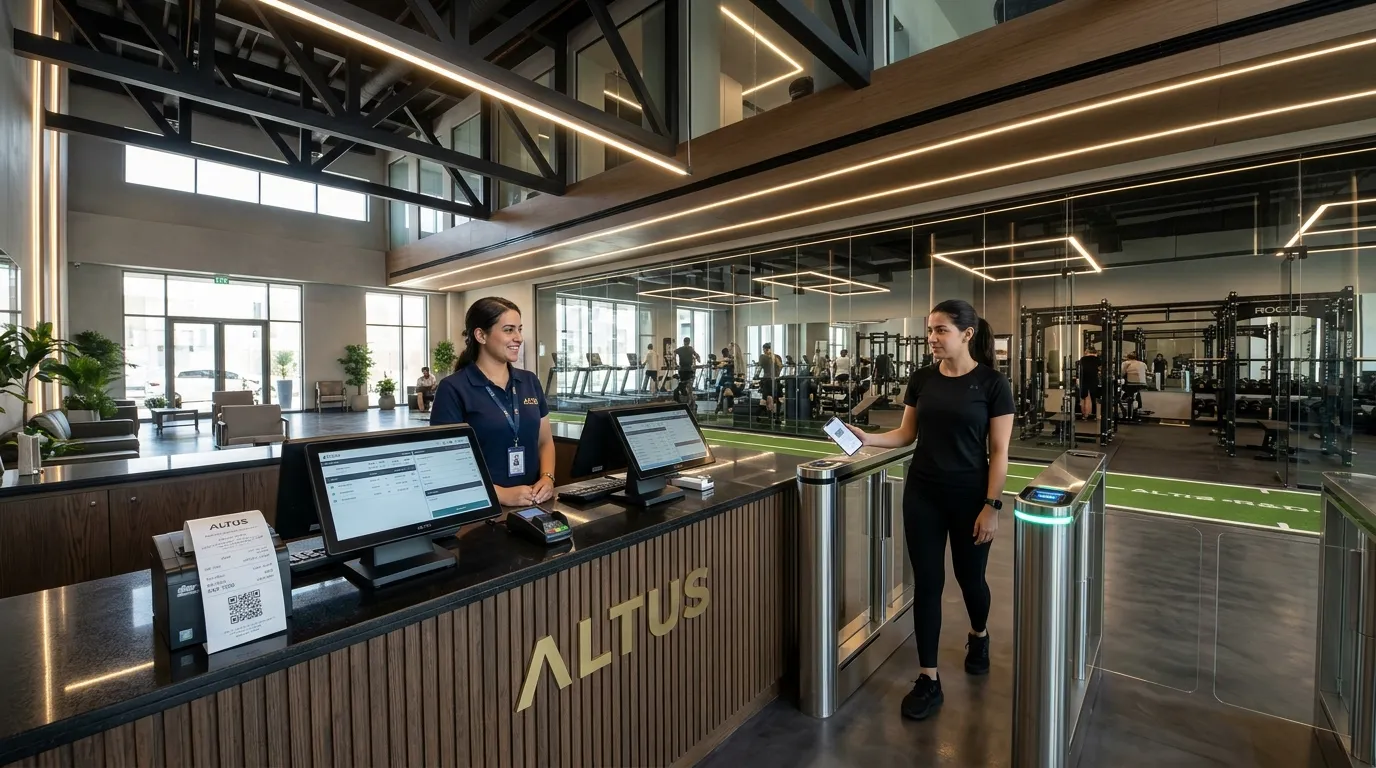
If your fitness club or boutique wellness studio is absorbing SAR 25,000 to SAR 55,000 every quarter in uncollected recurring membership renewals, turnstile buddy-tailgating, and disputed personal trainer commission payouts, your front-desk software is operating as a dumb cash register rather than an automated access and revenue engine.
The commercial fitness industry across Riyadh, Jeddah, Dammam, Dubai, Abu Dhabi, and Muscat is experiencing unprecedented expansion. Propelled by national wellness initiatives—such as the Quality of Life Program under Saudi Vision 2030—fitness operators are opening massive 24-hour franchises, high-intensity CrossFit boxes, boutique reformer Pilates studios, and dedicated ladies-only wellness centers.
Yet, behind the polished aesthetics and imported European strength machines, the daily reality inside many front offices is financially chaotic. Receptionists manually track membership freeze periods on shared Google Sheets. Expired members walk past un-synchronized turnstile gates because staff are busy answering phone inquiries. Personal trainers verbally book private clients on WhatsApp, only to engage in hostile end-of-month shouting matches with general managers over unpaid commission splits. Meanwhile, when members request plan upgrades or statutory summer freezes, accounting teams struggle to reconcile unearned deferred revenue against ZATCA Phase 2 E-Invoicing compliance.
Transforming a fitness facility into a predictable, high-margin enterprise requires eliminating the gap between the member access gate, the coaching floor, and the financial general ledger. This operational guide details how high-performing Gulf fitness operators deploy WaslaSoft POS and Multi-Branch Management to automate recurring subscription billing, lock down turnstile access with biometric security, and eliminate personal training commission leakage.
The Anatomy of Fitness Club Margin Bleed: Where the Money Evaporates
Unlike traditional retail where revenue is recognized immediately upon product exchange, a fitness club operates on a subscription annuity model. Profitability depends on maximizing Customer Lifetime Value (LTV), minimizing involuntary churn, and capturing ancillary revenue through personal training, sports supplements, and merchandise.
In un-integrated fitness operations, margins erode through four primary operational fissures:
Turnstile Tailgating and Buddy-Sharing (5% to 8% Capacity Dilution): Physical RFID keyfobs and plastic barcode membership cards are fundamentally insecure. In busy clubs, college students and working professionals routinely lend their access cards to friends or photograph the barcode on their smartphones. At evening peak hours (5:30 PM to 9:30 PM), when dozens of athletes enter per minute, desk staff cannot visually verify whether the face on the reception screen matches the person pushing through the gate. Unpaying guests consume locker space, wear down expensive cardio equipment, overcrowd peak-hour group classes, and dilute paying member satisfaction.
Failed Recurring Card Tokenization and Involuntary Churn (6% to 11% Monthly Drop-Off): Gyms that rely on members walking up to the counter every thirty days to swipe their card experience massive subscriber attrition. If a member's billing cycle lapses on a Tuesday, they may skip the gym for two weeks, realize they survived without working out, and cancel their subscription entirely. Furthermore, when clubs attempt automated card debits through generic e-commerce plugins, expired cards and banking authentication friction cause up to 15% of recurring charges to fail silently, with no automated dunning sequences to recover the lost revenue.
Disputed Personal Trainer (PT) Commission Math (4% to 6% of Coaching Revenues): Personal training represents the highest margin service in a fitness facility, with packages commanding between SAR 1,500 and SAR 4,500 for ten to twenty private sessions. However, tracking session execution manually is a recipe for accounting disaster. Trainers keep private pocket notebooks, claiming: "I trained Captain Ahmed four times this week." Meanwhile, the client calls reception three weeks later insisting they attended only one session. When the club pays the trainer a 40% commission split on unverified verbal reports, it ends up paying commissions on ghost sessions, only to face client refund demands when the package expires prematurely.
Membership Freeze Accounting Chaos & ZATCA Non-Compliance: Under regulatory guidelines established by the Saudi Ministry of Sport and municipal commerce authorities, gym members hold statutory rights to freeze their annual contracts (typically up to 60 days per year) for travel, religious pilgrimages (Hajj/Umrah), or certified medical conditions. When a front-desk agent manually pauses an account on a spreadsheet without adjusting the accounting system, unearned revenue balances distort. The club recognizes revenue it has not yet delivered, resulting in erroneous VAT filings and unexpected cash shortfalls when frozen members return to exercise months later.
Modern Access Control: Dynamic QR Codes and Biometric Turnstiles
The first line of defense in protecting gym revenue is the physical perimeter. A commercial fitness club cannot afford to treat turnstiles as isolated mechanical gates; they must function as real-time network endpoints connected directly to the central member billing database.
Traditional access hardware fails because it relies on static credentials:
The Flaw of Static Credentials:
- Plastic RFID Cards: Cost SAR 10 to SAR 20 to procure, easily lost by members, and endlessly swapped between friends outside the entrance.
- Static Mobile Screenshots: A member logs into their mobile account, screenshots their barcode, and sends it via WhatsApp to two colleagues who use it to enter during alternate shifts.
- Manual Reception Check-in: Creates twenty-person queues during peak post-work hours, frustrating high-paying members and causing receptionists to simply buzz the gate open for everyone.
How WaslaSoft Secures the Access Perimeter
WaslaSoft connects directly with leading speed-gate manufacturers—including magnetic optical flap barriers, full-height exterior turnstiles, and ADA-compliant motorized glass gates—using high-speed local controller protocols:
Dynamic Time-Based QR Codes (TOTP Technology): Inside the WaslaSoft branded member mobile app, the entrance barcode is not a static graphic. The software generates a dynamic, encrypted QR code that rotates every fifteen seconds using Time-Based One-Time Password (TOTP) algorithms. If a member attempts to take a screenshot and send it to a friend, the code expires before the friend arrives at the gym door. The scanner reads the dynamic payload, validates the cryptographic token against the local controller, and unlocks the speed gate in less than 300 milliseconds.
High-Speed Optical Facial Recognition: For premium executive health clubs and 24-hour unstaffed facilities, WaslaSoft integrates high-precision dual-lens infrared biometric terminals. When a member enrolls, a rapid 3D facial mesh is captured at the reception desk. Upon arrival, the member simply glances at the scanner atop the turnstile. The terminal matches the face against the local active member registry even if the member is wearing a sports cap, glasses, or light makeup, granting hands-free entry while completely eliminating buddy-sharing.
Automated Status-Based Gate Logic: The gate controller does not simply check whether an ID exists; it evaluates real-time business rules:
- Active Subscription: Flap opens smoothly with green LED confirmation.
- Frozen Membership: Gate locks with amber LED; display reads: "Subscription Frozen — Visit Reception to Reactivate."
- Payment Past Due: Gate locks with red LED; display directs member to tap the mobile app to settle outstanding dues.
- Gender Schedule Violation: In facilities with alternating male and female hours, the system blocks entry based on current clock schedules, preventing embarrassing regulatory violations.
Real-World Implementation Breakdown: What Went Wrong in Riyadh's Olaya & Hittin Clubs
To illustrate the financial impact of disjointed gym software, examine the crisis faced by a three-branch boutique fitness operator running premium clubs across the Olaya, Hittin, and Al Malqa districts of Riyadh.
In late 2025, the executive board conducted an operational audit following months of frustrating cash-flow bottlenecks. Despite boasting 2,400 active registered members and an enviable reputation for high-end coaching, the chain experienced an annual revenue leakage exceeding SAR 280,000.
The audit revealed three devastating failure modes across their locations:
- Over 140 non-paying individuals were using the facilities weekly using cloned RFID cards or taking advantage of tailgating during peak evening hours.
- A senior personal trainer who resigned to launch his own private studio had logged 48 personal training sessions in his final month. When clients were contacted, 60% revealed those sessions never took place, representing SAR 36,000 in fraudulent commission payouts.
- Receptionists had manually processed 320 membership freeze requests on desktop spreadsheets during the summer vacation period. Because these notes were never synced with the turnstiles, members enjoyed two months of free workouts while their official contracts remained paused, extending their membership dates by an extra 60 days without paying a single riyal.
Our retail and hospitality engineering team was deployed to conduct a five-day operational overhaul across all three locations.
The Remediation Architecture Implemented
We retired their disconnected front-desk software and deployed WaslaSoft's specialized Fitness & Studio POS engine:
WASLASOFT INTEGRATED GYM OPERATIONAL ARCHITECTURE:
- Member Registration: Digital National ID / Iqama scan with photo capture & health waiver
- Automated Recurring Card Tokenization (mada / Apple Pay recurring mandate)
- Real-Time Turnstile Edge Controller: Dynamic 15-second rotating mobile QR + Biometric Face ID
- Automated Access Gate Evaluation: Active vs Frozen vs Overdue billing validation
- Gym Floor PT Session Handshake: Client dynamic QR scan on trainer tablet to burn session credit
- Self-Service Member Portal: Automated freeze requests with unearned revenue recalculation
- ZATCA Phase 2 E-Invoicing Engine: Automated sequential tax invoices for subscription renewals
- Multi-Branch Roaming Ledger: Automatic revenue-sharing splits between home and visiting branches
1. The Gym Floor PT Handshake Gate
We eliminated paper training logs and verbal manager reports. We deployed dedicated 10-inch rugged tablets across the free-weight and functional fitness floors. When a personal trainer meets a client for a private session, the trainer cannot claim the session credit unilaterally. The client must present their smartphone, and the trainer scans the member's dynamic QR code using the floor tablet camera. Alternatively, the client inputs a 4-digit one-time PIN sent via SMS to their registered mobile number. The moment the handshake completes:
- Exactly one session credit is decremented from the client's package balance.
- An automated SMS notification confirms the session completion to the client: "Session 4 of 12 completed with Coach Tariq."
- The trainer's verified commission balance increments automatically on the corporate payroll ledger.
If a client disputes remaining sessions at the front desk, management pulls up the immutable audit trail displaying the exact minute, tablet location, and verification method used for every single workout.
2. Automated mada Recurring Subscriptions & Smart Dunning
We migrated all members from manual monthly counter payments to automated card tokenization using Saudi mada and GCC banking gateways:
- On the monthly renewal date, WaslaSoft executes an automated recurring debit in the background.
- If the transaction succeeds, the system automatically issues a certified ZATCA Phase 2 E-Invoice with cryptographic stamp and QR code, sending the receipt via WhatsApp and updating turnstile permissions in real time.
- If the card fails (due to insufficient funds or card replacement), the system initiates an automated Smart Dunning Workflow:
- Day 0: Instant polite SMS and WhatsApp alert notifying the member with a one-click payment link.
- Days 1 to 3 (Grace Period): Turnstile allows entry with an amber reminder prompt on the screen.
- Day 4: System automatically restricts turnstile entry and sends a final payment reminder.
- Day 5: Automated secondary charge attempt.
Within four months of implementing this automated workflow, the Riyadh fitness chain recovered over 84% of previously lost recurring subscription revenue, eliminated 100% of turnstile ghost entries, and completely stopped personal training commission disputes, restoring over SAR 240,000 in annual net profit.
Managing Deferred Revenue and ZATCA Phase 2 on Membership Freezes
One of the most complex accounting obligations in the fitness sector is managing membership freeze accounting in compliance with ZATCA electronic invoicing mandates and international accounting standards (IFRS 15 - Revenue from Contracts with Customers).
When an athlete purchases an annual gym membership for SAR 3,600 (plus 15% VAT of SAR 540, total SAR 4,140):
- The Invoicing Event: The club issues a full ZATCA Phase 2 tax invoice on Day 1 for SAR 4,140 and remits the SAR 540 VAT to ZATCA in that reporting period.
- The Revenue Recognition Trap: The remaining SAR 3,600 cannot be recognized as immediate revenue on the profit-and-loss statement. It must be recognized as an Unearned Revenue Liability and amortized at SAR 300 per month across the 12-month period.
- The Freeze Complication: If the member exercises their statutory right to freeze their contract for two months during July and August, the amortization schedule must pause immediately:
- Monthly revenue recognition for July and August drops to SAR 0.00.
- The contract expiration date shifts from December 31 to February 28 of the following year.
- Turnstile access permissions lock automatically during the freeze window.
- If the member attempts to break their freeze early by entering the gym on August 15, WaslaSoft automatically ends the freeze, resumes monthly revenue amortization, and adjusts the final contract end date accordingly.
By managing this entire financial schedule automatically inside WaslaSoft Multi-Branch ERP, club finance directors avoid massive balance sheet distortions and ensure that internal accounting matches physical facility usage with mathematical precision.
Multi-Branch Access: Managing Inter-Club Roaming Revenue Splits
For regional fitness chains operating multiple locations across Riyadh, Jeddah, or the Eastern Province, selling multi-club "All-Access" memberships is a powerful sales driver. However, it creates severe internal cost discrepancies:
- A member signs up and pays their SAR 4,000 annual membership at the residential Al Malqa branch (where the branch sales rep earns the commission).
- Because the member works downtown, they conduct 85% of their workouts, shower, and consume locker amenities at the high-cost Olaya corporate branch.
- The Olaya branch incurs all operating expenses (towel laundry, water, equipment wear, facility rent), while the Al Malqa branch pockets the revenue.
Automated Inter-Branch Cost Allocation in WaslaSoft
WaslaSoft solves this through an automated Internal Roaming Settlement Engine:
- Every time a member scans their biometric face or dynamic QR code at a non-home club, the system logs a "Visiting Workout Unit".
- At the end of the monthly accounting cycle, the ERP calculates inter-branch usage ratios and executes automated internal journal entries, transferring a contractual fee (e.g., SAR 25 per visit) from the originating sales branch to the host facility.
- This ensures that every club general manager is fairly compensated for member traffic, encouraging high hospitality standards across all chain locations without inter-branch friction.
Practical Implementation Checklist for Gulf Fitness Club Operators
To modernize your health club, combat revenue leaks, and achieve complete regulatory compliance, follow this phased operational implementation plan:
Upgrade Physical Turnstiles to Dynamic Optical Gates:
- Decommission physical plastic RFID cards. Deploy optical speed gates equipped with dynamic time-based QR scanners and infrared facial recognition cameras.
- Configure local edge controllers to ensure turnstiles operate with sub-second latency even during complete internet connectivity drops.
Automate Recurring Subscriptions via mada Tokenization:
- Transition your front desk from manual monthly card swipes to automated recurring card mandates with smart dunning recovery workflows.
- Ensure every automated charge triggers an instant ZATCA Phase 2 electronic tax receipt delivered to the member via WhatsApp.
Deploy Digital Gym Floor PT Handshake Tablets:
- Strictly prohibit paper personal training sheets or verbal manager logs.
- Mandate client QR or OTP verification on gym floor tablets before any trainer can burn a session credit and claim payroll commission.
Automate Statutory Membership Freezes:
- Provide members with self-service freeze options inside the branded mobile app in accordance with Ministry of Sport rules.
- Ensure the software automatically pauses turnstile access and recalculates unearned revenue amortization schedules without manual spreadsheet intervention.
Establish Inter-Branch Revenue Sharing Protocols:
- If operating multiple facilities, configure automated internal roaming transfer fees based on verified turnstile check-ins to balance branch operating costs.
The Bottom Line: Powering Fitness Growth with Intelligent Club Management
A commercial fitness club is a community health hub where business success depends on member engagement, inspiring coaching, and flawless operational logistics. Your club managers should spend their days motivating members, coaching trainers, and expanding wellness offerings—not hunting for expired cards at the front gate, mediating screaming matches over trainer commission splits, or untangling spreadsheet errors.
By replacing disconnected cash registers and manual clipboards with WaslaSoft's unified fitness POS architecture—integrating dynamic turnstiles, recurring card tokenization, verified PT session handshakes, and ZATCA Phase 2 tax compliance—you eliminate operational leakage and protect your club operating margins.
Discover how WaslaSoft Retail and Service POS and WaslaSoft Multi-Branch ERP help fitness chains, CrossFit boxes, and wellness studios across Saudi Arabia, the UAE, and Oman maximize recurring revenue. Schedule an operational demo with our fitness systems team today.