
The Caliber Code: How Gulf Ceramic, Porcelain & Marble Showrooms Eliminate Shade Lot Mismatches, Staged Warehouse Leaks, and Box-to-Meter Billing Errors
At 10:15 AM on a blistering Tuesday along Al-Kharj Road in southern Riyadh or Industrial Area 4 in Sharjah, an agitated villa finishing contractor storms into the executive office of a premier ceramic and porcelain showroom. His tiling crew has just laid 280 square meters of 120x60cm rectified porcelain across the main ground-floor reception majlis of a private palace in the Hittin district. As the morning sunlight poured through the double-height curtain walls, an undeniable disaster was exposed: the southern half of the majlis glowed with a warm, creamy ivory tint, while the northern half appeared cool, chalky, and ash-gray.
When the site engineer inspected the empty cardboard cartons stacked in the courtyard, the catastrophic failure was revealed. The showroom warehouse had fulfilled the 280-square-meter order using two separate production batches: 130 cartons from Tone 44 / Caliber 03, and 65 cartons from Tone 49 / Caliber 04. To the warehouse laborers loading flatbed trucks under dim mercury-vapor lamps, the boxes looked virtually identical. To the master tiler working under construction halogen floods, the wet thin-set mortar obscured the nuance. But cured under natural Riyadh desert daylight, the subtle chemical variations in the kiln firing run created an unmistakable checkerboard floor.
The financial fallout was swift: the palace owner refused handover, demanding complete floor demolition, replacement of ruined imported porcelain, reimbursement for specialized polymer-modified adhesive, and liquidated delay penalties exceeding SAR 180,000.
This operational disaster plays out across the Arabian Gulf hundreds of times every month. The commercial building materials, architectural porcelain, and natural stone sector across Saudi Arabia, the UAE, Qatar, Kuwait, Bahrain, and Oman is experiencing an unprecedented boom driven by mega-projects, master-planned residential communities, and private luxury villa developments. Yet, behind prestigious architectural glass showrooms displaying bookmatched Italian marble and Spanish slabs, operational back offices are collapsing under inventory mismanagement, shade lot mismatches, manual box-to-meter calculation errors, and uncontrolled staged deliveries.
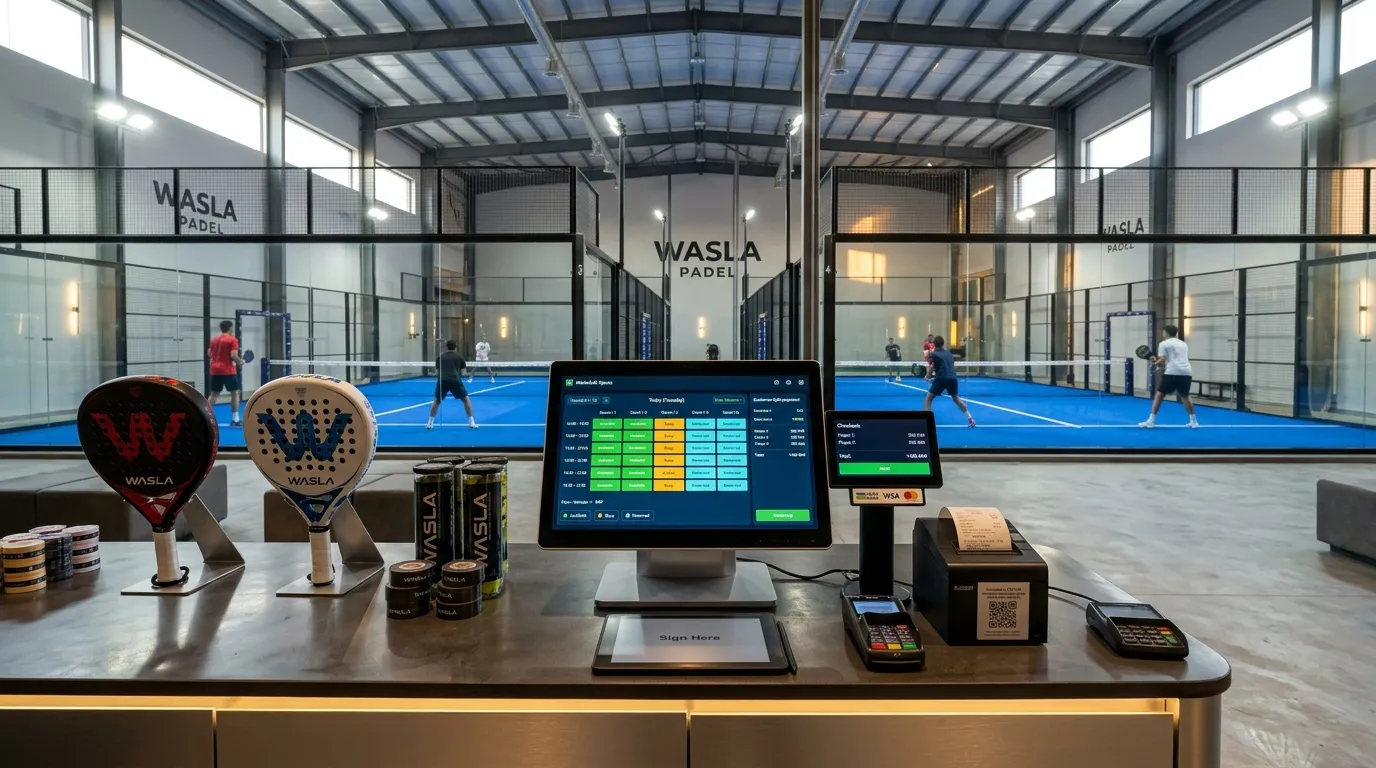
Modernizing this massive trade requires trading obsolete generic retail software for an enterprise engine built specifically for the physical realities of architectural stone: WaslaSoft Retail and Enterprise Building Materials POS.
1. The Chemistry of Dye Lots: Why Tiles Are Not Standard Retail SKUs
Standard retail inventory systems operate on a fatal assumption: that two items sharing the same barcode and item code are identical. In fast-moving consumer goods or packaged electronics, a product manufactured in March matches one produced in November. In architectural ceramics and porcelain, this assumption destroys businesses.
The Physics of Kiln Variations: Tone and Caliber
Ceramic and porcelain tiles are manufactured from natural clay, feldspar, quartz, and mineral oxides subjected to extreme hydraulic pressing and fired in continuous roller kilns at temperatures exceeding 1,200 degrees Celsius. Even in the most technologically advanced factories in Castellon, Spain, or Sassuolo, Italy, minute environmental shifts produce two physical variances:
- Tone (Shade / رقم الطبخة والنغمة): Atmospheric humidity, mineral trace concentrations in raw clay, and minor kiln temperature fluctuations alter the glaze vitrification. The resulting color shift is classified into distinct production "Tones" (e.g., Tone 52 vs. Tone 54). Tiles from different tones can never be installed within the same visual sightline.
- Caliber (Work Size / رقم الكاليبر والمقاس الفعلي): Firing causes thermal shrinkage between 7% and 10%. Rectified tiles are mechanically cut, but structural shrinkage leaves dimensional differences measured in fractions of a millimeter. A 600x600mm tile might leave the kiln as Caliber 01 (598.5mm) or Caliber 02 (600.0mm). Mixing differing calibers within a single room ruins grout joints and causes lippage.
| Operational Factor | Generic Retail POS Failure | WaslaSoft Building Materials Architecture |
|---|---|---|
| Batch Resolution | Single SKU pool for 15,000 m² inventory | Composite Key: SKU + Production Tone + Caliber Code |
| Checkout Verification | Sells available balance regardless of batch origin | Enforces Single-Lot reservation; blocks split lots without manager override |
| Warehouse Picking | Generic pick slip lists product name and total cartons | Barcode scanner verifies SKU, Tone, and Caliber before truck loading |
| Customer Disclosure | No batch record on printed invoice | Prints Tone and Caliber clearly on ZATCA Phase 2 tax invoices |
Enforcing the Composite Barcode Architecture
WaslaSoft treats ceramic inventory through a multi-dimensional ledger. Every incoming ocean container from Spain, Italy, India, or China is registered down to the pallet level:
$$\text{Unique Pallet Identifier} = \text{SKU} + \text{Production Batch} + \text{Tone Lot} + \text{Caliber} + \text{Warehouse Bin}$$
When a client selects a porcelain model in the showroom, the WaslaSoft POS terminal scans the display sample and immediately displays available stock partitioned by individual tone lots. If a contractor requires 400 square meters for a villa reception and the showroom holds 320 m² of Tone A1 and 250 m² of Tone A2, the system prohibits the cashier from creating a single unified picking slip. The sales consultant is prompted to allocate the 320 m² to the ground floor reception and the 250 m² to the isolated first-floor bedrooms, printing separate, color-coded installation tickets for the site supervisor.
2. The Conversion Conundrum: Square Meters to Whole Cartons and Scrap Factors
The commercial dialogue in a tile showroom occurs in square meters, but physical fulfillment occurs exclusively in whole cardboard cartons and wooden pallets. This dual-unit reality generates immense margin leakage when handled through manual cashier calculations.
The Mathematics of Box Rounding
Architectural floor plans specify exact net room areas—for instance, a master suite measuring $184.6 \text{ m}^2$. However, porcelain tiles are manufactured in fixed physical dimensions:
- Large Format (60x120 cm): Packed 2 tiles per carton = $1.44 \text{ m}^2$ per box.
- Medium Format (80x80 cm): Packed 3 tiles per carton = $1.92 \text{ m}^2$ per box.
- Slim Facade Slabs (120x278 cm): Packed individually in specialized timber A-frames or crates.
Dividing $184.6 \text{ m}^2$ by $1.44 \text{ m}^2$ yields $128.194$ cartons. In an untrained showroom environment, cashiers either round down to 128 boxes (leaving the tiler short by $0.28 \text{ m}^2$ at the doorstep) or enter $184.6$ directly into the POS, prompting the warehouse to open sealed manufacturer cartons and send loose, unprotected tiles that shatter during transport.
Furthermore, no professional tile installation occurs at 0% waste. Cutting around columns, electrical floor boxes, plumbing floor drains, and perimeter perimeter baseboards creates physical scrap. A standard rectilinear installation requires a 10% scrap allowance, while herringbone, chevron, or 45-degree diagonal patterns demand 15% to 18%.
The WaslaSoft Flooring Calculation Engine
WaslaSoft embeds a real-time architectural calculation engine directly into the checkout interface:
- Net Dimension Entry: The sales consultant inputs the contractor's net room dimensions ($184.6 \text{ m}^2$).
- Installation Pattern Selection: The consultant toggles between "Straight Grid (+10%)", "Staggered Running Bond (+12%)", or "Diagonal (+15%)". Selecting straight grid adds $18.46 \text{ m}^2$, establishing a gross requirement of $203.06 \text{ m}^2$.
- Automated Carton Quantum: The engine divides gross area by the SKU carton factor ($1.44 \text{ m}^2$), calculating $141.01$ boxes, and automatically rounds up to 142 whole cartons ($204.48 \text{ m}^2$).
- Pallet Layer Optimization: The system checks pallet packing standards (e.g., 36 cartons per pallet = 3 full pallets + 34 loose cartons) to optimize warehouse fork-truck travel.
WaslaSoft Flooring Calculator Parameter Audit
- Net Room Area: 184.60 m²
- Installation Pattern: Straight Grid (10% Scrap Allowance)
- Gross Area Required: 203.06 m²
- Carton Coverage (SKU): 1.44 m² / Carton (2 tiles, 60x120cm rectified)
- Mathematical Cartons: 141.01 Cartons
- POS Billed Cartons: 142 Whole Cartons (204.48 m²)
- Pallet Breakdown: 3 Full Pallets (108 ctns) + 34 Loose Cartons
- Reserved Lot Status: Tone 52 / Caliber 02 (Pallet Bins: WH2-D12..D15)
This automated conversion eliminates fractional carton sales, prevents opened-box stock returns, and ensures the contractor finishes the job without panic phone calls for matching tone boxes.
3. Staged Contractor Deliveries: Solving the "Ghost Stock" Nightmare
In the residential villa and commercial hospitality market across Riyadh, Jeddah, Dubai, and Doha, customers rarely take delivery of their entire tile purchase at once. A villa owner finalizing finishes during Foundation Day promotions may purchase 1,200 square meters of porcelain in February to secure discounts and guarantee lot uniformity, but request delivery across four distinct construction phases:
- Phase 1 (March): Basement floors and service quarters (300 m²).
- Phase 2 (April): Ground floor reception and outdoor patios (450 m²).
- Phase 3 (May): First floor family bedrooms and dressing suites (350 m²).
- Phase 4 (June): Rooftop recreation annex and perimeter boundary walls (100 m²).
The Peril of Generic Inventory Systems
When managed through spreadsheet workarounds or basic point-of-sale software, staged deliveries create two operational catastrophes:
- The Phantom Depletion Trap: If the cashier bills the invoice as "delivered" in February to record revenue, the physical warehouse shows 1,200 m² of inventory on the shelves that doesn't exist on the balance sheet. During physical stock-takes, auditors flag massive unexplained surpluses.
- The Accidental Resale Trap: If the cashier holds the order as an unconfirmed quote or open order without hard reservation, the central warehouse view shows 1,200 m² as "Available". Three weeks later, an aggressive showroom sales consultant sells those exact pallets to a cash customer walking into the store. When the contractor requests his Phase 2 delivery in April, his reserved tone lot is gone.
Available-to-Promise (ATP) Staging Architecture
WaslaSoft resolves staged fulfillment through a three-tier inventory reservation architecture:
- On-Hand Physical Stock: Total pallets physically present inside the central warehouse.
- Reserved Project Allocation: Stock sold and legally owned by clients, physically staged in allocated warehouse bay bins.
- Available-to-Promise (ATP): Free stock available for showroom sales consultants to quote and bill.
$$\text{Available to Promise (ATP)} = \text{Physical On-Hand} - \text{Reserved Project Stock} - \text{Safety Buffer}$$
When a staged contract is executed, WaslaSoft issues a ZATCA Phase 2 compliant Tax Invoice for the contract value while generating a master Project Fulfillment Record. As the contractor's site manager calls in delivery requests, dispatchers issue sequential Partial Delivery Notes.
Each delivery note generates mobile picking lists for forklift drivers, prints barcode shipping manifests, and prompts the flatbed driver to capture the contractor's digital signature and GPS delivery pin upon site drop-off. The project balance decreases in real-time, preventing stock cannibalization.
4. Natural Marble Bundles & Bookmatched Slab Serial Control
Manufactured ceramic tiles, despite tone variations, come in uniform cartons. Natural marble, granite, quartzite, and onyx represent an entirely different operational paradigm.
The Individuality of Natural Stone
Imported natural marble blocks from Carrara, Volakas, or Alicante are sawn into continuous slabs of 20mm or 30mm thickness. No two slabs are identical; veining patterns flow sequentially through the original quarry block like pages in a book.
High-end Gulf residences feature Bookmatched (البوك ماتش) feature walls in formal reception majlises and master bathrooms, where two or four consecutive mirror-cut slabs are positioned side-by-side to create symmetrical geometric veining.
If a showroom manages marble as generic square meters, disaster strikes. A sales consultant might sell Slab #12 and Slab #15 from a bundle to two walk-in vanity customers. Two days later, a luxury villa client arrives willing to pay SAR 40,000 for a bookmatched quartet (Slabs #11, #12, #13, #14). Because Slab #12 was sold out of sequence, the remaining slabs can no longer be bookmatched, destroying 60% of the bundle's commercial value.
Quarry Block #B-8841 (Italian Statuario Extra) Slab Sequence
- Slab #11 (A-Cut): 310 cm × 185 cm = 5.735 m² | Bookmatched Pair 1 (Mirror A)
- Slab #12 (B-Cut): 310 cm × 185 cm = 5.735 m² | Bookmatched Pair 1 (Mirror B - Locked with Slab #11)
- Slab #13 (A-Cut): 310 cm × 185 cm = 5.735 m² | Bookmatched Pair 2 (Mirror A)
- Slab #14 (B-Cut): 310 cm × 185 cm = 5.735 m² | Bookmatched Pair 2 (Mirror B - Locked with Slab #13)
Serialized Slab Ledger in WaslaSoft
WaslaSoft Stone & Marble edition introduces slab-level serialization:
- Block & Bundle Tagging: Every bundle carries the quarry origin, block registration, and finish (Polished, Honed, Flamed, Bush-hammered).
- Sequential Slab Indexing: Slabs are barcoded individually with exact dimensions measured to the centimeter (e.g., $3.12\text{m} \times 1.84\text{m} = 5.74 \text{ m}^2$).
- Bookmatch Pair Locking: Mirror-cut slabs are designated as linked pairs (A/B). The system locks them together: a sales consultant attempting to bill an individual slab from a bookmatched pair triggers an automated validation warning requiring branch manager authorization.
- Visual Slab Gallery Integration: High-resolution digital photographs of each slab face are linked to the inventory record, allowing showroom consultants to present real veining patterns to architects and owners on tablets without pulling heavy 300-kg stone slabs from storage racks.
5. Heavy Logistics: Axle Weights, Gross Vehicle Weight, and MOT Highway Compliance
Operating a tile and stone business is fundamentally a heavy materials logistics enterprise. The physical weight of ceramic and natural stone exposes distributors to severe regulatory liabilities under Gulf transport regulations.
The Physical Mass of Flooring
| Material Classification | Nominal Thickness | Weight per Square Meter ($m^2$) | Metric Tonnage per 500 $m^2$ |
|---|---|---|---|
| Glazed Ceramic Wall Tile | 8 mm | 14 – 16 kg | 7.5 – 8.0 Metric Tons |
| Vitrified Porcelain Floor Tile | 10 mm | 21 – 24 kg | 10.5 – 12.0 Metric Tons |
| Heavy Outdoor Porcelain Paver | 20 mm | 44 – 48 kg | 22.0 – 24.0 Metric Tons |
| Natural Marble Slab | 20 mm | 54 – 60 kg | 27.0 – 30.0 Metric Tons |
| Thick Granite / External Kerb | 30 mm | 82 – 88 kg | 41.0 – 44.0 Metric Tons |
Under regulations enforced by the Saudi Ministry of Transport and Logistic Services (MOT), the UAE Federal Transport Authority, and regional road policing divisions, heavy commercial vehicles must adhere to strict Gross Vehicle Weight (GVW) and axle weight thresholds. Mobile weigh stations and automated dynamic road sensors on highways (such as the Riyadh-Dammam corridor or Sheikh Mohammed Bin Zayed Road) impose immediate fines ranging from SAR 5,000 to SAR 20,000 for overloaded trucks, alongside mandatory roadside cargo offloading.
Automated Dispatch Weight Calculation
Generic POS systems record item quantities without physical mass awareness. A showroom dispatcher might assign a 700-square-meter porcelain delivery to a standard 3-axle rigid flatbed with an 18-ton payload limit. At 23 kg per square meter, the cargo weighs 16.1 metric tons; when combined with heavy wooden pallets ($45 \text{ kg} \times 20 = 0.9 \text{ tons}$) and the vehicle tare weight, the truck triggers an axle overload violation at the first highway scale.
WaslaSoft incorporates real-time load calculation algorithms directly into the warehouse fulfillment flow:
- Dynamic Pallet Mass Calculation: Every tile SKU maintains a precise unit weight per square meter and box tare specification.
- Fleet Fleet Constraints: The delivery dispatch module maintains profiles for the showroom's transport fleet—from small 3.5-ton Dyna trucks to 40-ton articulated semi-trailers—complete with statutory GVW and payload ratings.
- Automated Multi-Vehicle Splitting: When an order exceeds a vehicle's maximum permissible legal payload, the dispatch engine automatically splits the shipment into legal trip manifests, generating sequential delivery waybills and crane offloading schedules.
- Waybill & Driver Bay Integration: Generates standardized transport manifests complete with vehicle plate numbers, driver mobile credentials, and total gross tonnage, ensuring smooth clearance at highway inspection checkpoints.
6. Financial Architecture: Contractor Credit, Retention Balances, and ZATCA Phase 2
The commercial relationships between tile showrooms and finishing contractors differ fundamentally from cash retail. Contractors operate on structured milestone terms, requiring specialized financial tracking within the point-of-sale environment.
Managing Contractor Retentions
On major residential projects, finishing contractors typically negotiate credit terms: 30% advance upon contract signing, 60% upon progressive site deliveries, and a 10% retention holdback payable 60 days following successful client handover and architectural snagging clearance.
Basic retail cash registers cannot handle conditional retention balances: they either classify the retention as bad debt or refuse to complete the delivery note until the balance is paid in full. WaslaSoft tracks contractor aging ledgers with automated credit limit controls:
- Credit Limit Ceiling: Enforces authorized exposure limits per contractor. If unpaid invoices exceed SAR 250,000, new delivery notes require financial controller approval.
- Retention Escrow Ledger: Isolates retention holdbacks into a distinct sub-ledger with scheduled release dates linked to project completion milestones.
- Advance Deposit Amortization: Automatically amortizes initial contractor deposits proportionately across progressive delivery invoices, ensuring clean audit trails.
ZATCA Phase 2 E-Invoicing Compliance for Construction Retails
Under the Saudi Zakat, Tax and Customs Authority (ZATCA) Phase 2 e-invoicing framework, building material distributors face strict electronic compliance rules. Every invoice issued—whether a retail cash sale in the showroom or a 50-ton project milestone invoice for a commercial contractor—must be cryptographically stamped and submitted to the ZATCA Fatoora portal.
WaslaSoft ensures compliance across every scenario:
- B2C Simplified E-Invoices: Instant cryptographic QR code generation on thermal receipts for retail walk-in villa owners paying via Mada, Visa, or bank transfer.
- B2B Standard Tax Invoices: Real-time generation of compliant Phase 2 XML invoices with cryptographic signatures, cryptographic hashes, and unique UUIDs for registered construction firms and interior design corporations.
- Contractor Advance Payments & Credit Notes: Generates compliant Tax Advance Invoices when deposits are received, and issues compliant Credit Notes if returned unopened cartons or agreed site discounts occur, synchronizing financial records with ZATCA regulations without friction.
7. Frequently Asked Questions (FAQ)
How does WaslaSoft prevent mixing differing tone lots and calibers on a single project invoice?
In the ceramic industry, every production run from industrial kilns results in slight variations in color shade (Tone/Dye-Lot) and physical shrinkage (Caliber). Standard retail systems treat 10,000 square meters of a tile as a single uniform SKU. WaslaSoft tracks inventory at the sub-batch level, combining SKU, Tone, and Caliber into a composite barcode. When a sales consultant prepares an order for 250 square meters, the system checks whether the requested quantity can be fulfilled from a single contiguous lot. If stock must be split across two separate production runs, the POS blocks the checkout and requires branch manager approval and a printed customer acknowledgment disclaimer.
How does the system calculate whole cartons and wastage percentages from floor plan square meters?
Customers and architectural drawings specify tile requirements in raw square meters (m²), but factories package tiles in fixed box increments (such as 1.44 m² for 60x120cm tiles or 1.92 m² for 80x80cm tiles). WaslaSoft incorporates an automatic flooring calculation engine: cashiers input room dimensions or net area, choose an installation pattern (straight 10% waste, diagonal or herringbone 15% waste), and the system automatically calculates the exact gross area and rounds up to the nearest whole carton. It prevents cashiers from invoicing fractional boxes, completely eliminating warehouse dispatch discrepancies.
How are staged contractor deliveries managed without ghost stock or accidental stockouts?
Contractors building private luxury villas frequently buy 600 square meters of porcelain in advance to lock in pricing and shade consistency, but request warehouse staging across four phases (basement, ground floor, first floor, roof annex) over three months. In basic systems, marking the invoice as paid depletes stock immediately, leaving warehouse staff confused about physical shelf presence, or leaves stock unreserved, allowing retail staff to resell the tiles. WaslaSoft utilizes an Available-to-Promise (ATP) ledger: tiles remain physically recorded in the central warehouse under a dedicated project reservation bin, while partial delivery notes draw down the staged balance with customer digital signatures.
How does WaslaSoft handle natural marble bundles, slab thicknesses, and bookmatch pairings?
Unlike manufactured ceramic tiles, natural marble slabs (such as Italian Statuario, Spanish Crema Marfil, or Omani Beige) vary in veining, thickness, and slab dimensions. WaslaSoft tracks marble slabs by quarry block number, bundle code, and individual sequential slab index. For bookmatched feature walls, the software pairs sister slabs (Slab A and Slab B mirrors) as locked composite kits. A sales consultant cannot sell an odd slab from a bookmatched bundle without explicit warehouse supervisor clearance, preserving the artistic continuity and commercial value of premium luxury marble.
How does the dispatch module prevent truck overload fines from the Ministry of Transport?
Heavy building materials carry massive shipping weights: porcelain tiles average 21 to 24 kg per square meter, while 20mm and 30mm natural marble slabs weigh between 55 and 85 kg per square meter. The Gulf logistics module calculates gross vehicle weight (GVW) dynamically during trip generation based on tile density and pallet tare weights. If a planned dispatch exceeds the statutory axle weight limit for a 3-axle flatbed or 4-ton Dyna truck, the system prompts the dispatcher to split the shipment, eliminating heavy highway fines at Ministry of Transport weigh bridges.
How are contractor credit limits and retention payments handled under ZATCA Phase 2 compliance?
Commercial finishing contractors frequently operate on structured credit terms with 10% retention holdbacks pending final site snagging inspection. WaslaSoft integrates direct contractor credit limits, tracking aging balances and unbilled delivery notes. For Saudi operations, the system generates compliant ZATCA Phase 2 electronic tax invoices for advance deposits, progress milestone billing, and retention reconciliations with cryptographic stamps and Phase 2 XML clearance.
8. Strategic Action Blueprint for Showroom Executives
The transition from a vulnerable showroom vulnerable to shade disputes and warehouse leakage to a precision enterprise operation follows a clear operational sequence:
- Audit Warehouse Inventory by Production Run: Reclassify all central warehouse stock from generic SKUs into tripartite identifiers: Item Code + Tone Lot + Caliber Code. Physically segregate mixed pallets into distinct warehouse bins.
- Implement Mandatory Scrap and Rounding Rules: Mandate that all showroom sales proposals utilize WaslaSoft's automated room conversion engine, enforcing standard 10% straight or 15% diagonal waste additions and whole-carton rounding.
- Activate Available-to-Promise Staging Protocols: Eliminate off-the-books verbal holds for finishing contractors. Every staged order must be backed by a formal contract with dedicated warehouse bay allocation.
- Digitize Natural Marble Bundles: Barcode all imported natural marble slabs sequentially, locking bookmatched pairs into indivisible inventory units.
- Enforce Dispatch Weight Ceilings: Calibrate logistics profiles to vehicle tare weights, eliminating truck overload fines at transport weigh stations.
- Deploy ZATCA Phase 2 Integration: Connect point-of-sale terminals and back-office invoicing directly to the ZATCA portal for instant cryptographic clearance.
Explore how WaslaSoft Building Materials ERP and Retail POS provides the specialized operational framework needed to protect profit margins, maintain contractor trust, and scale your architectural stone business across the Arabian Gulf.