
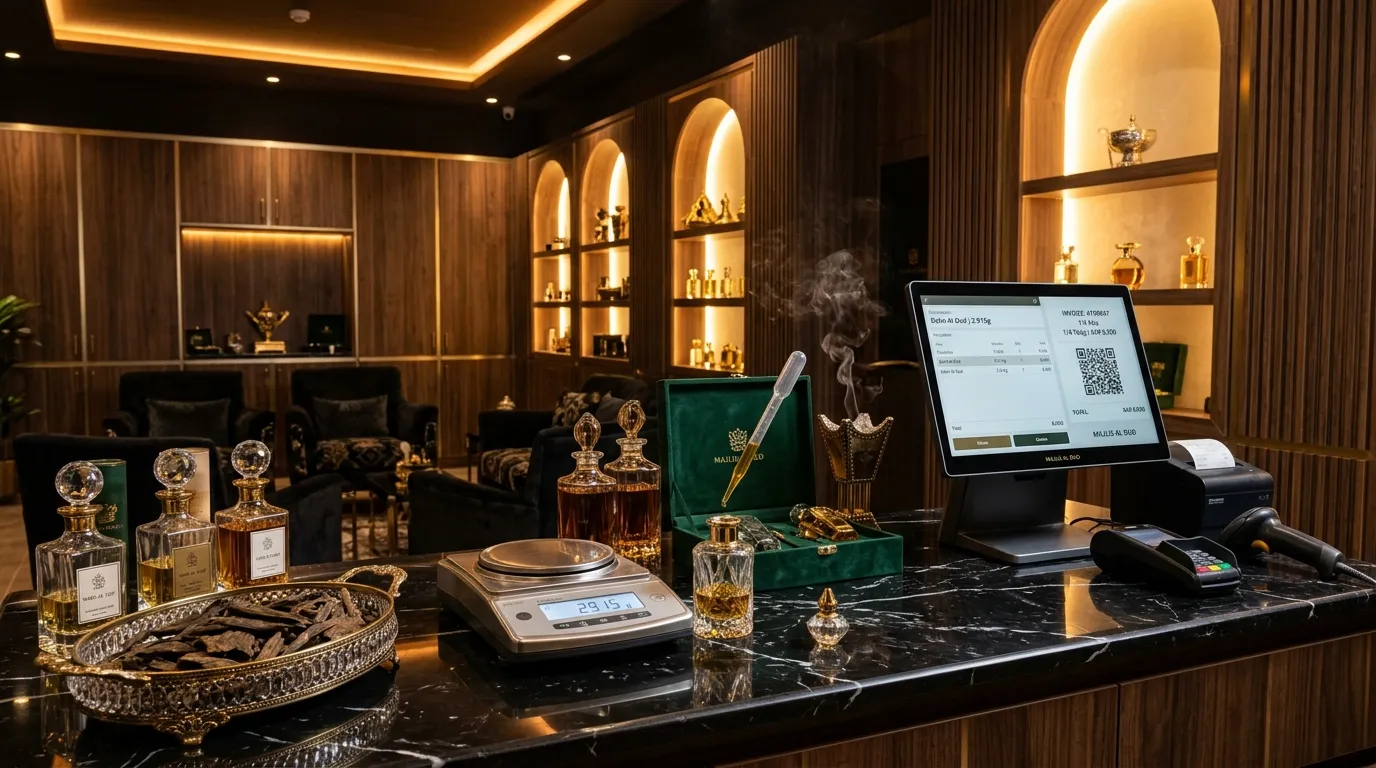
At 7:45 PM in Riyadh's historic Souq Al-Zal or inside a flagship fragrance showroom on Al Tahlia Street, a customer inspects a crystal vial of vintage Cambodian Dehn Al Oud priced at SAR 4,200 per Tola (11.66 grams). The sales consultant uses a glass pipette to decant a quarter-tola (2.91 grams) into an ornate crystal flacon. A two-drop overflow spills onto the wooden counter pad, while residual oil coats the inside of the glass pipette. In a trade where raw agarwood oil trades at higher valuations than silver, unmonitored decanting loss and pipette residue bleed tens of thousands of riyals in unrecoverable inventory every month.
The oriental perfumery, agarwood (Bukhoor), and bespoke fragrance sector in Saudi Arabia, the UAE, Qatar, and Kuwait represents one of the most culturally revered and financially lucrative retail environments in the luxury goods world. Fragrance is an indispensable pillar of Gulf hospitality and daily life, woven into Friday prayers, wedding receptions (Majlis), diplomatic gifting, and seasonal celebrations. Connoisseurs willingly pay SAR 500 to SAR 8,000 for a single Tola of pure aged oud oil or rare ambergris, while bespoke perfume blending bars turn over millions of riyals creating customized Eau de Parfum formulations.
Yet beneath the rich aroma of burning wood chips and the gleam of crystal atomizers, boutique owners struggle with severe operational complexity. Raw oils are purchased in bulk kilograms from distillers in Assam, Cambodia, and Vietnam, but retailed in traditional Tolas, quarter-tolas, and milliliters. Standard retail cash registers cannot handle fractional unit conversions, forcing staff to calculate prices on pocket calculators. Pipette decanting spillage, ambient evaporation during aging (maceration), and wood chip sorting losses accumulate unmonitored. Furthermore, stringent regulations enforced by the Saudi Food and Drug Authority (SFDA) through the Ghad electronic cosmetic portal mandate rigorous batch traceability and allergen disclosures that generic cash registers completely ignore.
Protecting showroom margins requires replacing static retail terminals with an intelligent, multi-unit point-of-sale system engineered specifically for precious liquids and aromatic woods. This operational guide explores how leading Gulf perfume houses deploy WaslaSoft Retail POS and Multi-Branch ERP to automate tola conversions, track decanting loss, manage custom blending recipes, and maintain full ZATCA Phase 2 E-Invoicing compliance.
The 4 Costliest Margin Leaks in Luxury Fragrance Retailing
Oriental perfumery margins appear generous at first glance—often exceeding 60% gross markup on blended perfumes. However, on pure aged Dehn Al Oud and premium natural agarwood chips, margins are fragile (typically 12% to 22%), leaving zero room for measurement inaccuracies or inventory shrinkage.
Showroom profits drain through four primary operational channels:
The Tola-to-Gram Conversion Trap (0.15g to 0.40g Keystroke Errors): The South Asian Tola (11.6638 grams) is the universal trading unit for oriental oils. A quarter-tola is 2.915 grams; an eighth-tola is 1.457 grams. When a generic POS terminal requires cashiers to manually type prices or convert grams into milliliters, sales assistants round numbers for convenience. Rounding a 2.91g quarter-tola down to 2.50g or over-pouring to 3.20g bleeds SAR 120 to SAR 250 on a single transaction of rare Kalakassi oud. Across a month of 400 oil transactions, careless fractional math costs the business tens of thousands of riyals in uncollected inventory.
Viscous Decanting Loss & Pipette Residue Shrinkage: High-grade artisanal oud oils possess honey-like viscosity. When a consultant draws oil from a 1-kilogram glass carboy using a pipette, approximately 0.08 grams of oil sticks to the pipette walls, while surface tension retains another 0.04 grams on the bottle lip. If the inventory software expects 85.7 quarter-tolas from a 250-gram bottle, but physical decanting only yields 81 units due to unavoidable physical adhesion, the system reports a 4.7-unit "theft" shortage. Without an automated decanting tolerance factor, managers cannot distinguish between legitimate physical decanting loss and actual staff pilferage.
Custom Blending Recipe Blindspots (Bespoke Perfume Bars): Modern Gulf consumers increasingly demand personalized perfumes created on the spot: combining 20% French fragrance oil, 5% Taif rose, 5% white musk, and 70% perfumer ethanol into a 100ml atomizer. In unautomated stores, cashiers ring this up under an arbitrary catch-all SKU like "Custom Perfume 100ml - SAR 450." The raw perfume oils, alcohol, crystal bottle, spray pump, and gold magnetic cap leave the boutique without deducting from raw materials. By month-end, the stockroom faces massive unrecorded shortages across expensive essence bottles and packaging supplies.
Natural Agarwood (Wood Chip) Moisture & Sorting Variances: Natural agarwood chips (Oud Bakhour) are natural organic materials imported in sacks containing mixed grades (Triple Super, Double Super, Super, and Standard). As wood sits in air-conditioned showrooms, ambient moisture evaporates, reducing overall batch weight by 1.5% to 3.5%. Furthermore, when staff clean wood chips to remove unfragranced white wood (Haso / حشو), weight decreases while quality improves. If the POS cannot re-grade and re-value wood inventory dynamically after cleaning, the store balance sheet carries false inventory valuations.
The Architecture of a Modern Fragrance & Oud Atelier POS
To eliminate measurement leakage and streamline bespoke perfume creation, WaslaSoft deploys an integrated multi-unit fragrance architecture:
WaslaSoft Multi-Unit Fragrance Management Loop:
- Native Tola & Fractional Conversions: Cashiers select 1 Tola, 1/2 Tola, 1/4 Tola, or 1/8 Tola on the POS screen. The system automatically converts the portion into exact metric grams (e.g., 1/4 Tola = 2.915g), deducting the exact decimal weight from the central inventory carboy.
- Automated Decanting Loss Tolerance: WaslaSoft applies a configurable shrinkage coefficient (e.g., 1.8%) to viscous oil decanting. Monthly physical safe weigh-ins reconcile against expected portion yields, isolating true shrinkage from unavoidable tool adhesion.
- Dynamic Blending Kit Explosion (BOM): When a bespoke 100ml perfume is ordered, the system breaks the product into its component parts: pure fragrance oil milliliters, ethanol volume, bottle casing, pump atomizer, and packaging box, deducting all elements from live stock simultaneously.
- Direct Precision Balance Integration: Connecting RS-232 analytical scales (0.01g precision) directly to the checkout terminal locks manual typing fields, ensuring that expensive agarwood chips and ambergris are billed on exact, stabilized physical weight.
- SFDA Batch Lot Tracking: Formulated batches are stamped with mandatory SFDA Ghad notification codes and lot numbers, printing compliant ZATCA Phase 2 tax invoices with verified manufacturing records.
Real-World Case Study: What Went Wrong in a 3-Branch Riyadh Oud House
To understand the financial transformation of specialized fragrance software, examine the actual turnaround of an established oriental perfumery operating three showrooms in Souq Al-Zal, Al Olaya, and Al Nakheel in Riyadh.
During their 2025 financial audit, the owners discovered a disturbing paradox. The brand enjoyed high footfall and annual gross revenues of SAR 8.2 million, but net profit had dropped to an alarming 3.4%.
The operational audit revealed severe hidden leakage:
- SAR 196,000 in Unaccounted Dehn Al Oud Shrinkage: Safe audits revealed a 1,420-gram deficit across rare Cambodian, Indian, and Trat oud oils. Staff were over-filling customer flacons by an average of 0.25 grams per sale to appear generous, while unmonitored pipette decanting spills went unrecorded.
- SAR 84,000 in Custom Perfume Bar Stock Variances: The boutique bespoke blending stations had consumed 180 liters of fragrance concentrates, but register records showed no corresponding raw material deductions, making inventory reconciliation impossible.
- SAR 62,000 in Moisture Loss & Agarwood Sorting Discrepancies: Raw Moroki and Kalakassi wood chip shipments showed an aggregate 4.2% weight deficit between warehouse receiving weights and counter sales weights due to wood cleaning and humidity loss.
- SFDA Warning Notice: Municipal inspectors issued a compliance warning for selling bespoke bottled perfumes lacking registered lot numbers and ingredient hazard labeling.
The Turnaround with WaslaSoft Perfumery POS
In February 2026, the company upgraded all three locations to WaslaSoft Retail POS with specialized fragrance modules:
Hardware-Locked Certified Balances: Every counter was equipped with RS-232 connected Ohaus precision balances. Manual weight entry on the POS was permanently locked. When selling agarwood chips or pure oud oil, the sales assistant places the flacon on the scale; the software waits for the balance reading to stabilize to within 0.01 grams before pulling the certified weight into the bill.
One-Tap Tola Fraction Matrix: The POS interface was customized with dedicated buttons for 1 Tola (11.66g), 1/2 Tola (5.83g), 1/4 Tola (2.91g), and 1/8 Tola (1.45g). Staff no longer performed mental math. The system calculated the exact price based on live per-gram pricing and automatically applied a 1.5% decanting adhesion allowance.
Dynamic Recipe Blending at the Perfume Bar: The brand digitized 35 signature bespoke fragrance formulas. When an artisan mixes a 100ml bespoke bottle, WaslaSoft instantly depletes the individual essence oils, perfumer alcohol, glass flacon, and atomizer collar, while printing an automated back-label with the mandatory SFDA cosmetic notification code, batch number, and production date.
Wood Chip Cleaning & Re-Grading Module: When raw wood shipments are cleaned of white filler wood (Haso), the warehouse manager logs the process in WaslaSoft: 10 kilograms of raw Moroki yields 8.2 kilograms of Grade-A chips and 1.8 kilograms of incense powder. The software automatically re-calculates the unit cost of the refined wood, keeping balance sheet asset valuations 100% accurate.
Measurable Results After 90 Days:
- Precious oil inventory shrinkage collapsed by 93.8%, recovering over SAR 180,000 in annualized net profit.
- Bespoke perfume bar inventory variances dropped to less than 1%, perfectly matching raw materials purchases with finished bottle sales.
- Showroom transaction speed increased by 45%, as cashiers eliminated calculator arithmetic and scale manual typing.
- The company passed an unannounced SFDA retail inspection with 100% compliance, fully supported by automated batch records and ingredient labeling.
Managing SFDA Ghad Portal Compliance & ZATCA Phase 2 Invoicing
Operating a fragrance atelier in Saudi Arabia requires strict adherence to regulatory standards:
Key Standards for SFDA and ZATCA Compliance in Fragrance Retail:
- SFDA Product Notification Tracking: Under SFDA cosmetic regulations, every marketed perfume must have a valid notification number on the Ghad platform. WaslaSoft links each fragrance SKU to its active Ghad registration, ensuring non-compliant formulas cannot be rung up at checkout.
- Lot Number & Expiration Traceability: Perfumes and fragrance oils require clear batch lot numbering and expiration periods (typically 36 months after opening). WaslaSoft tracks lots from raw essence imports through retail bottling, allowing instant trace-backs in case of supplier recalls.
- ZATCA Phase 2 Electronic Invoicing: Every retail sale—whether for an eighth-tola of Dehn Al Oud or a corporate gift box—generates a compliant ZATCA Phase 2 simplified tax invoice with cryptographic stamp and encrypted QR code ready for consumer tax scanning.
- Corporate Gifting & VIP Event Invoicing: For major corporate orders (e.g., 200 custom oud gift boxes for National Day), WaslaSoft issues consolidated Phase 2 B2B tax invoices with detailed itemized breakdowns, buyer tax identification numbers, and digital signatures.
5 Practical Steps to Upgrade Your Fragrance Boutique Operations
- Lock POS Fields to Certified Analytical Balances: Connect precision 0.01g scales via RS-232 to eliminate manual weight typing errors on high-value oils and agarwood.
- Implement Native Tola-to-Gram Conversion Rules: Automate 1 Tola (11.66g) and Quarter-Tola (2.91g) unit fractions to stop staff from under-billing precious oils.
- Configure Decanting Viscosity Loss Factors: Set automated 1.2% to 2.5% shrinkage allowances for thick oils to distinguish unavoidable pipette adhesion from employee theft.
- Digitize Custom Perfume Recipes (BOM): Build multi-component formulas for bespoke blending bars to automatically deplete raw oils, alcohol, and packaging in real time.
- Automate SFDA Batch Labeling on Checkout: Ensure every custom-filled perfume bottle prints compliant lot numbers, Ghad registration references, and ZATCA Phase 2 QR codes.
Discover how WaslaSoft Retail and Service POS and WaslaSoft Multi-Branch ERP help luxury oud houses, oriental perfumeries, and bespoke fragrance boutiques across Saudi Arabia, the UAE, and Oman master tola conversions, track decanting loss, and comply with SFDA regulations. Schedule an operational consultation with our luxury retail specialists today.