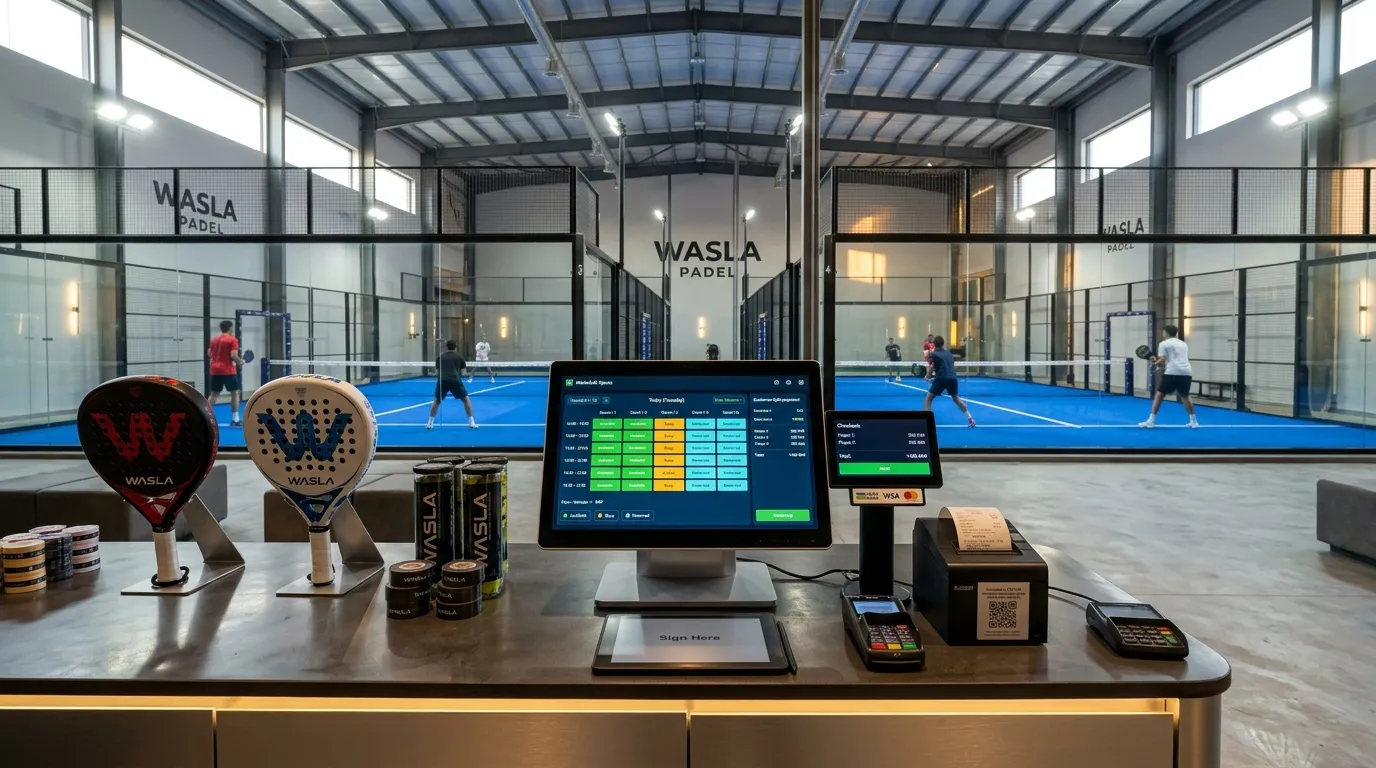
At 8:55 PM on a Thursday night in Riyadh's Hittin district or Dubai's Al Quoz, eight players are warming up on courts three and four while four more wait at the reception desk to settle a SAR 380 90-minute booking. One player pays SAR 95 via Mada, another taps Apple Pay, the third hands over cash, and the fourth asks to split a can of pressurized balls and a racket rental onto the same ticket. When a sports complex runs on separate WhatsApp booking calendars, generic retail cash registers, and manual light switches, front-desk bottlenecks bleed court utilization and leave pro-shop inventory unaccounted for before the evening rush even peaks.
The padel and indoor sports arena boom across Saudi Arabia, the UAE, Kuwait, and Qatar has evolved from a trendy pastime into a multi-million-riyal commercial industry. Modern venues boast panoramic glass courts, Italian indoor turf, climate-controlled enclosures, pro-shops stocked with carbon-fiber gear, and artisanal specialty coffee bars. With court rental rates reaching SAR 240 to SAR 420 per 90-minute session, an 8-court facility operating at peak capacity can generate over SAR 25,000 in daily court fees alone.
Yet behind the vibrant social energy and energetic rallies, sports club managers fight an uphill battle against operational friction. Front-desk staff fumble with manual calculator math trying to split bills four ways. Players casually stay on court for an extra 20 minutes because nobody remembered to flip the lighting breaker. Expensive demonstration rackets disappear from the pro-shop without checkout records. Coaches dispute their private lesson commission splits at the end of the month, claiming sessions that were never verified on the club master calendar. Furthermore, managing prepaid academy packages under ZATCA Phase 2 E-Invoicing requires strict advance payment accounting and VAT compliance.
Transforming an indoor sports complex into a profitable, high-utilization enterprise requires an integrated venue management system engineered specifically for sports retail. This operational guide explores how leading Gulf padel complexes and multi-sport arenas deploy WaslaSoft Retail POS and Multi-Branch ERP to automate court scheduling, master 4-player split payments, integrate IoT lighting relays, and run audit-proof pro-shops.
The 4 Primary Leakage Channels in Gulf Sports Venues
Sports arena profitability is dictated by two mathematical realities: court slot utilization rate (monetizable hours divided by available hours) and ancillary revenue per player (pro-shop sales, racket rentals, coaching lessons, and café spend). When manual procedures bottleneck check-in, revenue slips away across four primary operational channels:
The 4-Player Split Payment Check-In Bottleneck: Unlike standard retail where one buyer purchases goods, four distinct individuals arrive to play a single padel match. When reception staff must manually divide SAR 380 into four SAR 95 payments on a standard retail terminal, it takes three to five minutes per group. When three groups arrive simultaneously for the 9:00 PM slot, check-in spills past the hour, cutting 10 minutes off the players' match time, causing customer frustration, and delaying the entire evening booking grid. Even worse, cashiers frequently collect from three players and let the fourth "pay after the match"—a promise that results in thousands of riyals in uncollected balances every month.
The Unmetered Overtime Bleed (Manual Light Switches): In venues relying on manual wall breakers or staff inspection, matches that finish at 9:30 PM routinely continue until 9:50 PM if the next group is slightly delayed. Twenty minutes of unauthorized play across 6 courts over 30 days equals 60 hours of uncollected court fees—representing more than SAR 18,000 in lost revenue, in addition to wasted air conditioning and high-draw sports floodlight electricity costs.
Pro-Shop Inventory Shrinkage & Unreturned Rental Rackets: Padel rackets are precision high-value items, ranging from SAR 600 to SAR 2,200 each. Clubs provide rental rackets for SAR 30 to SAR 50 per match. In the rush of evening play, assistants hand out rackets over the counter without scanning a unique barcode or holding a pre-authorized deposit. Damaged frames, broken carbon faces, and missing demonstration units accumulate, eroding pro-shop retail margins. Similarly, cans of pressurized balls, grip tapes, and electrolyte drinks disappear from counter displays without ringing through the POS.
Coaching Lesson Disputes & Academy Attendance Disconnect: Private coaching lessons command premium rates (SAR 250 to SAR 450 per hour), typically split 60% to the certified coach and 40% to the club. When coaches record student attendance on personal smartphones or paper logbooks, clubs face constant reconciliation arguments. Coaches report 40 completed sessions while the club system only logged 32 paid bookings, creating bad blood between management and top coaching talent.
The Architecture of an IoT-Automated Sports Venue
To eliminate check-in queues and enforce strict court schedule discipline, modern sports venues operate an automated hardware-software loop:
WaslaSoft Automated Court Management Loop:
- Booking Confirmation & WhatsApp Pre-Payment: When a reservation is booked online or via phone, WaslaSoft generates an instant payment link sent via WhatsApp. The reservation is secured with an advance deposit, eliminating no-show losses.
- Instant 4-Way Split Checkout: At the reception desk, one tap on the 3D visual court grid splits the booking balance into four equal amounts. Each player taps their card or mobile wallet, printing individual ZATCA Phase 2 receipts in under 15 seconds.
- IoT Lighting Relay Activation: 3 minutes prior to the scheduled 9:00 PM start, the WaslaSoft edge controller triggers the smart relay for Court 3. The 1,000W LED floodlights illuminate automatically, welcoming the players onto the turf.
- Automated Expiration Warning: At 10:25 PM (5 minutes before slot expiration), the court floodlights pulse once to notify players that their match time is concluding.
- Automated Cut-Off or Paid Extension: At 10:30 PM sharp, the lights safely power down unless the front desk has processed a paid 30-minute extension, ensuring the next scheduled group steps onto an empty, illuminated court on time.
By removing human discretion from court lighting and payments, the club eliminates disputes, protects prime-time schedule integrity, and maximizes daily slot yields.
Real-World Case Study: What Went Wrong at a 6-Court Riyadh Padel Arena
To understand the financial transformation of operational automation, examine the actual turnaround of an upscale 6-court indoor padel complex located in the Hittin district of northern Riyadh.
During their 2025 year-end financial review, the ownership partners faced a baffling paradox. The complex was visibly packed every evening, boasting an enviable 86% prime-time occupancy rate. Yet, annual net operating profit was barely breaking even at 3.2%.
The operational audit revealed severe hidden financial drain:
- SAR 148,000 in Uncollected Split Payments: Front-desk receptionists, overwhelmed by evening check-in crowds, routinely allowed the fourth player to "pay after the match." Unsettled balances accumulated, with players walking out through side exits after their games without settling.
- SAR 74,000 in Wasted Overtime & Energy Costs: Because court lights were operated via manual wall switches in the back office, matches routinely overran by 15 to 25 minutes during changeovers, consuming heavy electricity and preventing timely starts for subsequent paying groups.
- SAR 56,000 in Pro-Shop Inventory Discrepancies: Fourteen premium demonstration rackets had vanished over nine months, while pressurized ball sales showed a persistent 18% inventory shortage between wholesale purchasing logs and cashier register receipts.
- Coaching Commission Friction: Two senior Spanish coaches threatened to resign following monthly disputes regarding private lesson attendance records and split percentages.
The Turnaround with WaslaSoft Sports POS
In February 2026, the venue underwent a comprehensive operational overhaul, deploying WaslaSoft Sports POS integrated with local IoT network lighting relays and RFID pro-shop tracking:
Native 4-Player Split Interface: The reception desk was upgraded with dual-screen WaslaSoft terminals. When a group approaches the counter, the receptionist selects the booking on the visual 3D arena map and taps "4-Way Split." Each player taps their Mada card or Apple Pay device consecutively. The entire four-player check-in process was reduced from four minutes down to 28 seconds.
Automated IoT Lighting Relays: WaslaSoft engineers installed industrial network relays connected to each court lighting contactor panel. All manual wall switches were bypassed. Lights now turn on automatically at minute :00 of the booking, flash a warning at minute :85, and extinguish at minute :90 unless an extension is authorized on the POS. Overtime play without billing dropped to zero on day one.
Rental Racket Barcode & Pre-Authorization Tracking: Every rental and demo racket was fitted with an encoded micro-barcode tag. To issue a racket, the staff scans the customer booking profile and swipes the racket barcode. The system places a temporary pre-authorization hold on the player card. When returned to the storage rack, the receptionist scans the barcode, the system confirms frame integrity, and the deposit hold is immediately released.
Digital Coach Lesson Scheduling & Attendance Check-In: Coaches were provided with mobile tablet access to their daily lesson rosters. When a student arrives for a private session, the coach taps "Start Lesson" on the tablet, which automatically checks the member against their prepaid 10-session package balance. The system calculates the 60/40 revenue split automatically, and both the coach and management can view real-time commission earnings on their mobile dashboards.
Measurable Results After 90 Days:
- Uncollected court balances dropped from SAR 12,300 per month to literally zero, recovering more than SAR 140,000 in annual net margin.
- Court turnover punctuality reached 99.4%, allowing the complex to add an extra 30-minute booking window late at night, generating an additional SAR 22,000 in monthly court fees.
- Pro-shop shrinkage was completely eliminated, with racket inventory matching 100% of physical counts during weekly audits.
- Coach satisfaction rebounded, with both senior coaches signing two-year contract extensions backed by transparent automated commission reporting.
Academy Subscriptions, Tournament Brackets & ZATCA Compliance
Beyond casual court rentals, elite sports complexes generate stable recurring cash flow through youth academies, competitive adult leagues, and weekend corporate tournaments. Managing these programs requires rigorous compliance with regional financial regulations:
Core Standards for Sports Academy & Tournament Management:
- Advance Academy Package Invoicing: Under ZATCA Phase 2 regulations in Saudi Arabia, selling a 12-session youth padel academy package for SAR 2,400 requires issuing a compliant Tax Invoice at the time of payment, with VAT recognized upfront and unearned session revenue tracked on the balance sheet.
- Session Balance Drawdowns: Each time a student attends a clinic, WaslaSoft deducts one session from the member digital wallet, generating a check-in receipt and updating remaining package credits without creating duplicate tax events.
- Tournament Entry Fees & Corporate Event Billing: Organizing a 32-pair weekend tournament requires handling multi-tier entry fees, sponsorship packages, and bracket scheduling. WaslaSoft manages team registration fees, applies early-bird discounts, and issues corporate B2B tax invoices with embedded cryptographic stamps and QR codes for company sponsors.
- Integrated Café & F&B Cross-Billing: Many premier padel clubs operate in-house specialty coffee counters and smoothie bars. WaslaSoft allows players to charge café drinks and protein snacks directly to their court tab or member account, settling the combined bill at checkout with a single payment.
5 Practical Steps to Upgrade Your Sports Arena Operations
- Deploy One-Tap 4-Player Split Billing: Replace manual calculator math with dedicated POS split workflows to accelerate reception check-in and eliminate unpaid balances.
- Automate Court Floodlights with IoT Relays: Connect court electrical panels directly to your booking software to eliminate unbilled overtime and save commercial electricity costs.
- Control Racket Rentals with Barcode Deposits: Require unique asset barcode scans and card pre-authorizations before handing out premium rackets and demonstration gear.
- Digitize Coaching Lesson Roster & Attendance: Implement tablet-based check-in for private trainers to automate 60/40 commission math and eliminate end-of-month payroll disputes.
- Enforce Tokenized WhatsApp Booking Deposits: Collect advance deposits automatically for prime-time evening slots to guarantee zero no-show court vacancies.
Discover how WaslaSoft Retail and Service POS and WaslaSoft Multi-Branch ERP help padel clubs, tennis centers, and sports academies across Saudi Arabia, the UAE, and Oman maximize court slot utilization, automate lighting, and eliminate balance sheet leaks. Schedule an operational consultation with our sports venue management specialists today.