In the Fast-Moving Consumer Goods (FMCG), beverage, bakery, and wholesale sectors across Saudi Arabia, the UAE, and Oman, the fleet of delivery vans is the lifeblood of distribution.
Every day, sales representatives visit dozens of baqalas, supermarkets, restaurants, and retail shops. Yet, many distribution businesses still rely on handwritten carbon-copy receipt books, manual evening data entry, and phone call stock confirmations.
This legacy approach results in severe operational bottlenecks:
- Cash and Stock Leakage: Discrepancies between what was loaded onto the van and what was billed.
- Lost Sales Opportunities: Sales reps arriving at a store without knowing real-time promotional pricing or customer credit limits.
- Compliance Penalties: Handwritten receipts that fail to meet ZATCA (Saudi Arabia) or FTA (UAE) e-invoicing standards.
In this guide, we explore how modern, cloud-connected Van Sales POS software transforms route distribution into a high-efficiency profit engine.
1. What is Van Sales Software (DSD)?
Direct Store Delivery (DSD) or Van Sales software is a specialized mobile POS and inventory management platform designed for delivery drivers and route sales representatives.
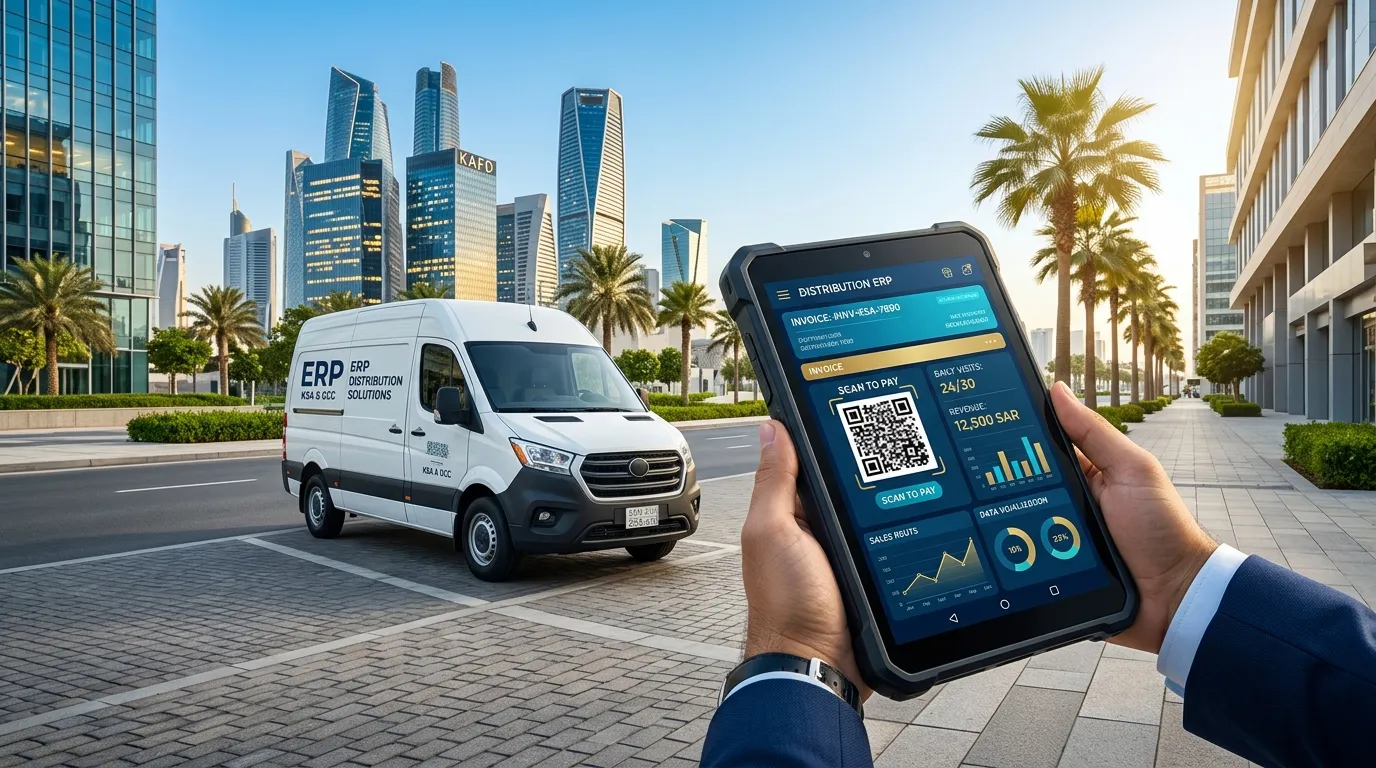
Instead of waiting for office staff to generate invoices, the sales representative uses a portable Android terminal or tablet paired with a mobile Bluetooth thermal printer to manage the entire sales cycle right at the customer's doorstep.
Key Capabilities:
- Pre-Sales: Booking advance orders for future warehouse delivery.
- Spot Sales (Van Sale): Selling and delivering physical stock carried directly on the truck.
- Collections & Credit Control: Accepting cash, card, or recording credit ledger entries with strict credit ceiling limits.
- Customer Returns: Processing damaged, expired, or unsold items with automated return notes.
2. The 3-Step Daily Van Sales Workflow
A well-structured van sales operation follows a disciplined daily routine:
Stage 1: Morning Load-In (Van stock verification)
➔ Stage 2: On-Route Selling (Offline GPS, orders & instant invoicing)
➔ Stage 3: Evening Settlement (Cash, card & stock reconciliation audit)
Step 1: Morning Van Loading & Gate Pass
Before the driver leaves the central warehouse:
- The warehouse supervisor issues a Stock Transfer Order to the van.
- The driver scans each crate or pallet using barcode handhelds to accept custody.
- The van becomes a unique, mobile warehouse branch within the ERP system.
Step 2: Route Execution & Offline Invoicing
Throughout the day, the driver follows a GPS-optimized customer route:
- No Internet Required: In underground parking deliveries, remote highways, or rural baqalas, the POS continues billing without interruption.
- Customer-Specific Pricing: The system automatically applies the correct contract price, bulk discount, or payment terms for that specific client.
- Compliant Invoicing: A bilingual thermal invoice with the required ZATCA/FTA cryptographic QR code prints in under 3 seconds.
Step 3: Evening Close & Settlement
Upon returning to headquarters:
- The driver completes an end-of-day reconciliation.
- Physical unsold stock is counted and returned to central inventory.
- Cash collections, POS card receipts, and credit sales are balanced against total billing.
- Any variance is identified instantly before the driver clocks out.
3. Solving the Connectivity Problem: The Hybrid Advantage
The Gulf region features hyper-modern city centers alongside remote industrial parks and rural distribution routes. A pure cloud application that requires an active 4G/5G connection at all times will fail the moment a driver steps inside a walk-in freezer or basement delivery bay.
WaslaSoft’s Hybrid Architecture ensures the mobile terminal holds a local database of:
- Full product catalog with barcodes and images.
- Assigned route customers and credit histories.
- Price lists, tax categories, and promotional rules.
Transactions are signed and recorded locally. The moment a cellular data or warehouse Wi-Fi connection is detected, the app automatically syncs all deliveries, payments, and stock movements to central headquarters with zero data loss.
4. Key Metrics to Measure Fleet Performance
To optimize distribution profitability, management dashboards should track:
| Metric | Definition | Business Impact |
|---|---|---|
| Drop Size (Average Order Value) | Average revenue generated per customer stop. | Higher drop size reduces fuel and delivery cost per unit. |
| Route Adherence | Percentage of planned customer visits completed. | Prevents drivers from skipping lower-volume customers. |
| Vehicle Shrinkage | Unexplained variance between loaded stock and billed items. | Keeps shrinkage below 0.5% through strict accountability. |
| Invoice-to-Cash Cycle | Speed at which credit invoices are settled. | Prevents bad debt accumulation with real-time credit checks. |
Conclusion & Next Steps
Modernizing your van distribution fleet is no longer just about cutting paper—it is about protecting working capital, enforcing tax compliance, and empowering your sales drivers to sell more on every route.
WaslaSoft provides a dedicated Van Sales & Mobile Distribution Module designed specifically for Gulf distributors—supporting Android handheld terminals, Bluetooth printing, offline ZATCA/FTA compliance, and automated warehouse reconciliation.
Equip your fleet with modern mobile POS.
Schedule a live van sales demo with our regional team in Riyadh, Dubai, or Muscat.